 English
 Deutsch
 Italia
 August 27, 2026 By admin
Khajuraho Dance Festival
IN THE TEMPLES OF LOVE – CELEBRATING THE KHAJURAHO DANCE FESTIVAL
If you’ve ever puzzled over a vacation choice – are you in the mood for historical monuments or nature, cultural stimulation or wildlife – visiting Khajuraho, in the Central Indian state of Madhya Pradesh, during its annual dance festival will cover all these bases.
Mid-February, the best time and weather to visit, a weeklong classical Indian dance festival is an annual draw to this UNESCO World Heritage Site. This village of fabulous Hindu and Jain temples is surrounded by waterfalls, teak forests, a tiger reserve, and the beautiful River Ken.
There are many ways to the Divine. I have chosen the ways of song, dance, and laughter.
– Mevlana Jalaluddin Muhammad Rumi
It was only in the mid-1800s that the British happened upon the magnificent remnants of the Chandela Dynasty’s building spree of around 1,000 years ago. Only 25 of the approximately 85 temples have survived or been excavated so far.
Khajuraho takes its name from the date palm – khajura. Gates flanked by date trees provided entry to the religious capital of the Chandelas. The Chandela rulers believed in the separation of political, religious, and cultural activities, and therefore established their political capital 60 km away.
Visiting Khajuraho while the festival is on will fill your evenings with classical dance and music by distinguished performing artists from across India. Days easily fill up with touring the three main temple groups and excursions to experience breathtaking natural beauty, wildlife, and even more temples in the hilltop forts.
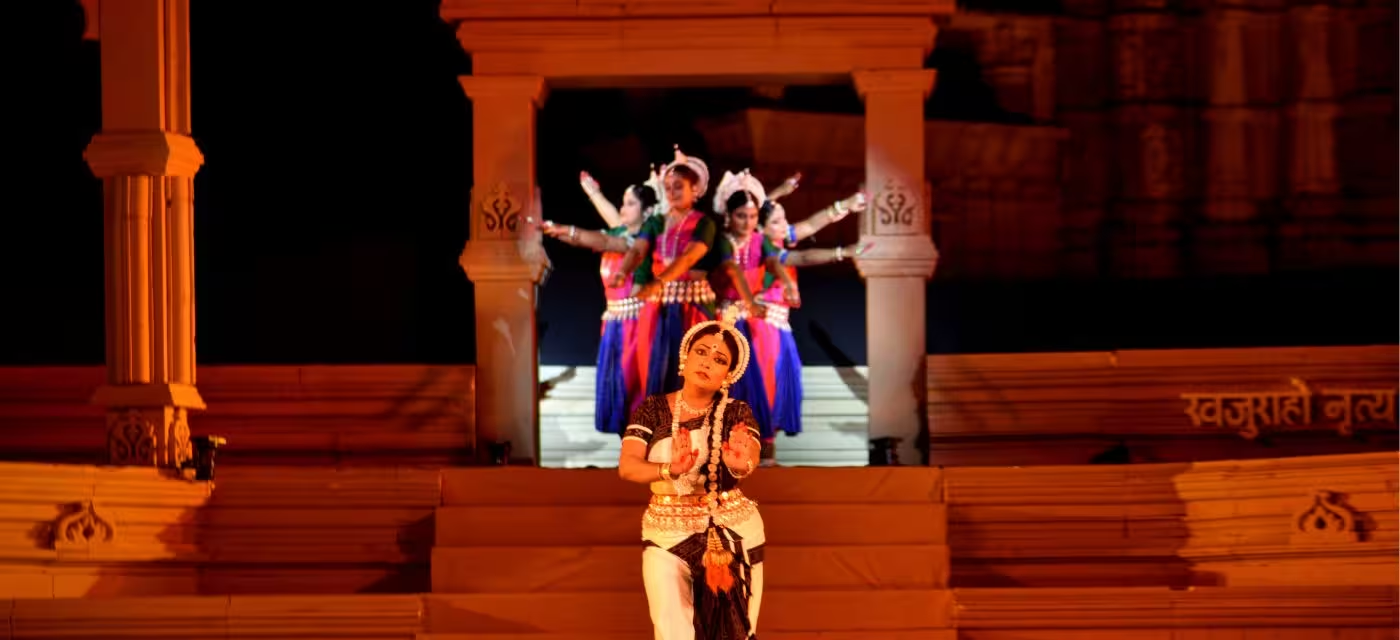
The Khajuraho Dance Festival takes place under a star-studded sky against the backdrop of the towering Chitragupta Temple, dedicated to Surya, the Sun God from the Vedic pantheon of nature deities. Also framing the open-air stage is the Vishvanatha Temple, dedicated to Lord Siva. These temples of the Western Group can be explored at leisure during the day.
The upcoming 45th Dance Festival in February 2019 opens on February 25 with three to four diverse dance traditions from across India presented each evening through March 3, organised by the Madhya Pradesh Kala Parishad. The opening programme features the lyrical, sculpturesque Odissi from Odisha, performed by nationally honoured exponent Ranjana Gauhar and her group. North India’s rhythmically fast-paced Kathak, performed by Shukla Rai, is always a crowd pleaser. From South India, Madhuri Majumdar will charm audiences with Andhra Pradesh’s Kuchipudi dance. This sprightly classical dance tradition was adopted by female dancers in the mid-20th century from an all-male dance-drama tradition and retains its dramatic element along with dynamic movement. The evening finale will be one of the finest examples of how Indian dance can evoke universal emotions as text is interpreted through the Bharatanatyam tradition of Tamil Nadu by dancer Purvadhanashree.
The next six evenings offer an equally diverse mix of India’s classical, traditional, and contemporary dance traditions. Mohiniyattam – the Dance of the Enchantress – from Kerala brings to mind the swaying palm trees of its home state; it is performed in stunning white costumes trimmed with gold.
Manipuri dance, from the far northeastern state bordering Myanmar, is known for its subtle elegance and distinctive potloi hoop skirt, symbolising stars and clouds as dancers move in intricate curves, circles, and figure eights. The Manipuri Rasleela creates an ethereal vision of the charming flute-playing god Krishna dancing with his beloved Radha and the other gopikas (cowherding girls) of Brindavan.
Seraikella Chhau is a masked, martial-arts-based dance from the eastern state of Jharkhand. One of three major forms of masked and non-masked Chhau from contiguous states of eastern India, Seraikella Chhau developed with royal patronage, choreography, and participation by performers.
This year’s festival lineup also includes two Indian contemporary dance performances and more Kathak, Odissi, Bharatanatyam, and Kuchipudi sprinkled throughout the week. Having personally performed at this festival, I can attest to the magical experience of these performances shared in front of these magnificent ancient temples.
After an evening immersed in the richness of India’s performing arts, it is a tough choice whether to head out to see nearby waterfalls, tigers and forts or explore Khajuraho itself. I’d say give yourself time for all of it and start with the Western Group of Temples, followed by the Eastern and then Southern groups.
The temples of Khajuraho are covered in some of the finest sculptures in the world, scattered over an area of about nine square miles. The outer walls of these temples were created to motivate the viewer to understand the levels and stages of life, rising from the physical to the metaphysical before entering the sanctum sanctorum. We see dancers and wrestlers, royalty and meditation, women putting on makeup, musicians making music, potters, farmers, and scenes of medieval daily life, alongside the famous erotic art of the Maithuna (lovemaking couples).
Erotic art comprises approximately 10 per cent of the fine sculptures of these temples, and I tend to forget that this is what is featured as the main draw. Depending on your interest, you can get a guide who will only take you around to see the couples, groups, and interesting positions and permutations of how sex was enjoyed during Chandela times. Other guides will be more inclusive of the remarkable stories and sculptural finesse of the full range of human and divine experiences portrayed at this UNESCO World Heritage Site in India.
Temples dedicated to Vishnu (Vaishnavism), Siva (Saivism), and Jainism were all constructed and used at about the same time and are found in pretty much equal numbers. This demonstrates the tolerance and respect for diverse systems of belief at the time. In each group, you find major temples surrounded by smaller ones.
A kilometre away from the Western Group of Temples is Khajur Sagar and the old village of Khajuraho. Once I stopped at the junction leading to either the Eastern Group or the village, confused by seeing the nearby village temple, and was delighted to discover Pradeep Gagrele’s Poonam Arts & Crafts shop, basically the front of his home adjoining the temple, where he offered antique brass and bronze at lower prices than the reproductions sold in the main market. I always return with more precious artefacts from this tiny shop from my annual Shivaratri visits, presenting a classical dance production for the thousands of local pilgrims who come to the Siva temple here.
The Jain community during the Chandela rule lived on the eastern side of Khajuraho, which explains why more Jain temples are found in the Eastern Temple Complex, 10 minutes away from the Western Group. The Southern Group includes three scattered temples: the Duladeo Temple is closest to the Eastern Group, the Chaturbhuj Temple has a spire far above the tree line, and the third, the Beejamandal Temple, is still under Archaeological Survey of India excavation.
If you still have a taste for more temples, I strongly recommend a visit to Ajaigarh Fort and even Kalinjar Fort, east of Khajuraho. Chandela temple remains lie casually scattered in their relatively unmanicured environments, giving you a feeling of what it was like when the Khajuraho temples were first discovered.
To reach Ajaigarh, you can do what I did: leave Khajuraho early and travel 30 minutes to the elegant forest resort, The Sarai at Toria, on the banks of the River Ken adjoining Panna National Park & Tiger Reserve. Collect a guide and lunch, then travel another 30–40 minutes to the amazing 11th-century fortress. The 500 steps to the top are well worth it for the views, temples, and likely experience of discovery without others around. There is even a 1300 CE panel of yoginis meditating on corpses, reflecting the tantric yogini cult flourishing at the time. If you are game for more, head to Kalinjar Fort a little farther east for more Chandela ruins.
Staying at the best five-star hotel in Khajuraho itself, the Lalit Temple View is a short walk from the Dance Festival and a great base for daily excursions. Another excellent option amidst nature is The Sarai at Toria, created by one of India’s finest wildlife conservationists, Dr Raghu Chundawat, and his photographer wife, Joanna Van Gruisen, to support their conservation efforts.
It is a destination in itself, and the peace and serenity of floating on the River Ken is justifiably called “a Zen experience”. One can see so many birds, an occasional gharial, and the riverbed itself; this boat ride is one of the most treasured memories of my Khajuraho visits. Since this is adjoining the Panna Tiger Reserve, it is a perfect location to go into Khajuraho for the dance festival, east to the forts and other excursions, or simply to relax elegantly in nature.
Among the animals found at Panna are the tiger, leopard, chital, chinkara, nilgai, sambar, and sloth bear. The park is also home to more than 200 species of birds, including the bar-headed goose, honey buzzard, king vulture, blossom-headed parakeet, changeable hawk-eagle, and Indian vulture. It is also a Biosphere Reserve where the continuity of the tropical and subtropical forest belt of South India is broken and the great Indo-Gangetic Plain begins.
A little-known fact about a visit to Khajuraho is that Asia’s biggest and only active diamond mine is in the Panna district, in Majhagaon, about 55 km from Khajuraho. You can take a tour to witness first-hand the process of extracting diamonds from crushed ore through screening and discovery.
Not to be missed are the Raneh and Pandava waterfalls. The Raneh Waterfalls, on the River Ken near Panna, were formed by a volcanic eruption that created a 250-foot-deep crater. During the monsoon there are gushing waterfalls; in the dry season, you can enjoy the beautiful pink, yellow, red, black, white, and grey granite, dolomite, jasper, basalt, and quartz rock formations. An interesting detail is that it is said to be the only place in Asia with all five types of igneous rocks in one location.
About 30 km from Khajuraho and 25 km from Panna, but well off the main road, the Pandava Falls and Caves are believed to be where the Pandavas, from the Indian epic Mahabharata, stayed during their Agyatvas (secret stay). At the entrance to the caves, water flows from above, creating a curtain of drizzle; the source of this water remains a mystery.
You might like to take a local guide for a small payment, as there is a bit of a walk and a few hundred steps to reach the caves situated in the middle of the hills, the beautiful heart-shaped Draupadi Kund, and the small waterfall surrounded by a mineral-rich pond. Note that the falls close at noon on Wednesdays. Since the Pandava Falls and Caves are inside the Panna Reserve, you would do well to club these visits together.
The Khajuraho Dance Festival is a wonderful opportunity to dive into the treasury of India’s performing arts, architecture, sculpture, medieval history, and bountiful natural beauty and peace.
Have a great trip!
Related Posts