 English
 Deutsch
 Italia
 August 27, 2026 By admin
Tibetan Cuisine Food
FLAVOURS OF COMFORT, CELEBRATION, AND CEREMONY:
THE FOOD OF TIBET
When we come across ‘Momo’ counters in Delhi, do we think of Tibetan Cuisine? I am really not sure.
Usually, the people manning the counters are mostly either from Nepal or from India’s North-east. Also, the ingredients have evolved so much to suit urban tastes that if we were to present the authentic momo, I am afraid customers may not even like it!
Anyway, that’s the story of Tibetan cuisine. Even the stories inside Tibet are no different. With the huge influx of Chinese migrants, Tibetans have become a minority in their own land, and so has Tibetan cuisine.
You don’t have to cook fancy or complicated masterpieces – just good food from fresh ingredients.
– Julia Child
Tibetan Cuisine: A Short History
Historically, Tibet has had a close relationship with neighbouring countries such as Mongolia, China, Nepal, and India; and along with cultural influences, there is bound to be some influence on the country’s cuisine. However, because of Tibet’s unique geographical location, extreme weather, and treacherous terrain, the staple food of Tibetans has remained almost unaltered for several centuries, which is true even now.
Taking weather and irrigation suitably into account, it was almost impossible to grow anything in Tibet, especially in areas where the lifestyle is nomadic in nature. It was only highland barley that emerged as the superstar among all the ingredients that were available indigenously or from neighbouring countries. I believe barley is also a binding force among the three provinces of Tibet, even though the dialects are sometimes difficult to understand when people converse.
The remarkable yak and dri (female) are also integral to the evolution of Tibetan cuisine. Again, due to extreme weather conditions, Tibetans are heavy meat eaters and consumers of dairy products. Both the yak and dri play important roles; and it is the latter whose dairy products keep the women of the house busy from dawn to dusk. There is no such thing as ‘Yak Butter’, and you know now why!
Men usually look after grazing and some hunting when required. Deeply Buddhist, Tibetans don’t kill animals either for sport or in excess of what they need; proper rituals and prayers are always observed before doing so.
Tsampa-eaters
Barley’s importance is huge in Tibet. It is not only easy to grow but also widely accepted. Highland barley is unique and exclusive to Tibet. Scientific research findings also explain the same.
Over the centuries, barley has not only become the staple food but has also found a significant place in religion and culture. Barley and barley flours are used extensively on occasions such as the Tibetan New Year, Losar, Buddhist rituals, and even funeral ceremonies.
The highland barley grains are roasted and then ground under natural flowing stream mills. The whole process involves considerable community work and looks like some sort of festivity in the neighbourhood.
As my late mother used to say, for a nomadic family there isn’t a specific time for meals, hence you can have Tsampa anytime and anywhere. The most common way of eating Tsampa is in ‘Pa’ – usually made by mixing it with tea, butter, sugar, and dried cheese. The most common way is then to put it straight into your mouth by squeezing it into smaller pieces with your hand.
Heavy Tea-drinkers
Another typical habit of many Tibetans is drinking Tibetan Tea or Bodcha. In popular culture, tea is prepared as either salted butter tea or black tea. Tibetans are happy to drink at least a few dozen cups from morning till late night!
For making salted butter tea, a special churner called Dongmo – a cylindrical length of wood about three to four feet in height – is used to mix hot water, milk, butter, and salt. Each family has to have one of these ‘appliances’.
My mother would keep her collection of Dongmos in super condition by attending to them every day. However, surprisingly, by the time I was an adult, her habit of drinking had changed to sweet tea, but with a pinch of butter on the rim of the cup. Perhaps that’s the perfect example of living in India with your roots in Tibet.
Festivity and Occasions
There are certain occasions where certain kinds of foods are more dominant and popular. One such food item is Khabsay. You could call it a Tibetan-style deep-fried snack made of wheat flour.
There are various kinds of Khabsay in varied sizes and shapes, among which Bungu Amchok (Donkey-Ear) is especially made during the Tibetan New Year, mainly for decoration for a few days and later, of course, enjoyed by all the family members with Bodcha.
Dresil, a lightly sweet rice with butter, sugar, raisins, and droma (a small, slightly sweet tuber), is served on special occasions such as religious affairs and marriage ceremonies.
Bhartsa-Marku is somewhat like a sweet Tibetan macaroni, again made of wheat flour and cheese, served specially during the religious fasting practice of Nyungne.
Guthuk, a variety of Tibetan soupy noodles, is eaten two days before the Tibetan New Year. The speciality is that it consists of nine items which predict the nature of whoever receives them in their bowl.
Stories from Exile
My earliest memories of childhood are from Manali in Himachal Pradesh, a state in India’s north, where I was born. My mother and father were young exiles from Tibet during the 1960s.
During the course of several years of living in India, my mother would often fondly remember how the locals of Manali, especially of Palchaan, treated them so well. They would offer local produce along with the Tibetans who were mostly road labourers and made the entire stretch of road from Manali to Leh.
Tibetan dishes like Thenthuk, Shabakleb, Momos, Tingmo, Dropa-Khatsa, Gyuma, Lowa Khatsa, Shabtra, Bodcha and Chang are some of the old dishes that they enjoyed even though living conditions were very tough. However, with time and experience, many Tibetans gradually started adjusting their eating habits.
Popular Tibetan Food
Tsampa & Bodcha
As briefly mentioned earlier, Tsampa and Bodcha have become an important part of Tibetan identity. In Tibet, this proclamation still stands, I believe.
But for Tibetans outside Tibet, they would love to associate with these two important preparations, but savouring them in daily life is something that has dwindled drastically. Perhaps because of the environment or influences from immediate contacts in everyday life.
Dairy Products
Tibetans eat a lot of dairy – from fresh dri, goat or cow cheeses to yoghurt to cheeses dried in rock-hard, bite-sized squares called Churra that you can suck on, sort of like a dairy jawbreaker.
Breads
Tibetans eat plenty of wheat bread, not ‘barley bread’. The most common breads are small round flat breads called Baglep Korkun, crusty yeasted round loaves called Amdo Baglep, steamed buns called Tingmo, and deep-fried poofy breads called Numtrak Baglep.
Momos
Momos are the most popular food among Tibetans. They can be made with both vegetable – though with limited varieties – and meats, either fried, steamed, or served in soup.
Though delicious in their own right, momos require skill and patience, for the process of making them can be quite challenging and tedious.
Shabakleb
The Shabakleb, a deep-fried bread stuffed with minced meat and vegetables, is as much beloved as the momo. The labour-intensive process is immediately forgotten once this delicious bread is placed on the table, served with hot chilli sauce.
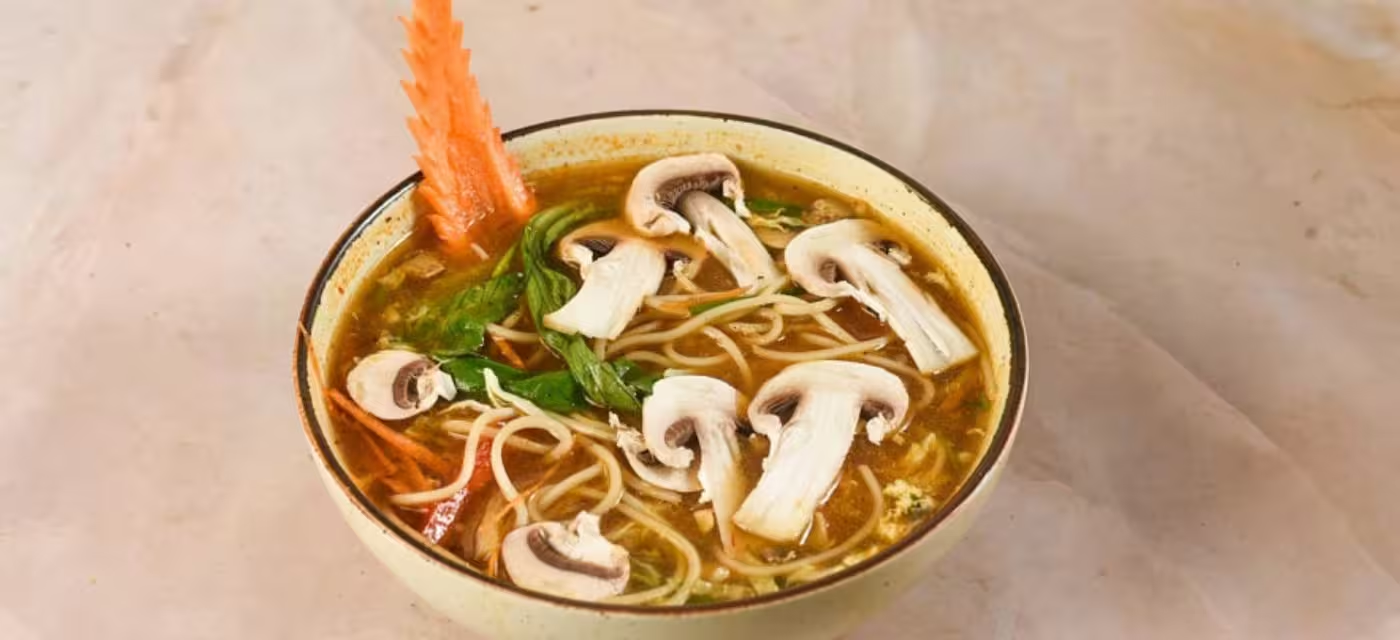
A Bowl of Thukpa
Thukpa is basically a noodle soup of all types, famous for its warming effect, especially in the cold climate of Tibet.
Thukpa is usually made with meat and radish, and greens. The noodles are of many kinds, ranging from long spaghetti noodles to little conch-like shapes to the flat ‘pull’ noodles of thenthuk; and all of them are traditionally handmade. Nowadays, however, both traditional methods and modern machines are used to prepare the noodles.
Some of the varieties of Thukpa include:
- Dethuk: includes yak or sheep soup stock along with rice, different types of Tibetan cheeses and droma
- Gyathuk: long spaghetti-type noodle soup
- Guthuk: a noodle soup in Tibetan cuisine eaten two days before Losar
- Thenthuk: hand-pulled noodle soup
- Bhagthuk: a common Tibetan cuisine noodle soup that includes small handmade conch-shaped noodles
- Tsamthuk: prepared with yak or sheep soup stock and tsampa as well as a variety of Tibetan cheeses
Meat
Contrary to popular belief, Tibetans are not usually vegetarian and are, in fact, heavy meat eaters, eating primarily yak and goat.
The first-generation Tibetans in India during the 1960s and 1970s had hard times as they had to change this habit. In the cold climatic region of Tibet, meat has played an important role in people’s survival.
It is difficult to grow vegetables on the Tibetan Plateau, so Tibetan diets – at least in Central Tibet – have traditionally focused on barley, dairy products, and meat, when the household could afford it.
- Yak Jerky: A big favourite; chunks of meat are served at the table, cut with knives, and dipped in hot sauce, which Tibetans love to put on just about anything.
- Shamdre: Meat with potatoes, rice, and crystal noodles
- Shabtra: A simple stir-fried meat dish
- Dropa Khatsa: A spicy stir-fried tripe dish
- Gyuma: Sausage filled with blood and minced meat
- Lowa Khatsa: Made of pieces of fried animal lung and spices
Chang: Tibetan Beer
Chang is the traditional and mostly homemade alcohol in Tibet. Highland barley, millet, and rice grains are the major ingredients for Chang.
As a traditional alcohol, it is the most popular drink during Tibetan festivals and other special occasions, such as wedding ceremonies and religious ceremonies. Chang can also be made with rice, which is mostly the case with Tibetans living outside Tibet.
In Tibet’s social structure, Chang is often given to guests to welcome them. It has great cultural significance and is often used as a tool to even settle disputes.
A Classic Tibetan Recipe
Thenthuk or ‘Pull’ Noodle Soup
Soup
- 1 kg meat with bone
- Ginger
- Onion
- Spring onion
- ¼ teaspoon Erma (Szechuan pepper)
- ¼ teaspoon whole pepper
- Salt
Dough
- 3 cups wheat flour
- 1 egg
- 1½–2 cups water
Thenthuk
- Vegetable oil
- ½ onion, chopped
- 3 cloves finely chopped garlic
- ½ kg meat, sliced into thin bite-sized pieces
- 300 gm radish, sliced into thin bite-sized pieces
- Spring onion, for garnish
- Salt and soya sauce
Soup Base
Put all the ingredients in a large pot, fill it with water halfway through, and bring it to a boil. Once it boils, bring the flame down and let it simmer for about 45 minutes.
Occasionally, skim off the scum that builds over the soup liquid. Add just a little salt to flavour the meat, but not too much as you’re going to use the soup later and it will get salty then.
Dough
Put the flour in a large bowl and make a well in the centre. Add one egg and slowly add the water, kneading the dough until it is firm but supple.
Flatten the dough and slice it into strips about one inch wide. Add a little oil and let it sit covered on a plate. This is your thenthuk dough ready to be pulled.
You can bypass the egg, but adding it makes the noodle a little firmer – it absorbs less liquid and keeps its firmness.
Thenthuk
The first step is to make the radish. In a pan, add a little oil and fry the radish on a medium flame by itself until it becomes nice and golden. Once browned, leave it aside – it will be added to the soup at a later stage.
In a big pot, add the oil, onion, and garlic, and let the onion brown. Add the meat, a dash of black pepper, and salt to taste. As it browns, add a dash of soya sauce to flavour the meat.
Once the meat is nicely browned, add your strained soup stock and bring it to a boil, letting the meat cook nicely.
Finally, add the browned radish and now you are ready to throw your thenthuk.
Basically, take one of the strips of oiled dough, flatten it out with your fingers, and gently pull it until it is nice and flat like a long ribbon. Now, starting with one end, break off a square, thumb-sized piece from the end and throw it directly into the soup.
Keep repeating – the trick is not to get the steam on your hands, so stay a little clear of the soup pot and throw the dough into the soup. If this is too hard, you can pull off longer strips and add them to the soup.
After adding all the dough, cover, bring to a boil, and turn off the heat. Let stand for two minutes and your soup is ready to serve. Garnish with chopped spring onion.
To Serve
First, serve the boiled meat accompanied by some nice spicy hot sauce. Next, serve the bowls of thenthuk along with a side vegetable or two.
Related Posts