 English
 Deutsch
 Italia
 August 20, 2026 By admin
Indian Storytelling Traditions
LET ME TELL YOU A STORY
In India, important ideas are often explained or described with a story to touch the heart as well as the mind. Epic tales of Good overcoming Evil, and human love as a metaphor for understanding divine love have been shared across the Indian subcontinent for millennia through oral storytelling along with puppetry, scroll paintings, dance, and theatre.
“The real voyage of discovery consists not in seeing new landscapes, but in having new eyes.”
– Marcel Proust
The ancient Indian epic, Mahābhārata, is roughly ten times the length of the Iliad and the Odyssey combined.
Amazingly, rural, largely illiterate communities are familiar with the intricate plots and sub-plots of this story of rivalry, intrigue, love, deceit, and honour.
Other national and regional epics are also known through storytelling traditions. Many involve local participation during special festivals and holidays while others are performed by travelling performers.
For thousands of years, Indian culture has been expressed through magical realism. Metaphors, allegory, and symbolism are used in stories to communicate the challenging abstractions of the wonders of the universe and our internal universes.
STORIES OF THE GODS
We see the demotion of nature gods to a universal concept of divinity in the story of Indra, Lord of the Heavens, bowing to Krishna, Preserver of the Universe.
Danced, painted, and told, Krishna holds up a mountain with his little finger to protect the villagers from Indra’s torrential rains and fury when not appeased by offerings.
Indian nature gods weren’t discarded, as in the West, but simply downgraded in status.
Gods and Goddesses as metaphor for unknowable ultimate realities are understood to be symbolic and allegorical, somewhat like the photograph in your wallet that reminds you of a person but clearly isn’t them.
KAAVAD STORYTELLING – RAJASTHAN
One of my favourite examples of this is seen in the Kaavad storytelling box shrines of Chittor in Rajasthan.
This artistic tradition began 400–450 years ago. Every village had one of these story shrines, which was kept with the headman of the village.
Twice a month, and on special holidays, the village priest would open it for pooja (devotion) by the women of the village.
The box unfolds on both sides to finally reveal the inner three figures representing different Hindu gods, depending on which side of the story-box is opened to tell its story.
On Purnima, the full moon night of the month, it is the blue, flute-playing god Krishna along with his brother Balaram and sister Subhadra.
On Amavasya, the darkest night of the month, the side telling the story of Rama is opened and the same inner shrine shows Rama, Lakshmana, and Sita.
PHAD – THE PAINTED STORY SCROLLS OF RAJASTHAN
Rajasthan is also famous for travelling story minstrels who unfold 15–30 feet long painted scrolls while singing tales to enthralled villagers, and are accompanied by percussion on folk instruments.
Called Phad, the painting tradition vividly depicting the lives and deeds of local heroic kings and folk deities like Pabuji or Devnarayan has inspired similar life-story murals at the Gandhi Smriti in New Delhi and at the Martin Luther King Memorial in Washington, D.C., United States.
WARLI ART – MAHARASHTRA
Visual interpretations of the shared myths of India are found throughout India.
One of the oldest continuous traditions dates back to 2500 BCE in a region in the Western Ghats, in what is now the state of Maharashtra.
Here, the Warli tribe uses circles, triangles, and squares to show not only daily life in the village but also hunting and dancing.
I love the way insects are shown as large as horses and how the communal dance creates a mandala of white figures on the ochre background.
PATUA STORY SCROLLS – BENGAL
The bold folk images of Bengal’s Patua story scrolls, like the Rajasthani Phads, are also accompanied by song; and now the repertoire of stories of Rama and Krishna have expanded to include modern stories of Hiroshima and the French Revolution!
RAGHURAJPUR – ODISHA
Rather than mentioning all the incredibly diverse painted storytelling traditions across India, all superb, my preferred place to actually visit and see the artists at work would definitely be Raghurajpur, Odisha.
The world-famous village of artisans on the eastern coast of India, a short drive from the temple town of Puri, is home to the Patachitra painters who, besides the brightly coloured story paintings on sized cloth, also create pen and ink palm-leaf story drawings, and magical papier-mâché masks and figures.
The village is home to a dance troupe of traditional gotipuas – boys dressed as girls – who combine acrobatic dance and devotional stories of Radha and Krishna set amidst tropical greenery.
There is even a temple to honour the mother of the legendary Odissi (classical dance of Odisha) guru, Padmavibhushan Guru Kelucharan Mohapatra.
PUPPETRY – STORIES BROUGHT TO LIFE
Puppets have a unique ability to capture the imagination and India is home to every variety and combination of glove, rod, string, and shadow puppetry.
Sutradhar, meaning the holder of strings, was the term used to describe the theatre director/narrator in the Natyashastra, the renowned 2nd century BCE to 2nd century CE treatise on dance and drama.
GLOVE PUPPETS
The glove puppets are found mainly in Orissa, Kerala, and Tamil Nadu.
These puppets are worn on the hand and the puppeteer manipulates their heads and arms with his fingers.
The puppeteer narrates his story in verse or prose, while the puppets provide the visual treat.
The glove puppet in Odisha is called Kundhei Nacha.
The glove puppets of Kerala are more ornate, colourful, and resemble the actors on the Kathakali stage in their make-up and costume.
Their performance is known as Pava Koothu or Pava Kathakali.
The stories of this theatre are mainly Radha-Krishna stories and episodes from the other ancient Indian epic poem, the Ramayana.
STRING PUPPETS
String puppets are found in the southern, western, and eastern states of India – Andhra Pradesh, Rajasthan, Orissa, Tamil Nadu, and Karnataka.
Here, more stress is laid on the manipulative skill of the puppeteer.
The Kathputli shows of Rajasthan, the Sakhi Kundhei of Odisha, Putla Nach of Assam, Malasutri Bhaulya of Maharashtra, Bommalattam of Tamil Nadu, and Gombeyatta of Karnataka all fall under this category.
KATHPUTLI – RAJASTHAN
Any visitor to Rajasthan is sure to see a Kathputli (marionette) show.
With simply two to three strings, we see the puppets walk, though only skirts made of recycled saris indicate everything below the waist.
An interesting whistle is held between the teeth of the puppeteer, very similar to the Punch whistle of the English Punch and Judy shows.
The elaborate stories of Rajasthan’s warrior-kings have given way to the court entertainment with trick horse riders, swivel-hipped dancers, and magicians who remove their heads!
GOMBEYATTA – KARNATAKA
A more elaborate marionette tradition can be seen in the southern state of Karnataka.
A 350-year-old tradition of folk theatre called Yakshagana Bayalata is performed with puppets replicating the stories and dances in Yakshagana Gombeyatta.
The Gombeyatta puppet figures are highly stylised and have joints at the legs, shoulders, elbows, hips, and knees.
They have the same elaborate makeup and moustaches, distinctive gold, red, and black pointed head gear and heavy jewellery.
The legs are strung turned out at the hip joint so that the dance movements accurately mimic complicated movements, accompanied by a live orchestra.
If you are paying a visit to the coastal region of Karnataka, especially to Kundapura, do make it a point to visit Gombe Mane (Puppet House) at Uppinakudru.
Bhaskar Kamath gave up a banking career to preserve this ancient storytelling tradition handed down to him through six generations.
ROD PUPPETS
The Putal Nach of West Bengal and the Kathi Kundhei of Odisha are the best examples of rod puppetry in India.
These old traditions are maintained within family traditions and, in fact, the puppets I collected in the 1970s were easily identified by the great grandsons of the Putal Nach maker.
SHADOW PUPPETRY
India has the richest variety of types of shadow puppets.
Cut from flat pieces of leather and treated to appear translucent when pressed against a screen with a strong source of light behind, Indian shadow puppets are colourful or mono-shaded, jointed or one piece.
They bring to life epics such as the Ramayana, Krishna Leela, Mahabharata, and other stories, in night-long performances.
The tradition of shadow puppets survives in Odisha, Kerala, Andhra Pradesh, Karnataka, Maharashtra, and Tamil Nadu – essentially all the southern states of India rising up along the Bay of Bengal to Odisha and the Arabian Sea coast to Maharashtra.
MASKED DANCE-THEATRE
Shifting from puppets to masked dance-theatre storytelling opens up another magical world woven throughout the fabric of traditional Indian culture.
The south of Odisha, especially the Ganjam district, celebrates festivals such as Thankurani Yatra during which masked dances are performed as the idols are taken in procession through the village and town lanes.
Even marriage processions include Animal Mask Dancers.
CHHAU – EASTERN INDIA
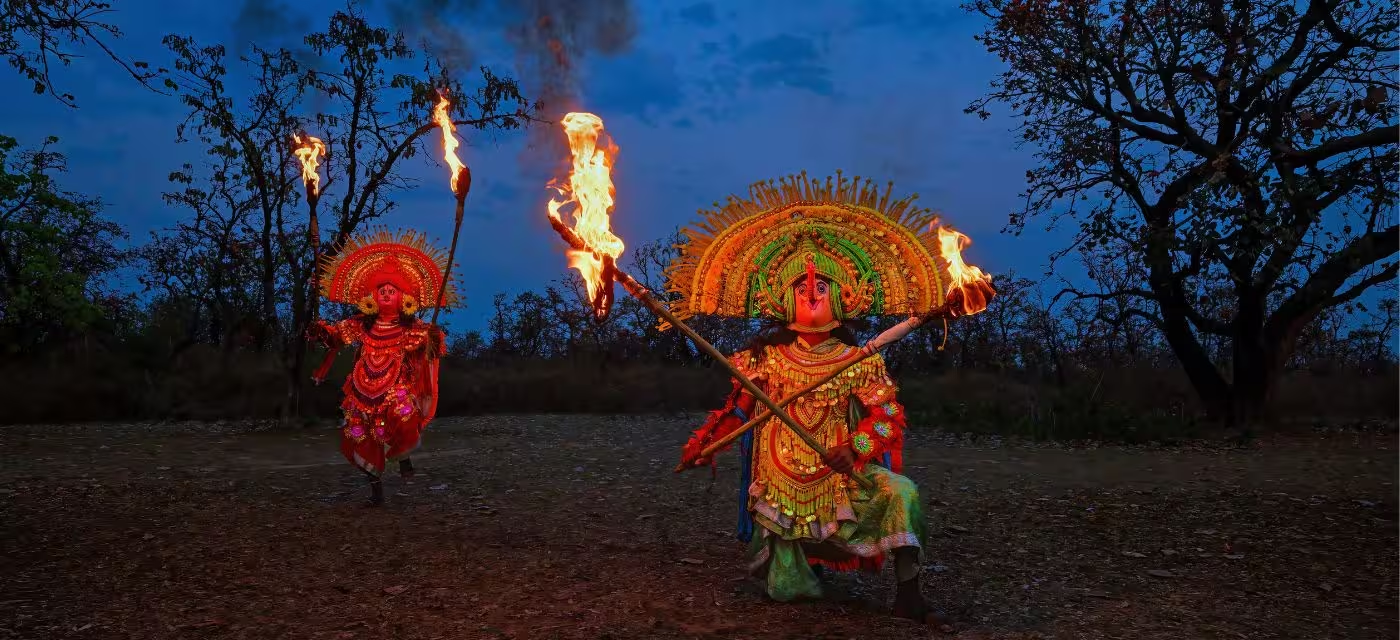
The best time to see the martial arts-based masked Seraikella Chhau dancers performing mythological, nature, and allegorical human tales with leaps and sinuous body movements is mid-April during the annual springtime festival of Chaitra Parva.
Seraikella is near Tatanagar in the eastern Indian state of Jharkhand.
It is also possible to see another masked form of Chhau in Purulia, West Bengal or Mayurbhanj Chhau in Odisha as these destinations are all only 100 km apart and mount three-day festivals that overlap.
Seraikella and Mayurbhanj Chhau developed under royal patronage, competing troupes in Mayurbhanj and royal choreographers and dancers in Seraikella.
CHHAM – HIMALAYAN STORYTELLING
If you are travelling during the summer then definitely head for the hills, or to the Himalayas to be more accurate.
Buddhist monk Chham dancers perform a meditation in motion with masks of wrathful protective deities accompanied by long trumpets and drums that resound through the valleys.
These dances are performed in Mahayana Buddhist monasteries during festivals – all the way from northwest India to the state of Arunachal Pradesh in the northeast.
I would recommend a visit to Leh, Ladakh – a short flight from Delhi virtually straight up – to see the gigantic Thangkha (a sacred Buddhist painting/embroidery on silk cloth) unfurled from the top storey of the over 300-year-old Hemis Gompa (monastery) during the Hemis Festival, along with the Chham performance.
The only cold desert in India, Ladakh is divine during the summer.
PANDAVANI – CHHATTISGARH
The art of storytelling is highly regarded throughout the country.
Teejan Bai is an exponent of Pandavani – a traditional performing art form from the state of Chhattisgarh in Central India – in which she sings and enacts tales from the Mahabharata, with musical accompaniments.
A member of the Pardhi Scheduled Tribe of Chhattisgarh, Teejan Bai broke tradition to take up this previously all-male style by performing standing and singing out with verve in her trademark guttural voice.
The President of India has awarded her the nation’s highest honours – the Padma Shri and Padma Bhushan – alongside the Sangeet Natak Akademi Award, given by India’s National Academy of Music, Dance, and Drama.
DASTANGOI – URDU STORYTELLING
Tales of adventure, magic, and warfare are the heart of the Urdu storytelling tradition of Dastangoi.
Telling a Dastan, or epic, dates back to 9th century Iran (then Persia); and the adventures of Amir Hamza, uncle of Prophet Mohammed were popular in the Indian Mughal courts of the 16th century.
Emperor Akbar commissioned an illustrated version of over 1,200 folios with each panel held by a narrator and changed as the story progressed.
Other Dastans emphasised magic and by the mid-19th century Urdu versions were popular in print, but even more as an oral performance tradition.
With fairies, djinns, and prophecies, the hero’s quest can be mystic or profane.
A successful Dastangoi must have performing skills ranging from drama to dance to mime.
This neglected Urdu storytelling tradition is seeing a revival with Fouzia, India’s first female Dastango breaking into the male bastion; and the tireless efforts of the late Ankit Chadha who wove research-based narratives of personalities like Kabir and Rahim to Dara Shikoh and Majaaz.
Ankit also worked extensively with non-profits to weave modern tales on sustainability, technology, and hunger.
BAUL SINGERS – WEST BENGAL
The soulful Baul singers of West Bengal can best be heard during the colourful December carnival, Poush Mela, in Santiniketan.
They are on the UNESCO’s list of the Masterpieces of the Oral and Intangible Cultural Heritage of Humanity.
These mystic minstrels belong to an unorthodox devotional tradition, influenced by Hinduism, Buddhism, Vaisnavism, and Sufi Islam, yet distinctly different from them.
The Bauls are as much admired for their freedom from convention as they are for their music (Baul Sangeet) and poetry.
They first appeared in Bengali literature in the 15th century and influenced the compositions of Nobel laureate Rabindranath Tagore.
The Poush Mela is held at Santiniketan – the visionary university town established by Tagore – and always hosts a gathering of Baul singers.
CLASSICAL DANCE – STORYTELLING THROUGH MOVEMENT
The storytelling traditions of India that are most seen internationally are the country’s various classical dance forms.
Since millennia, the dancer is not simply a mover in space but also an actor, as described and minutely codified in ancient texts.
It is not possible to generalise classical dance in India – some traditions are solo while others are group; some emphasise expression through hand gestures and facial expression while others use the whole body as an expressive unit; some wear ankle bells to accentuate the rhythms of the accompanying orchestra while others accentuate rhythms in other body parts and hence, never wear ankle bells.
What is shared in Indian classical dance forms is the value placed on communicating metaphysical truths through stories.
In Indian aesthetics, human love is considered the best metaphor to understand divine love.
The love play of Radha and Krishna represents the spiritual path of the human soul or atma, moving on a spiritual path to non-duality, union with the divine, paramatma.
KATHAKALI – KERALA
Kathakali is one of the major forms of classical Indian dance.
Katha (story) kali (art) is the best known dance-theatre genre of Kerala.
Its roots come from the martial arts-based Kalaripayattu (which also inspired the Shaolin Temple martial art of China), Kuttiyattam, and Krishnattam.
The elaborate costumes and highly stylised makeup are easily recognised while the highly refined expressional vocabulary of hands and micro-facial movements make it a highly sophisticated dramatic form sometimes compared to Japanese Noh drama.
Both are traditionally performed only by men after long and demanding training regimens.
Elaborate costumes and masks (Noh) or mask-like makeup (Kathakali) communicate the nature of the characters.
KATHAKALI MAKEUP AND CHARACTERS
Kathakali makeup makes it easy to identify the archetypical character based on the rice paste and vegetable colours applied to the face.
A green face with red lips is always a noble character, god or sage.
Green with red dots or lines means an evil inner nature and all red is totally bad.
Black depicts a forest dweller or hunter while demonesses are black with red patches.
Women and monks are yellow.
Similarly, costumes and head gear also communicate character.
The traditional all-night performances illuminated by a large brass oil lamp between audience and actor-dancers would present folk mythologies and spiritual stories from Hindu epics and the Puranas.
Today, you will find that some Kathakali troupes have not only included women artistes but have also occasionally adapted western stories from Shakespeare and the Bible.
THE LIVING TRADITION OF STORYTELLING
Experiencing storytelling in a live performance creates a personal communication in real time between storyteller and audience.
Alongside all multimedia available via film, television, and the internet, India’s storytelling traditions of oral and visual cultural heritage can be found in every nook and corner of this vast country.
Related Posts