
 English
 Deutsch
 Italia
 August 20, 2026 By admin
Ritual Significance of Indian Jewellery
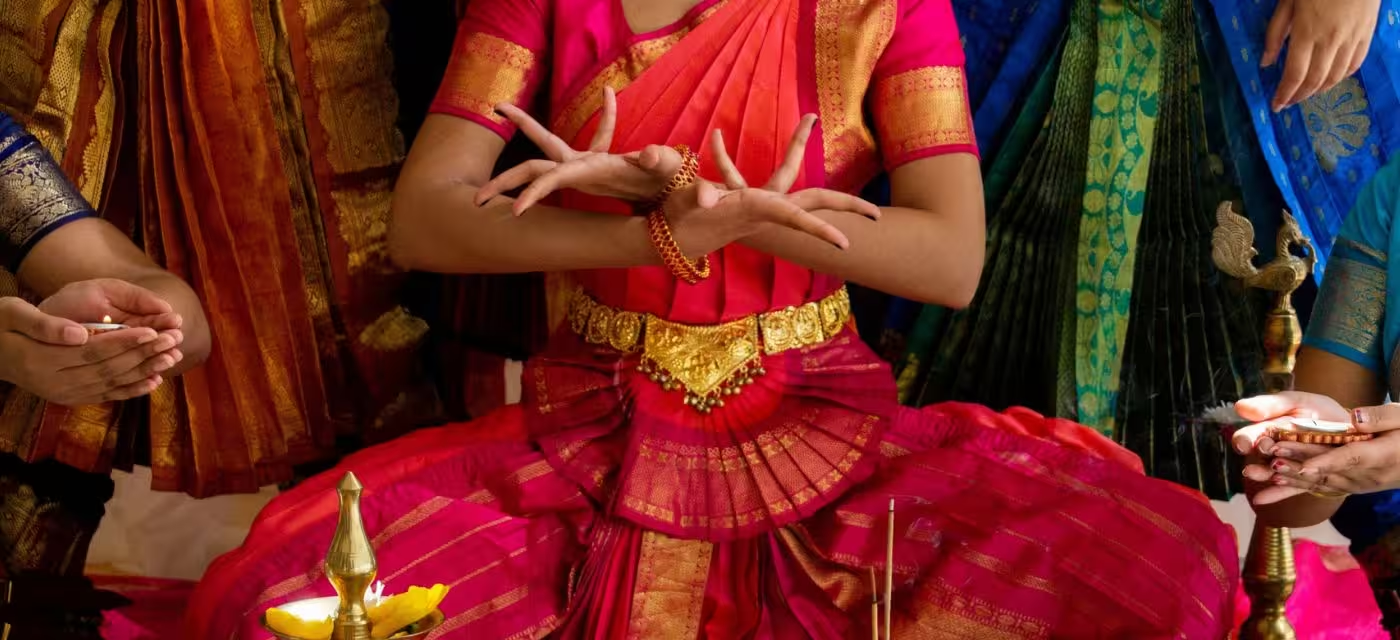
RITUAL SIGNIFICANCE OF INDIAN JEWELLERY
“Though you may travel the world to find the beautiful, you must have it within you or you will find it not.”
– Ralph Waldo Emerson
The watermark of any civilisation has often been gauged by its aesthetics, and jewellery is perhaps one of the most lasting indications of it.
Hardly surprising, considering that women’s penchant for adorning themselves with accessories fashioned out of metal, stones, feathers, terracotta etc. is perhaps as old as civilisation itself.
However, jewellery too – like other markers of civilisation – is region-specific, culture-specific and, in India, caste-specific.
India has a whole range of regional variations of jewels denoting the marital status of a woman.
BORLA – RAJASTHAN
In Rajasthan in western India, the beautiful borla or the maang tikka is worn in the parting of the hair to signify the marital status of a woman.
Made of either silver or gold – depending on the economic strata of the wearer – the piece of jewellery is meant to act as a barrier between the harmful rays of the sun and the skin, and not absorb the excessive heat and ultraviolet rays.
It is said that the borla also presses a certain pressure point that keeps the head cool.
Apparently, this comes in handy when a girl is in her in-laws’ home…!
NATH – NOSE RING
The nose ring or nath is also supposed to signify the woman’s marital status.
According to astrology, it is said that if a girl’s nose is pierced, it is auspicious for the girl’s maternal uncle.
The significance of this perhaps acquires even greater importance in the southern parts of India, where, in some communities, girls often marry their maternal uncles.
In some other parts of the country, a nose ring is worn until such time the girl or bride is a virgin; she starts wearing a nose stud or pin only after the marriage has been consummated.
In the kothas or houses of the nautch girls of yore, a girl whose nath or nose ring was intact would command a higher price.
Such was the premium attached to virginity.
DEJERU – KASHMIR
Up in Kashmir, the northernmost tip of India, there is the tradition of wearing a dejeru – an extremely beautiful ear ornament that is worn by piercing the inner cavity of the ear.
A thread or gold or silver chain is strung through the ear; a part of it goes over the ear for support and finally falls at the breast with a small hexagon ornament attached with tassels.
Interestingly, the piercing inside the lobe, on which rests the entire weight of the ornament, is a pressure point which helps the stomach to remain in top condition.
Even in acupressure and acupuncture, it is said that the ear – like the feet – is the reflection of the entire body, and the piercing has the same effect as would puncturing or pressing the points of the feet.
MANGALSUTRA – FERTILITY AND MOTHERHOOD
In a high mortality rate situation, fertility then assumes even greater significance.
There are many marital rites and rituals related to fertility.
The traditional mangalsutra (from the Sanskrit mangala, meaning ‘auspicious’, and sutra, meaning ‘thread or cord’, the mangalsutra is a necklace that the groom ties around the bride’s neck during a marriage ceremony) in Maharashtra, Karnataka, and Andhra Pradesh has two exact halves of a ball, signifying the breasts, relating to fertility and motherhood.
At a metaphorical level, it is these two equal halves that make the world whole, which again relates to the ardhanarishvara concept in Indian mythology – wherein a half man and a half woman together make the composite form of ardhanarishvara and one is incomplete without the other.
These half balls are strung on to a circle of black cheryu beads of the mangalsutra worn around the neck, and are supposed to ward off the evil eye.
KADAS AND KANGANS – GLASS BANGLES
In the old days, when various types of kadas and kangans (heavy bangles or bracelets) made of heavy metal were de rigueur, glass became a barrier from the heat generated by the open chullahs (hearth).
Since, unlike metal, glass does not retain heat, these became popular.
Again, the basis was more scientific than merely ritualistic: lest a child needed to be picked up or cuddled or, for that matter, for the own protection of the wearer.
Besides, of course, the aesthetics of the bangles and their price range made them accessible to all social strata.
KARDHAN – WAIST ORNAMENT
Popular all over the country earlier, the kardhan or waist ornament is no longer so easily visible but can still be seen around the waists of married women in the rural areas.
Perhaps for economic reasons, the half kardhan has gained popularity, but the real kardhan, which goes around the waist like a belt, is more than a mere ornament.
It supports the lower back and stomach muscles, which come into play especially in the case of women who have to do a lot of load carrying – be it water, firewood, fodder for the animals; apart from holding or carrying babies/little children on their hips as well.
The kardhan keeps the spine straight by supporting it and, following childbirth, helps to reign in the stomach muscles.
WEDDING AND ENGAGEMENT RINGS
The wedding and engagement rings worn by Christians on the ring finger of the left hand are said to press a nerve which is directly connected to the heart.
And so, the spouse is said to be connected to the heart all the time!
BICHHIYAS – TOE RINGS
On the other hand (pun unintended), the bichchiyas (toe rings) worn by Hindu women on the second toe of their feet are said to press a nerve that controls sexual desire.
Apparently, the reasoning behind this accessory is that unbridled sexuality may not be the best thing in situations where women are considered to be the caregivers for the entire family.
JEWELLERY, TRADITION AND SCIENCE
It is interesting to note that our traditions have well-thought-out logic and scientific reasons behind even outward manifestations of what are, on the face of it, said to mark a woman as a particular man’s property!
Related Posts