 English
 Deutsch
 Italia
 August 20, 2026 By admin
Heritage Villages in India
HANDS OF THE MASTERS – HERITAGE VILLAGES
India’s arts and crafts villages are dedicated examples of the country’s living vernacular heritage.
They are where India endeavours to revive, showcase, promote, and sustain its tremendous legacy of folk forms, and honour its immensely gifted craftspersons and artists.
“For once you have tasted flight you will walk the earth with your eyes turned skywards, for there you have been and there you will long to return.”
– Leonardo da Vinci
SARGAALAYA (IRINGAL, KERALA)
Iringal, a pretty but obscure little village some 42 km from Kozhikode, Kerala, suddenly found itself in the spotlight in 2011 when it became the permanent venue for a heritage village.
Welcome to Sargaalaya.
Sargaalaya, the Kerala Arts and Crafts village, is the pioneering enterprise of the Department of Tourism, Government of Kerala.
And in just seven years, Sargaalaya has grown to become a microcosm of the rural heritage of not just Kerala but of all of India.
The village is a now a wonderful platform for exhibition, sales, and craft-making.
Sprawled across 20 acres of land on the shores of the Moorad River at Iringal, the beautiful heritage village showcases not only craftspersons from Kerala but also over 60 varieties of exquisite crafts of craftspersons from across the country.
The stalls are housed in beautiful cottages that are environment-friendly, elegant, and ethnic in design.
Here, craftspersons train in the latest techniques of production even as they blend adherence to tradition with contemporary design, innovation, and tastes.
Designed and developed on the Responsible Tourism model, Sargaalaya’s uniqueness as a tourist destination lies in its very concept – it gives you the exclusive privilege of watching and learning the nuances of crafts-making while buying a product created by traditional craftspersons.
A great way to strengthen the significant link between tourism and handicrafts.
At Sargaalaya, you can see and choose from a wide range of stunning crafts made from raw materials ranging from less expensive natural options such as banana fibre, coir, bamboo, sand, terracotta, coconut-shells, husks, palm leaves, coconut leaves and screw-pine to modern alloys.
There’s jewellery, sculpture, pottery, home décor items, clay and paper objects, murals, toys, engravings, bags, handloom and much, much more.
And that’s not all.
If you happen to be on holiday in Kerala in the winter, do try and make a trip to Iringal.
For this is the time Sargaalaya hosts the annual Sargaalaya Iringal International Crafts Festival – considered South India’s biggest handicrafts fair.
The international crafts fiesta sees participants from countries such as South Africa, Uganda, Nepal, and Sri Lanka apart from the 400 selected craftspersons from various parts of the country.
Not only will you get the opportunity to experience India’s rich traditions of craftsmanship and pick up some fantastic souvenirs to carry home but also enjoy cultural performances, both classical and folk, by artistes from Kerala and across India.
DAKSHINACHITRA (MUTTUKADU, NEAR CHENNAI, TAMIL NADU)
A holiday in Tamil Nadu, in India’s peninsular South, would be incomplete without a visit to DakshinaChitra.
Overlooking the beautiful Bay of Bengal, at Muttukadu, 25 km south of Central Chennai, DakshinaChitra (literally translating to ‘picture of the south’) lies on the East Coast Road (ECR) to Mamallapuram, itself a UNESCO World Heritage Site and a treasure trove of ancient Tamil art and architecture.
DakshinaChitra’s founder Deborah Thiagarajan started the Madras Craft Foundation in 1984 as a platform that would encourage Indian art and craft.
A project of the Foundation, DakshinaChitra is a delightful cross-cultural living-history museum dedicated to the art, architecture, lifestyles, crafts, and performing arts of South India.
It first opened its doors to the public on December 14, 1996.
Over two decades later, the Heritage Museum continues to draw thousands of visitors and is apparently, one of the top excursion spots for children!
Thiagarajan and her team work hard to showcase, promote, and preserve aspects of the traditional cultures and architecture of the southern Indian states, bringing their rich combined heritage to the public in an interactive, interesting, and engaging way.
The pièce de résistance, however, of the 10-acre campus, designed by the late Laurie Baker – the renowned Britain-born Indian architect – is the colony of heritage houses steeped in history.
DakshinaChitra literally ‘houses’ a collection of 18 authentic historical homes representing the living styles of people from different regions of South India.
THE HERITAGE HOUSES
How does DakshinaChitra acquire these houses?
It all began when Thiagaran travelled to remote villages in western Tamil Nadu, where she came across the simple lifestyles of weavers, potters, craftsmen, craftspersons, even traders and merchants — she explored the architecture of their beautiful houses, and discovered their rich culture and traditions.
Over the years, the DakshinaChitra team has been collaborating with ‘conservators’, architects, and timber merchants from villages across South India – they send them word every time the owner of a house decides to dismantle or demolish their old house.
The team then travels to that particular village; the houses are bought, deconstructed piece by piece, transported to Muttukadu, and then reconstructed by the sthapathis (craftspersons) of the regions to which the houses belong.
DakshinaChitra has managed to curate houses from Kerala, Tamil Nadu, Karnataka and Andhra Pradesh, each house taking them close to three years and 10 trips to complete.
Each house is a fascinating insight into how architecture was defined not only by the culture and religion of a community but also the geography of a region.
Inside a silk weaver’s house from Tamil Nadu, you will see a large loom in place of conventional furniture – showing that the weavers did not separate home from work.
Then there’s a potter’s house, also from Tamil Nadu, built using mud and reed; a coastal house from Andhra Pradesh known as Chutillu or ‘round house’ was constructed from strong cob walls to keep the fierce winds at bay.
The Syrian Christian house from Kottayam, Kerala, showcases its distinct architecture by way of its long verandah, steeped roof, underground storage area, granary, fine wood work, and separate kitchen and dining areas.
Built in 1914, a massive multi-room trader’s house from Chikmaglur, Karnataka represents the Muslim heritage of the region.
FACILITIES AT DAKSHINACHITRA
Other facilities on campus include the Restaurant, Library/Archives, Open Air Theatre, Conservation Lab, Ceramic Centre, Craft Shop & Crafts Bazaar, Seminar Hall, Activity Hall, and spaces available for events.
The Library has over 14,000 books and journals on South Indian arts, crafts, performance, anthropology, and folklore.
It also houses more than 1,00,000 photographs and a vast collection of DVDs, CDs, and tapes.
And don’t miss the Ceramic Centre.
You can take a class or two on wheel-thrown pottery in its community studio that can be rented by any artist who wants to work in clay, glaze, and stoneware.
It also holds regular workshops for the public.
Also of interest is the Conservation Lab, where a group of experts works to restore and preserve objects, artefacts, and textiles.
DAKSHINACHITRA INTERNSHIP
DakshinaChitra offers a great internship program.
The DakshinaChitra Internship on Museum Management (DAK-IMM) enables interns to work on the collective heritage of India, South India in particular, covering tangible and intangible heritage – visual and performing arts, crafts, traditions, and cultural practices.
RAGHURAJPUR (NEAR PURI, ODISHA)
A quiet, idyllic village sits on the southern banks of the River Bhargavi in Odisha in eastern India, amidst groves of coconut and palm, mango and jackfruit trees, and paddy fields laced with betel vines.
But this is no ordinary village.
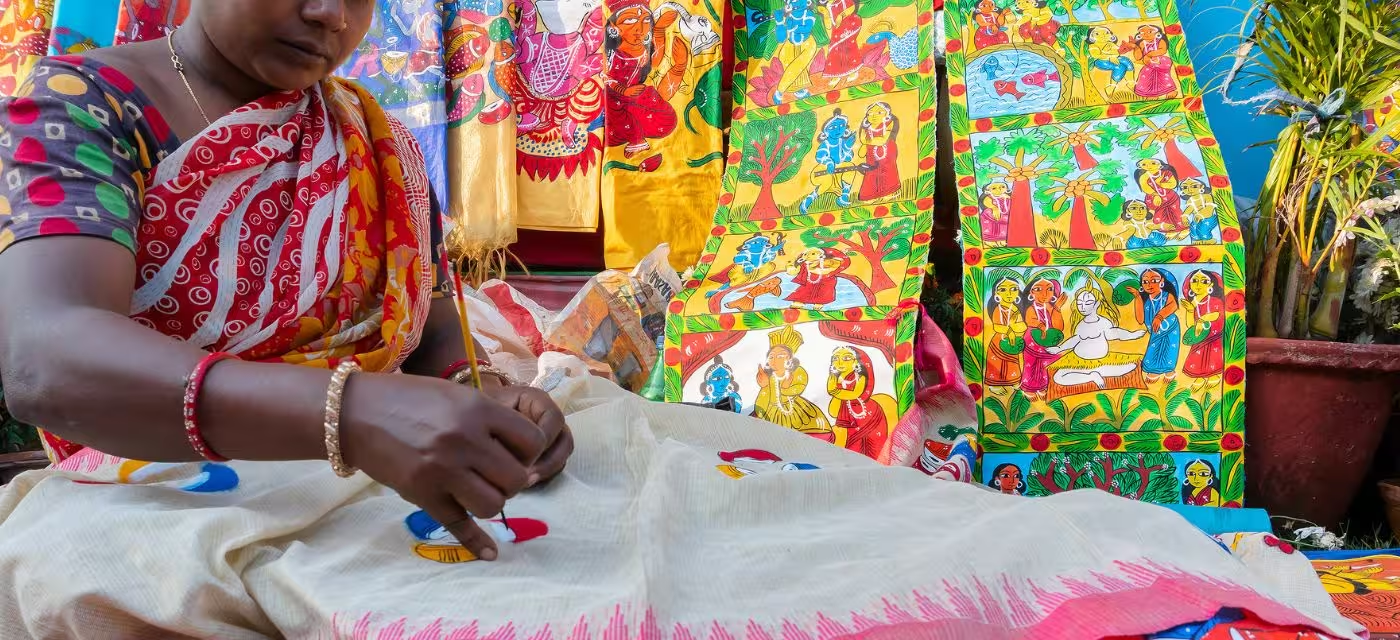
With over 120 houses decorated with mural paintings, and families that continue to carry forward the legacy of the art of their ancestors, Raghurajpur is famed for Pattachitra (GI tag), the traditional cloth-based scroll paintings of Odisha.
Only 18 of these families though, come from the lineage of the original Raghurajpur Chitrakaars.
The craft has been passed on from generation to generation and every family has created its own signature style.
In 2000, Raghurajpur became the state’s first heritage village.
It was developed as a crafts village by INTACH (Indian National Trust for Art and Cultural Heritage), a trust dedicated to the conservation and protection of India’s natural and cultural heritage.
Narrow village lanes are lined by neat rows of traditional houses facing each other; there is a sit-out area in front of every house and the interiors are in wood.
A series of small temples run in a line in the centre of the village.
Step inside any of these houses and you will understand how history and heritage are an integral part of the lives of the villagers.
This is where the chitrakars (painters) live and work with their families.
Their home is their studio.
Remarkably, every resident of Raghurajpur is engaged in crafts such as pattachitra, palm leaf engravings (tala pattachitra), tussar (silk) and tribal paintings, colourful papier mâché toys and masks, wood and stone carvings, and wooden toys and sculptures.
Many of the craftspersons have won prestigious national awards – not only for their skills but also for their immeasurable contribution to India’s wealth of traditional art, craft, and design.
PATTACHITRA PAINTING
The outer walls of each house are resplendent with murals depicting deities and demons; the folk motif runs as a constant thread through all the walls.
But the biggest inspiration comes from the triad deities of Puri – Lord Jagannath (Vishnu), Balabhadra, and Subhadra.
Painted in different sizes and colours, they are integral to every art and craft of Raghurajpur, particularly the pattachitra.
The intricate and exquisite pattachitra (literally translating to ‘cloth-picture’) style of painting is one of the oldest and most popular art forms of Odisha, and is said to date back to sometime between the 7th and 11th centuries.
PREPARING THE PATTACHITRA CANVAS
The process of preparation for the canvas for pattachitra begins with a piece of cloth that has been washed and dried.
A special gummy paste of boiled and ground tamarind seeds is spread over the cloth.
Another piece of cloth of the same size and dimensions is placed over it before the gum can dry.
The tamarind gum is applied on this cloth.
Once this layer of gum is dry, a mix of the tamarind gum and powdered white conch shells is applied on both sides of the cloth, and left to dry till it becomes hard.
Then, it is polished with a small pebble to give it a smooth leathery finish.
PAINTING THE PATTACHITRA
When the canvas is ready for painting, the outlines are drawn in either light yellow or red – the artists are such experts that they simply draw directly with the brush!
A decorative border is drawn on all sides to render a frame-like look.
Intricate images are then painted.
Then the colours (primarily white, red, yellow, blue, green, and black), prepared using natural products, are filled in.
The soot of burning lamps and coconut shells serves for black; white is prepared from powdered conch shells; while hues of red, yellow, blue, and green are obtained from plant leaves, flower petals, fruits, indigo, coal, ground rocks etc.
No chemical goes into any of the paintings.
Also, the three types of brushes – broad, medium, and fine – are, traditionally, made out of the hairs of animals such as buffalo, squirrel, mouse etc.
FINISHING THE PATTACHITRA
The final lines are drawn and the patta is given a lacquer coating to protect it.
The painting is held over a fireplace, exposing the back to heat.
Fine lacquer is then applied to the surface of the painting to give it gloss.
The pattachitra is finally mounted and ready.
Traditionally, the master artist draws the initial lines and gives the final finish to the paintings, while the women prepare the canvas, fill in colours, and give the final lacquer coating.
The chitrakars of Raghurajpur etch out stories on cloth and leaf in miniaturist detail with painstaking effort, vivid imagination, and immense patience.
Each one of them possesses a unique style, a keen eye, and nimble fingers that create outstanding works of art.
Related Posts