 English
 Deutsch
 Italia
 August 20, 2026 By admin
Indian Jewellery Traditions
SET IN STONE – THE JEWELLED SPLENDOUR OF ANCIENT INDIA
Spanning a legacy of some 5,000 years, the history of the jewellery traditions of India is really the history of the country itself – showcasing its finely developed aesthetic sense and throwing light on its multi-cultural assimilations.
For over 2,000 years, India was famed as the sole exporter of gemstones to the world – diamonds, sapphires, pearls, beads etc. were much coveted and drew both maritime and land merchants to India.
Ancient craftsmen created extremely sophisticated pieces of jewellery using both precious and semi-precious stones, and were backed by intricate engineering skills – their hands and tools.
Centuries on, museums, palaces, and royal houses across India hold what has survived of this jewellery; there are detailed references in classical literature and antiquated texts, descriptions in mythology and folklore – providing evidence of a tradition without parallel in the world.
Of technological prowess, of simple ornaments made extraordinary by complex styles and workmanship. And of continuity of design that sustains to this day.
“Wherever you go, go with all your heart!”
– Confucius
VANKI
The vanki (armlet) of South India is unique because of its inverted-V-shaped design.
The beautiful vanki could be inlaid with precious stones such as rose-cut diamonds, cabochon rubies, and emeralds.
Designs displayed striking effects such as coiled snakes or parrots and a classic lotus-motif pendant.
From old paintings and sculptures, it appears that its origin can be traced to Naga or snake worship.
The unusual shape of the vanki allows it to fit over the arm without any strain or pressure.
LINGA PADAKKA MUTHU MALAI
The linga padakka muthu malai (a garland of pearls with a lingam pendant) from Tamil Nadu in South India, displays rows of pearls that end in a pendant in which the lingam, the symbol of Siva, is shaped out of a precious stone and set in an elaborate encrusted base, usually with a classic lotus-motif pendant.
In ancient India especially, pearls were the favourite of the royals; they believed that flawless pearls prevented misfortune.
South India, in particular, is renowned for its pearls, and pearl necklaces with elaborate pendants were greatly admired and worn in the medieval courts of the mighty kingdoms of Vijayanagara and Thanjavur.
Sometimes, the pendant enclosed a scroll of sacred words; it was then worn as an amulet to ward off evil.
Images of the family deity were often engraved in gold and encrusted with stones, in the pendant.
NATH
Nose ornaments in India include – the single stone and the clove-shaped laung worn on one side of the nose, the jewel worn through the cartilage in the centre of the nose, the bulak, and naths (nose-ring) of various shapes and designs.
The nath style worn in the north of Maharashtra – in Western India – is a classic example of great elegance and fine design.
It could feature diamonds, pearls, and rubies etc. as embellishments.
References to nose jewellery in ancient Hindu texts are rarely seen – it is possible that it could have been introduced to India by the Islamic dynasties in the 9th or 10th century CE.
ODDIYANAM
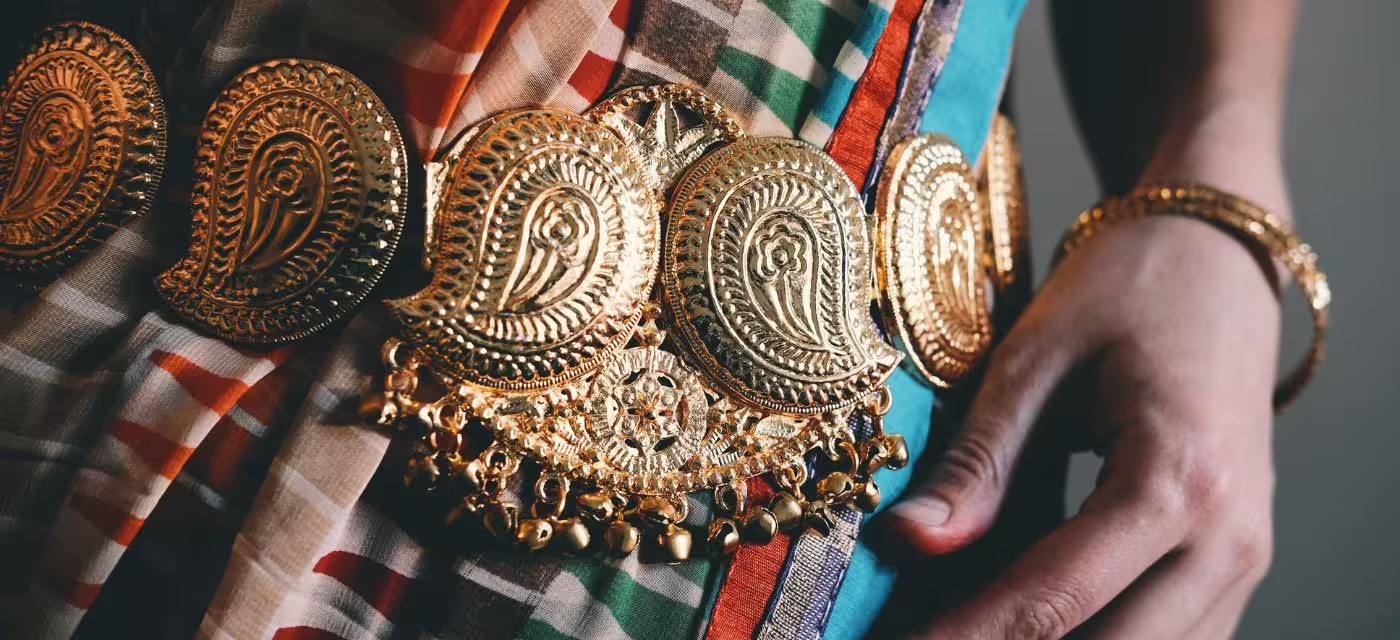
Although the original purpose of the oddiyanam, a waist ornament from South India, was to hold up the saree and keep it in place, it also served the purpose of keeping the waist slim, as the breath was drawn in before the belt-clasp was fastened.
An oddiyanam could be encrusted with precious stones such as rose-cut diamonds, emeralds, and cabochon rubies.
Complemented by exquisite designs displaying peacocks, flowers, buds, leaves etc. intermingling in perfect symmetry.
JADANAGAM
The jadanagam (‘hair-serpent’) of South India is worn by brides to decorate braided hair.
The rakkadi (used in the back of the head, to hold long soft hair spun and tied) shaped like the sun – symbolic of brilliance and power – is followed by the crescent moon, evocative of calm and peace.
The third piece is the fragrant thazhampoo (screwpine) flower.
Followed by a ruby and diamond-studded many-headed divine cobra, below which rest its coils.
The jewellery for the braided hair begins from here.
Flower and bud designs interlace to form a supple ornament.
Towards the end of the braid it bursts out into three silk tassels held together by encrusted bells.
The jadanagam was also worn by the Devadasis (temple dancers), who considered themselves the brides of the temple deity.
The tradition has continued to this day – seen in the jewellery of Bharatanatyam dancers, who wear the jadanagam or, where it is not available, a substitute made out of flowers.
SHINKA
The shinka is an unusual hair jewel of Gujarat in western India, worn especially at weddings and on festive occasions.
Although popular with certain communities, it is quite rare, the more common hair jewel being the damani worn on the brow in front of the hair-line.
The shinka is worn on the hair itself; a heavy ornament, it is held in place by gold hooks attached to the hair and linked by a series of heavy gold chains.
The shinka could be encrusted with precious stones such as sapphires, emeralds, rubies, and turquoise.
HATHPOOL
The hathpool (flowers for the hand), also known as the panchangala (jewel for the five fingers), is a hand ornament, especially popular in northwestern India.
A classic design would comprise a kundan-set flower-encrusted bracelet with stone-set chains leading to another flower on the back of the palm, and similar chains connecting it to five rings on the five fingers, each ring with a different flower motif.
The reverse of the jewel is covered with intricate enamel work of different colours and designs.
KUNDAN
The art of kundan (the setting of stones) is achieved by carving out little pits – of the size of the stones being used – in the front of the ornament.
Precious stones are set in these hollows and kept in place by a band of the purest gold.
Related Posts