 English
 Deutsch
 Italia
 August 20, 2026 By admin
The Handmade Tales
THE HANDMADE TALES
India is a treasure trove of ancient indigenous handicrafts, and every carved piece of wood, embroidered cloth, woven saree, painted story, hand-knotted carpet, moulded pottery, and sculpted image is deeply rooted in the land. Immersed in the history of a place and rich in heritage, traditional art and craft don’t just make for great souvenirs—they are windows to a region’s culture and geography.
There is a profusion of skill, design, technique, and creativity in the sophisticated crafts and robust creations of India. Every region and sub-region of the country has its own genres and styles of art and craft.
Remember what Bilbo used to say: It’s a dangerous business, Frodo, going out your door. You step onto the road, and if you don’t keep your feet, there’s no knowing where you might be swept off to.
– JRR Tolkien
India’s innumerable craftspeople are the inheritors of centuries of traditional skills and complex knowledge acquired after long periods of apprenticeship. India has over 3,000 crafts, many of which are struggling for survival or are on the verge of disappearing.
Combining India’s rich crafts heritage with a growing tourism industry can help empower livelihoods in rural India, also giving these crafts and their creators the visibility, acknowledgement, and tribute they deserve.
Travellers in India will experience not only the country’s stunning display and array of workmanship but also enjoy the cultural and historic sights of each destination they visit.
You can witness a live demonstration of the craft, even participate in a hands-on workshop, and create your very own piece of art or craft to carry back. You can meet the craftspeople and understand their lives – taking home with you the cherished memories of a lifetime.
We introduce you to some of India’s unique arts and crafts:
CHANNAPATNA TOYS
Tucked away on the Bengaluru-Mysuru highway in Karnataka, is Channapatna or “gombegala ooru” (toy town) as it is more popularly known.
On a narrow main road lined with stalls selling wooden toys stand rows of orange, ochre, red, yellow, blue, and parrot-green figurines shaped like various animals, dolls, caterpillars, kitchen sets, and bobbling dancers. They are the pride of Channapatna.
And one of many products from Karnataka to have earned the Geographical Indication (GI) tag, an international label awarded to products corresponding to a specific geographical location or origin.
Channapatna is famous for its uniquely beautiful lacquered wooden toys.
The toys are believed to date back to the era of Tipu Sultan, the mighty and fierce 18th-century ruler of Mysuru. Apparently, Tipu Sultan was a great patron and lover of wooden crafts and invited artisans from Persia to Mysuru, to teach and encourage local craftsmen.
Traditionally, the bright, colourful toys were handcrafted from rosewood, sandalwood, even ivory, and then lacquered using resin and vegetable dyes.
Today, eco-friendly paints are used by some of the local artisans who practise the craft, though sometimes with inexpensive wood like pine and rubber.
The allure of Channapatna’s toys is ageless. You will be entranced by dancing puppets, gliding wooden snails, and miniature mazes with pretty wooden damsels!
For a closer experience, you can visit one of the many workshops here and watch artisans hand-sculpt the wood.
Channapatna is around 60 km from Bengaluru on the Bengaluru-Mysuru Highway. It is connected to Bengaluru by train and bus.
BIDRIWARE
In the narrow lanes of the small but remarkable town of Bidar in north Karnataka, artisans hammer and shine silver, keeping a centuries-old tradition alive – delicate Bidri art.
The meticulous art (awarded the GI tag) was greatly patronised by the Bahmani Sultans, rulers of the Deccan between the 1300s and 1500s, and is today, one of the most important handicrafts to be exported from India.
Bidriware is made of an alloy of copper and zinc. The artisans sketch free-hand designs on this with a sharp metal stylus.
Pure silver wires or plates are then hammered and inlaid into the intricate design, standing out against the dark background.
The craftsmanship and skilled labour involved in creating Bidriware are considered invaluable, finding their way onto souvenirs, hookahs, trinket boxes, decanters, and jewellery with beautiful shapes and vivid motifs such as stars, flowers, elephants, and crescent moons.
The most important ingredient of Bidriware is the soil collected especially from inside the ancient Bidar Fort.
Unexposed to rain or sunlight for centuries, the soil has chemicals that give Bidriware its lustrous black colour. The quality of the soil is tested, apparently, by tasting it!
Since the richly embellished Bidriware is handcrafted after long hours of skilled labour, it cannot be ‘mass produced’ or manufactured in factories.
Bidar is around 690 km north of Bengaluru and is connected by bus and train.
MYSURU GANJIFA
The Goddess Chamundeshwari (a fierce form of the Goddess Durga in Hindu mythology), watches over the charming city of Mysuru, Karnataka, from an old temple in the Chamundi Hills.
Ardently worshipped here, Chamundeshwari has been the guardian deity of Mysuru’s maharajas for centuries.
The Chamundeshwari Chad is named for the goddess.
A complex card game that is played using circular cards of 16 suits, the Chamundeshwari Chad comprises hand-painted cards that depict chapters from Hindu mythology, cosmic beings, and zodiac signs in the characteristic ganjifa miniature style.
An exquisite miniature painting rendered on playing cards – made of cloth, leather, palm leaves, sandalwood strips, and handmade paper – with super-fine squirrel hair brushes using vegetable and mineral dyes, the ganjifa is said to date back to over 1,000 years but became prominent during the rule of the Mughals.
Popular in Persia until the 17th century, ganjifa baazi or treasure game —‘ganj’ is Persian for treasure—was a great favourite of the Mughals who eventually brought the addictive game to India, where it became hugely popular amongst the aristocrats.
Apparently during Akbar’s time, the cards were lavishly set in ivory, and often inlaid with rubies, emeralds, and lapis lazuli – a game of treasures indeed!
Other precious materials such as mother of pearl, tortoise shell, gold, and silver were also used. The emperor played with a 12-suited deck – of horses, snakes, forts, and djinns; and the stakes were high!
Though this was a remarkable instance of the superb workmanship of the ganjifa artists, with the coming of the British, and eventually, the introduction of European cards in the 19th century, the popular pastime declined and was found only in pockets of India including Mysuru, where it was patronised by the Wadiyar dynasty.
Today, however, more than the game itself, it is the intricate and painstaking art of making the ganjifa card which is recognised as an art form.
The Mysuru ganjifa now receives modern patronage at Kreeda Kaushalya, a biennial exposition of traditional Indian card and board games.
Internationally renowned artist Ganjifa Raghupathi Bhat is credited with having revived the Mysuru ganjifa style of painting – having practised the ganjifa art for over three decades, he has conducted workshops and trained hundreds of artists so far.
Mysuru is around 140 km southwest of Bengaluru, Karnataka’s capital. Daily buses and trains ply between the two cities.
AZULEJOS OF GOA
On the Panjim Riviera lies Azulejos de Goa, a 250-year-old meticulously redesigned mansion that has the finest example of Goa’s azulejos.
Azulejos, the distinctive hand-painted coloured tiles of Goa, can be seen adorning mansions, churches, hotel lobbies, and several homes, especially in heritage neighbourhoods like Fontainhas in Panjim.
Azulejos were introduced by Portuguese colonisers in the 19th century, and perfectly mirror the rich Indo-Portuguese culture of the land.
The art gradually vanished from the scene after Goa’s liberation in the 1960s, only to make a comeback in 1998, when Orlando de Noronha began to produce them locally with paints imported from Portugal.
Today, Noronha is renowned for his work with azulejos.
Velha Goa is another famous azulejos institution – their work can be seen in the renovated chapel in Pilar, 13 km south of Panjim.
The interior of the church, including its altar, is done up with stunning azulejo ceramic.
For those who are interested, there is an azulejos workshop in Bicholim, some 33 km northeast of Panjim.
Watching the azulejo take form is a fascinating experience. The clay tile is fired in the furnace, glazed, painted on with vivid colours, and then fired again, to fuse the paint with the tile.
Panjim, Goa’s capital, is easily accessible. Pilar is around 13 km south of Panjim, while Bicholim is around 33 km away.
PATTAMADAI MATS
Soft and flexible, the beautiful woven mats with brilliant colours that seem to leap out at you are handmade by the craftsmen of Pattamadai, a village hidden away in the Western Ghats mountain ranges of Tamil Nadu.
For generations, newlyweds have had the joy of receiving these made-to-order mats – an important part of the wedding trousseau.
Deep inside the magnificent Western Ghats, the River Thamirabarani nourishes a land of paddy fields and dense tropical rainforests.
The tall korai grass – the blades of which are used to weave the mats – grows on the banks of the legendary River.
Mat weaving is an elaborate process – the grass is first dried, then soaked in water to increase flexibility, and dyed before being woven.
Weavers say that the finest mats – the ones with the most delicate strands – are woven from korai that has been soaked for a long time.
Fresh off the loom, the mats are then polished and readied to be sold.
The sturdy korai also yields boxes, wall hangings, and shopping bags that are made to cater to local demands.
Pattamadai is a small village in Tamil Nadu’s Tirunelveli District and is around 600 km from both Chennai and Bengaluru, and around 150 km from Thiruvananthapuram in Kerala.
The closest town is Tirunelveli, 23 km away. Thoothukudi (56 km) is the closest airport.
BALUCHARI SAREES OF BISHNUPUR
The town of Bishnupur in West Bengal’s Bankura District is a handicraft collector’s delight.
Once the capital of the Malla kings in the 17th century, Bishnupur is renowned for its sublime medieval terracotta temples.
However, it is in the dim alleys of the town where you will find what may be the largest variety of craft traditions in Bengal – dhokra metal work, conch shell bangles, and terracotta pottery, jewellery, and artefacts.
But Bishnupur’s real claim to fame is the traditional Baluchari saree.
Handwoven with delicate silk, the gorgeous Baluchari is known for the mythological tales woven into its border and ends.
The first Nawab of Bengal, Murshid Quli Khan, patronised this rich weaving tradition and greatly encouraged the craft during his reign here in the 18th century.
The Baluchari weavers are inspired by the exquisite panels of the terracotta temples, recreating stories on silk.
Scenes depicting gods and goddesses, religious epics, courtly ceremonies, and mythological heroes are particular favourites.
Traditionally, beige tussore silk is used as a base, highlighted with motifs in bright red, deep purple, deep pink, and gold.
Every intricately planned arrangement of warp and weft in the Baluchari’s stunning motifs immortalises the rich culture and history of the region.
To own a Baluchari would truly mean owning an heirloom – one that can be handed down from generation to generation.
Today, the weavers of Bishnupur source mulberry silk from Karnataka – the silk is first boiled in a soda and soap mixture and then dyed in acidic colours.
The yarn is then transferred to small beams called sisaban and bigger beams called dhal. The weaver then attaches these beams to the loom and begins weaving.
In the old days, the sarees woven were reversible; the motifs could be seen and understood on either side. But apparently, saree motifs are no longer reversible.
Bishnupur is around 150 km northwest of Kolkata, West Bengal’s capital, and is well connected by bus and train. Kolkata is the closest airport.
THONGJAO POTTERY
The creations of Neelamani Devi, an Indian craftswoman and master potter from Manipur, have been the theme of two documentary films; Devi has travelled extensively in India and abroad with her works.
Apart from the prestigious National Award and several other awards, the Government of India awarded her the fourth highest civilian honour, the Padma Shri, in 2007, for her contribution to the art of pottery making.
Neelamani Devi made Thongjao pottery.
A remote village located some 55 km from Imphal, the capital of Manipur, Thongjao came into the spotlight because of its beautiful terracotta pottery.
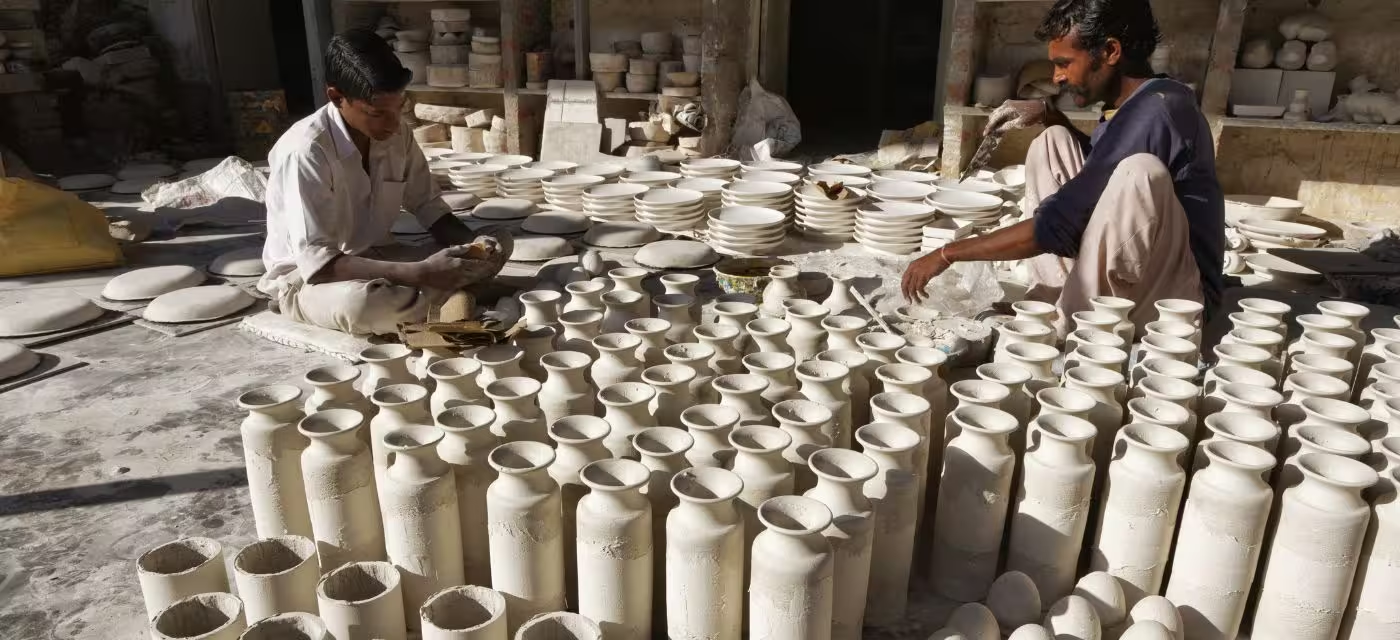
Pottery is one of the many skills that the tribes of the region have mastered over the centuries and that too without the use of a potter’s wheel!
Deftly using their nimble fingers and well-worked hands, they mould and produce an incredible variety of earthenware.
The terracotta pottery of Thongjao – such as pitchers, cooking vessels, plates, pot rings, lids, bowls, and pots – is made mostly by women, and is distinct for its form, craftsmanship, and the creative use of reduction firing, rendering it a unique colour.
The pottery is hand formed using slabbing and shaping techniques – achieved with a flat padding tool.
Red and black clay are mixed, kneaded, rolled into a wide slab, and turned into a cylindrical form; a circular slab forming the base is joined to it.
The neck and rim of the pot are shaped by using the fingers and pressing with a wet cloth.
A flat wooden beater is used to pat from the outside while the inner layer is supported with an oval-shaped stone held firmly in the other hand.
The surface is then burnished with a seed and the pots collectively baked in an open traditional kiln.
LONGPI HAMLEI POTTERY
Longpi (Loree), a village in the Ukhrul District of Manipur, is famous for its age-old black stone pottery – Longpi Hamlei.
Nearly every family in Longpi knows how to make black stone pottery, an art that is unique to the village.
Weathered rock and serpentine rock are crushed to a powder and mixed with water to form a clay-like consistency.
The mixture is kneaded the entire day and flattened on a wooden board for the initial slab work.
Not crafted on a potter’s wheel, every piece of pottery is shaped by hand with the help of moulds and tools.
Once the shaped clay has dried and hardened, it is taken to an open bonfire and heated for five to seven hours at temperatures over 1200 degrees centigrade.
The pottery is removed while still hot and scrubbed with machee, a local leaf, giving it fine finish and lustre.
The finished products are gray-black cooking pots and kettles, bowls, and mugs and trays, often with a lacing of fine cane at the handles and knobs.
Beautifully earthy yet contemporary in appearance, the Longpi Hamlei cookware can be used for direct cooking over gas stoves or firewood, and is microwave-safe as well.
Conceived and designed for utility-cooking and extremely hardy, the cookware is particularly good for simmering and slow cooking for hours over a low flame.
The pottery is completely natural and chemical-free.
KAAVAD STORYTELLING
Often missed or lost in the profusion of Rajasthan’s many alluring arts and crafts traditions, the kaavad, a collapsible, portable shrine with detailed panels, is brought to life by storytellers.
The kaavad banchana, a 400-year-old rich, oral tradition of storytelling is still alive in Rajasthan.
Stories from the mythological epics Mahabharata and Ramayana are told, folklore is recounted, and caste genealogies recited.
An experience that creates the idea of a sacred space against the backdrop of storytelling, the kaavad banchana gives each one – maker, teller, and listener – an identity.
The kaavad banchana takes the listener on an audio-visual journey made possible by the colourful kaavad shrine.
The kaavad is a beautiful travelling wooden temple/shrine that contains splendid visual narratives painted on its multiple panels that are hinged together.
Akin to doors, the panels open and close, simulating the several thresholds of a temple.
The images depicted are those of deities, saints, local heroes, mythical heroes, even the patrons who commission them.
The design of the kaavad, which resembles both a cupboard and a temple, is remarkable for how the story gradually unfolds through its hinged doors…until the supreme lord is revealed in the inner sanctum (garba griha).
With the mystery of a new turn in the tale behind every door, the kaavad leaves its audiences spellbound.
Made of mango or sheesham wood, the kaavad is made by the Suthar (carpenter) community in Mewar for the bard-like kaavadiya bhat (storyteller) from Marwar who brings the shrine to his jajman’s (hereditary patron) house to tell stories, recite his genealogy, and to sing praises of his ancestors.
Only a couple of families now make the original kaavads for storytellers. The rest create them in smaller dimensions for tourists.
A wonderful collage of images and symbols that are bound together in stories, the kaleidoscopic kaavad tradition is engaging, interactive, engrossing, and lucid.
All the while staying true to its credo ‘If you can’t go to the temple, the temple will come to you.’
Udaipur (in the Mewar region of Rajasthan) is around 700 km south of Delhi and is connected by a daily flight and train service.
Bassi village, where most suthars now live, is around 150 km northeast of Udaipur, and is connected by state transport buses.
CHOGTSE OF LADAKH
Iconic of Ladakh and an important part of trans-Himalayan homes, the chogtses are low wooden tables that serve multiple purposes.
In monasteries, the chogtse is used as a meditation table where monks place the scriptures from which they recite.
Elaborately designed and beautifully painted chogtses are placed in front of the altar and bear butter lamps lit for the deity.
In homes and at restaurants, you will be served traditional food and beverage on the chogtse.
Traditionally, mineral pigments were used to render stunning motifs such as snow lions, clouds, dragons, lotuses, and conch shells carved on the chogtses.
These ancient tables are designed as three-sided folding tables, so that they can be easily transported.
Each richly detailed panel in the willow-wood tables is individually crafted and then integrated into the frame using a simple dovetailing technique.
Depending on the complexity of the design, a chogtse can take between a fortnight and two months to complete.
To paint in deep crimsons, rich yellows, elegant ochre, and vibrant oranges itself takes about three days.
Leh, Ladakh, is a dry, high-altitude region in Jammu & Kashmir. There are weekly flights and a daily bus that connect Leh and Delhi.
DHOKRA METAL WORK
For nearly a century, the indigenous Jhara people of Ektaal, a village on the Odisha-Chhattisgarh border, have been crafting dull-gold figurines made of dhokra – a 4000–5000-year-old wax-casting technique, the earliest and most famed example of which is the iconic Dancing Girl of Mohenjo-daro, from the Harappan civilisation.
Several centuries on, Dhokra metal-work is admired all over the world for its primeval simplicity and enchanting folk motifs – gods and goddesses, tribal and animal figurines, trees etc.
And the ancient lost-wax technique remains largely unchanged.
A fascinating process, dhokra-making uses only natural raw materials.
The basic mould is made with fine sand (mostly found near river banks) and clay.
Goat and cow dung or husk is added to the principle material, then layered with pure beeswax from the jungles.
Wax threads are then prepared and wound around the clay mould until its entire surface is covered uniformly.
After this, decorative aspects are added.
The clay is then cooked over a furnace where the wax comes out from the drain ducts.
The wax burns in the furnace leaving a free channel for the metal to flow.
Molten metal (mainly brass and bronze) is poured into the mould.
The mould is taken out after the metal has melted, and a little later, water is sprinkled to cool it.
It is then cracked open and the final cast figure removed.
The metal icon is retouched and meticulously scoured at the river with clean sand to give the finished product a soft polished look.
Generally, a simple metal figurine could take anywhere between 15–30 days to make. More complex figurines could require months.
The craftspersons of Ektaal create an assortment of pieces such as traditional lamps, jewellery, decorative hooks, boxes, combs, vases, frames etc. with painstaking detail.
Some of the villagers are recipients of prestigious national awards while several others have received state awards for the quality of their craftsmanship.
Many have even travelled to Europe to display their exquisite work at fairs and exhibitions.
Rare, distinct, and unique, every work of dhokra is truly a collectible.
Ektaal is around 18 km from Chhattisgarh’s capital Raipur, and around 640 km from Kolkata, West Bengal.
A JOURNEY THROUGH INDIA’S HANDMADE HERITAGE
These are mere windows that offer small glimpses into India’s spectacular world of art and craft.
But we hope it has opened doors too – for you to make a journey to this extraordinary country.
Because sometimes, these works of the hand alone are worthy of that journey.
Related Posts