 English
 Deutsch
 Italia
 August 27, 2026 By admin
Wayanad Home of the Monsoon
WAYANAD – HOME OF THE MONSOON
Travelling — it leaves you speechless, then turns you into a storyteller.
– Ibn Battuta
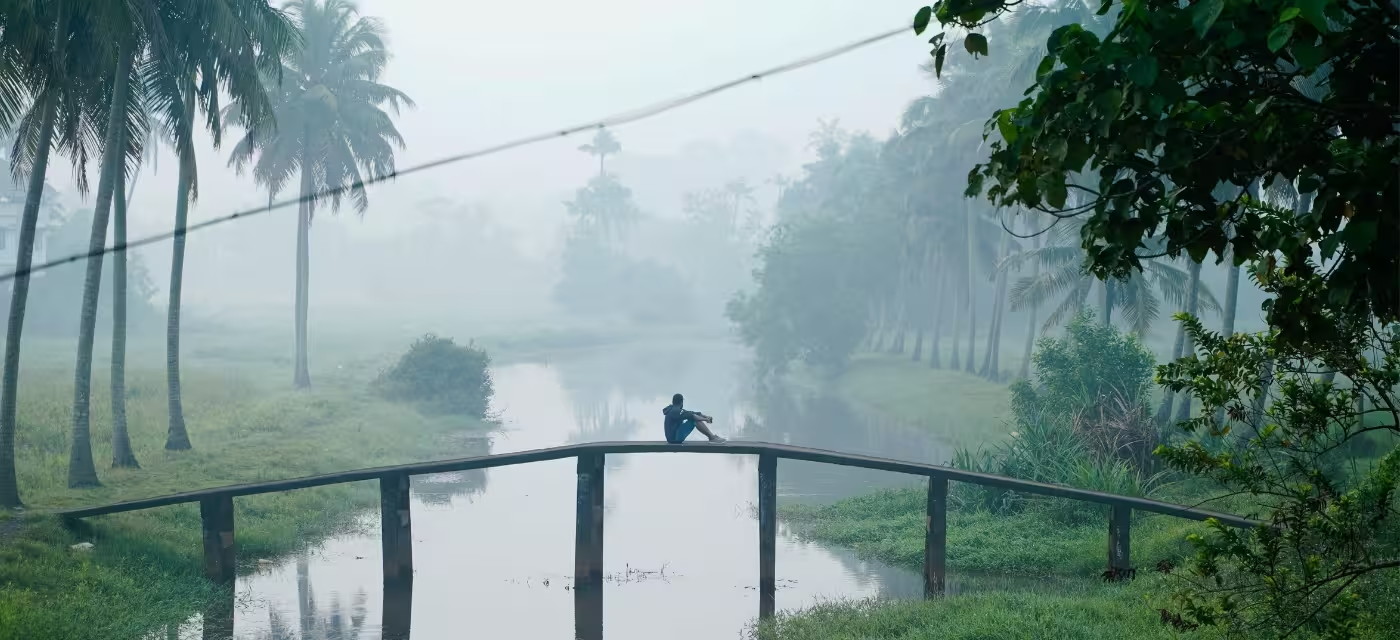
Kerala’s Wayanad district stands on the southern top of the Deccan Plateau amidst the mountains of the magnificent Western Ghats in the northeastern part of the state. Its chief glory is in the lofty ridges and rugged terrain of the Ghats interspersed with dense forest, tangled jungles, and deep valleys. Wayanad is known for its cool highland climate, misty peaks, and virgin forests.
Wayanad is bordered by the states of Karnataka (to the north and northeast) and Tamil Nadu (to the southeast) and enjoys a strategic location since some of South India’s major tourist destinations such as Ooty, Mysuru, Bengaluru, Coorg, and Kannur are situated around this region.
This serene and pristine hill destination is 76 km from the sea shores of Kozhikode and brims with plantations, forests, lakes, waterfalls, rivers, and wildlife that lay claim to its unique and splendid natural beauty. The Wayanad hills are contiguous to Mudumalai in Tamil Nadu and Bandipur in Karnataka, forming a vast land mass for the region’s indigenous wildlife to move free and far in their natural habitat.
Kalpetta town is the District Headquarters. Sultan Bathery, Mananthavady, and Vythiri are the other major towns.
Kalpetta, surrounded by coffee and tea plantations and mountains, was a major Jain centre in ancient times. Lakkidi, the gateway to Wayanad, is located on the top of the windy turns of the Thamaraserry Ghat Pass. Travelling through the nine hairpin curves from Adivaram to Lakkidi is the experience of a lifetime. The serpentine, chiselled-out road offers breathtaking views of the surrounding hills and valleys; and dense forests, gorges, streams, and plantations greet you at Lakkidi. Lakkidi has the highest rainfall in Kerala.
Sultan Bathery (also spelt as Sultan Battery) is named for its past as an ammunition storehouse. Tipu Sultan, the legendary 18th-century ruler of Mysuru who valiantly opposed the British, marched in with his army and stored his arms and ammunition in a 13th-century Jain temple here.
It was at Mananthavady that Lord Arthur Wellesley fought a guerrilla war with Pazhassi Raja and British supremacy marked the region for two centuries.
Vythiri is an unassuming little town whose easy and accessible location makes it possible to visit all the places of tourist interest within a 40-km radius of the town.
THE OUTDOORS TRAIL
Wayanad captivates with its ancient ruins, mountain caves, aborigine tribes, tree houses, jungle trails, and beautiful wildlife; it’s the perfect setting for a truly exceptional holiday.
The unique terrain here makes for fantastic adventure experiences; mountains and forests combine to offer numerous outback trails, trekking routes, and opportunities for other adventure sports. With vast areas still unexplored, Wayanad is waiting to be discovered!
Chembra Peak
At 2100 metres above sea level, the looming Chembra Peak is the tallest summit in the region. Chembra is 6 km south of Kalpetta.
Climbing this spectacular peak, especially for the uninitiated, is a challenging mountaineering endeavour (approx. 5–6 hours) and it is best to start early. Up the hill at about 4921 feet, lies a crystal-clear lake. The surrounding areas offer exquisite photo opportunities. Camping on the peak is an unforgettable experience.
Neelimala View Point
Neelimala is a superb place for trekking with plenty of exhilarating trails. The summit of Neelimala affords a great view of the cascading Meenmutty Falls and the beautiful valley in the foreground.
Meenmutty Falls
It is the journey to Meenmutty that is an adventure in itself. From a tiny hamlet called Vaduvanchal, a 6-km dirt road takes you to Chellangode, a small junction where guides are available, and which takes you to a track nearly obliterated by heavy rains and dense undergrowth.
An hour’s walk takes you through undulating terrain and a dangerously steep decline till you reach Meenmutty. But the effort is worthwhile. This magnificent waterfall cascades down in three steps and to witness this is the experience of a lifetime.
Chethalayam Falls
Chethalayam is one of Wayanad’s smaller waterfalls. Its surrounding areas offer several vantage points for bird-watching. It is also popular with trekking enthusiasts.
Pakshipathalam
Deep within the forest in the Brahmagiri Hills at an altitude of over 1700 metres is Pakshipathalam, a formation of colossal boulders.
The deep caves found here are home to many species of flora, fauna, and birds. The journey to Pakshipathalam involves a gruelling 7-km trek through dense forest beginning at Thirunelli. (Special permission required from DFO-North Wayanad at Mananthavady).
Banasura Sagar Dam
The Banasura Sagar Dam, considered to be the largest earthen dam in India, is the perfect point for treks to the Banasura Peak.
But what really makes this area an absolute delight is that it is largely untouched by mass tourism and you can explore the gorgeous countryside without bumping into crowds. An interesting feature is a set of islands that were formed in the dam’s waters when the reservoir submerged the surrounding areas.
Trek to Brahmagiri
The intense three-hour trek to Brahmagiri (alt. 1608 metres) is popular because it not only affords fabulous views but is also great for first-time trekkers. The trek begins from Thirunelli.
Priyadarshini Tea Environs
Priyadarshini Tea Environs at Pancharakolly is a tea estate, tea factory, tea museum, forest reserve, and tourist resort all rolled into one wonderful experience.
The Vishwas Point trek, which takes you to the highest point in Priyadarshini, is a great trekking route. You can enjoy mountain biking, nature walks, and camping trips here as well. Priyadarshini also has a natural pond, an amphitheatre, and herb gardens.
Explore the Villages of Wayanad
Travel through Wayanad’s fascinating villages, sample native cuisines, and try your hand at making indigenous tribal percussion instruments and handicrafts.
THE WILDLIFE TRAIL
With 26% forest cover, Wayanad is home to two major wildlife reserves: Muthanga and Tholpetty. Taken together, these two sanctuaries are home to an incredible range of flora and fauna, including several endangered species.
As part of the Western Ghats, they constitute an important swathe of the last surviving tracts of a unique ecosystem. For wildlife enthusiasts and nature lovers Wayanad’s wildlife sanctuaries are must-visit destinations!
WAYANAD WILDLIFE SANCTUARY – MUTHANGA AND THOLPETTY
The Wayanad WLS, part of the larger ecosystem of the Nilgiri Biosphere Reserve, borders Karnataka and Tamil Nadu. The Muthanga and Tholpetty wildlife ranges are the two entry points into the sanctuary.
Muthanga, located 18 km east of Sultan Bathery, is a rain forest reserve connected to two other major sanctuaries: Bandipur National Park (103 km) in Karnataka and Mudumalai Sanctuary (123 km) in Tamil Nadu.
Tholpetty is located along the northern ridge of the district bordering Coorg in Karnataka.
The area has mostly moist deciduous forest with smaller stretches of swamps, teak forests, bamboo, and tall grass. Muthanga, with its numerous watering holes, is home to a large population of pachyderms, and has been declared a Project Elephant site.
You can expect to see leopards, gaur, different kinds of deer, wild pigs, langur, Slender Loris, or if you’re lucky, even a tiger.
Wayanad is a birder’s paradise – look for the crested serpent eagle, the king vulture, the crested hawk eagle, and the Malabar grey hornbill.
THE HERITAGE TRAIL
For travellers, perhaps the most surprising and delightful discovery in Wayanad is its immense historical significance.
Relics, caves, and edicts found in various parts of the region speak of an important pre-historic era, one that points to the existence of human settlements here dating back to the Neolithic Age.
The region’s geographic isolation also contributed to the development of unique ways of life, traces of which survive intact amongst Wayanad’s fifty-strong indigenous tribes to this day.
Wayanad has the largest population of aborigine people in Kerala. They belong to several distinctive tribes with each tribe having its own language, trade, and skills. Many of the tribes are traditionally forest dwellers, and have perfected ways of living in communion with nature.
Their rich cultural legacy includes music, dance, ornamentation, and arts and crafts that draw inspiration from themes and motifs in nature.
Wayanad is home to some of the oldest temples in India and also played a pivotal role in the ancient spice trade. It was the famed spice gardens (known for their ‘black gold’ or black pepper) of Wayanad that drew merchants and traders from across the Indian Ocean to Kerala; it also made European powers establish direct sea routes to India for the dominion of this lucrative trade.
Wayanad’s diverse communities – Hindu, Muslim, Christian, and Jain – have all contributed their own subcultures and influences to Wayanad, making it a remarkably tolerant, multicultural place in spite of its relative isolation from the rest of Kerala.
Sultan Bathery Jain Temple
The temple is one of the most significant structures amongst a series of Jain ruins spread across Kerala, and marks a period of a strong Jain presence in the region.
The temple is believed to have been built in the 13th century; it served first as a religious shrine, then a commercial centre, and eventually as a battery (ammunition store) for Tipu Sultan’s marching army.
Edakkal Caves
An interesting trek up the Ambukuthi Hill near Ambalavayal town takes you to the fascinating Neolithic cave site of Edakkal, considered one of the oldest signs of human settlement to be discovered.
The rich engravings on the walls of the caves point to evidence of a prehistoric people; and the caves seem to have been inhabited by several human settlers over the course of time.
A telescope installed by the DTPC (District Tourism Promotion Council), a few feet from the caves offers fantastic views from the top – acres of green forest and hillocks.
Wayanad Heritage Museum
The Wayanad Heritage Museum in Ambalavayal exhibits artefacts that shed light on the history, culture, and heritage of the region. These include headgear, weapons, pottery, and objects associated with tribal life.
Muniyara
Excavations around the foot of the Ambukuthi Hill have unearthed a distinctive series of ancient burial vaults – Muniyaras.
Remnants of Stone Age tools and pottery found within these crypts are now displayed at the Wayanad Heritage Museum.
Uravu
Uravu is an NGO that works in the area of indigenous sciences and technology. They run a successful bamboo crafts design and production centre along with a bamboo nursery.
Uravu has a whole range of functional and decorative products created out of this wonderful material found so abundantly in Wayanad. You can view and shop for products at their sales outlets, one at Thrikkaipetta and another at Pookode Lake.
Pallikkunnu Church
Pallikkunnu Church, also known as Our Lady of Lourdes Church, was established in 1908 by a French missionary Fr Jefreno at Meenangadi, about 14 km from Kalpetta.
The annual two-week Perunnal Festival of the church in early February draws devotees from across Kerala, as well as outside.
An interesting aspect of the church is that several rituals and practices here resemble those of Hindu temples.
Korome Mosque
Korome Mosque is among the oldest religious places in Wayanad. It is located in an area which saw the earliest Muslim migration to the region.
The present structure is believed to be at least 300 years old and was built by the Athilan family who migrated to Korome. The mosque is a fine example of traditional Kerala architecture, seen in its extensive wood carvings and beautiful artwork.
Pazhassi Raja’s Tomb
Pazhassi Raja (1774–1805), a scion of the Kottayam royal family, was a warrior prince and one of the earliest to revolt against the British East India Company.
Taking refuge in the Wayanad hills, he resorted to classic techniques of guerrilla warfare against superior British forces; he died fighting in war, in a ferocious encounter in 1805.
Pazhassi’s tomb is at Mananthavady. He is popularly known as Kerala Simham (Lion of Kerala) on account of his martial exploits.
Jain Temples (Ruins)
The Jain temples at Punchavayal and Puthenangadi are an integral part of the rich history of Wayanad.
Although now in ruins, these temples, with their beautifully carved pillars, are excellent examples of the ancient stone sculpting tradition of the time. The temple sites exude an inexplicable aura of mystery.
Thirunelly
About 18 km from Mananthavady, Thirunelly or ‘Thekkankasi’ (the Kashi of the South) is wonderfully picturesque without the trappings of a pilgrim town.
Spectacular mountain ranges loom majestic in all four directions. Most devotees come by evening to perform puja; in the morning they take a dip in the sub-zero mountain waters of the River Papanashini, and leave.
The famous Thirunelly Temple stands against the backdrop of the Brahmagiri Range.
THE LEISURE TRAIL
The drive to Wayanad, along serpentine roads surrounded by dense forests and stunning landscape is an unforgettable experience.
This perfect weekend getaway is accessible by road through multiple entry points from Karnataka, Tamil Nadu, and Kerala. It has the added advantages of being uncrowded, pristine, and friendly.
It offers a range of experiences and activities for those looking to simply relax and rejuvenate, away from the stress and bustle of city life.
Pookode Lake
Pookode is a serene, picturesque freshwater lake encircled by the majestic Western Ghats and verdant forests.
An interesting feature of Pookode is that it appears to be in the shape of India’s physical map. Pookode is one of Wayanad’s top visitor draws.
Enjoy boating on the lake, visit the children’s park, shop for souvenirs and spices, see the freshwater aquarium, or eat at the café or restaurant.
Sentinal Rock Falls
Also known as Soochipara (needle rock) Falls, Sentinel Rock Falls lie 22 kilometres south of Kalpetta.
The three-tiered rock waterfall, at a height of 200 metres, is surrounded by dense forests. The area offers breathtaking views of some of the prettiest tea estates in Wayanad.
It is perfect for white water rafting, swimming, bathing, rock climbing, etc.; the tree huts here offer unique vistas of the valleys of the Western Ghats.
Kanthanpara Falls
Kanthanpara is one of the most beautiful waterfalls in Wayanad and a superb picnic spot. The 30-metre waterfall and the picture-postcard surroundings will make it worth your while.
Sunrise Valley
Sunrise Valley is a great viewpoint to watch the rising and setting sun against the dramatic background of mountain scenery.
The place also offers a panoramic view of the valley beneath with the River Chaliyar appearing like a thick silvery line curving around the hill and the Attamala waterfall as a small silvery patch.
Kuruva Dweep (Kuruva Island)
The 950-acre protected river delta of Kuruva Dweep lies on one of the tributaries of the River Kabini.
This is the only island in Kerala that is surrounded by a naturally purified water source. You will find rare species of birds, orchids, and herbs, as the island’s evergreen forest is replete with them.
One of the most exciting things about Kuruva Dweep is its famous bamboo raft rides. Due to the presence of elephants and other wild animals, an entry pass to the island has been made mandatory prior to the visit.
Regional Agricultural Research Station (RARS)
RARS is located at Ambalavayal. It conducts agricultural research on paddy, tropical fruits, spices, and vegetables.
It also has a horticulture division which houses many rare ornamental plants and flowers.
WHAT TO SHOP FOR
While you take in the captivating sights and sounds of beautiful Wayanad, you can also shop for the region’s famous specialties such as spices, coffee, tea, bamboo products, native craft, honey, and herbal plants.
WHEN TO VISIT
The monsoon season (June–September and October–November) is the best time to visit Wayanad if you want to see this glorious land at its best.
The ‘double monsoon’ and the accompanying mist is the reason Wayanad is called the ‘home of the monsoon’.
Alternatively, the summer months of March–May are great for outdoor experiences and wildlife safaris. Animal sightings too tend to be better in the summer as many animals migrate here from other reserves, in search of better water resources and prey.
Related Posts