 English
 Deutsch
 Italia
 August 27, 2026 By admin
Ramnagar Ramlila Miracle Plays Sacred Tails
Miracle Plays and Sacred Tales: The Ramlila of Ramnagar
The world is full of magic things, patiently waiting for our senses to grow sharper.
— W. B. Yeats
Ramnagar ki Ramlila
Whenever I hear the sentence ‘Ramnagar ki Ramlila’, it gives me goose bumps. For it is the festival I would wait for the entire year during my childhood.
At the time, the biggest attractions for me were the bow and arrow, made of bamboo and soft wood, and toys made from soil and mud. Also unforgettable were the street food counters that served some of the tastiest sweets and spicy snacks.
Now, all the childhood memories bring back scenes of the crowd, their affection towards the King, and their devotion towards Lord Rama.
Rama is a major deity in Hindu culture. He is considered to be the seventh avatar of the god Vishnu, and one of his most popular incarnations.
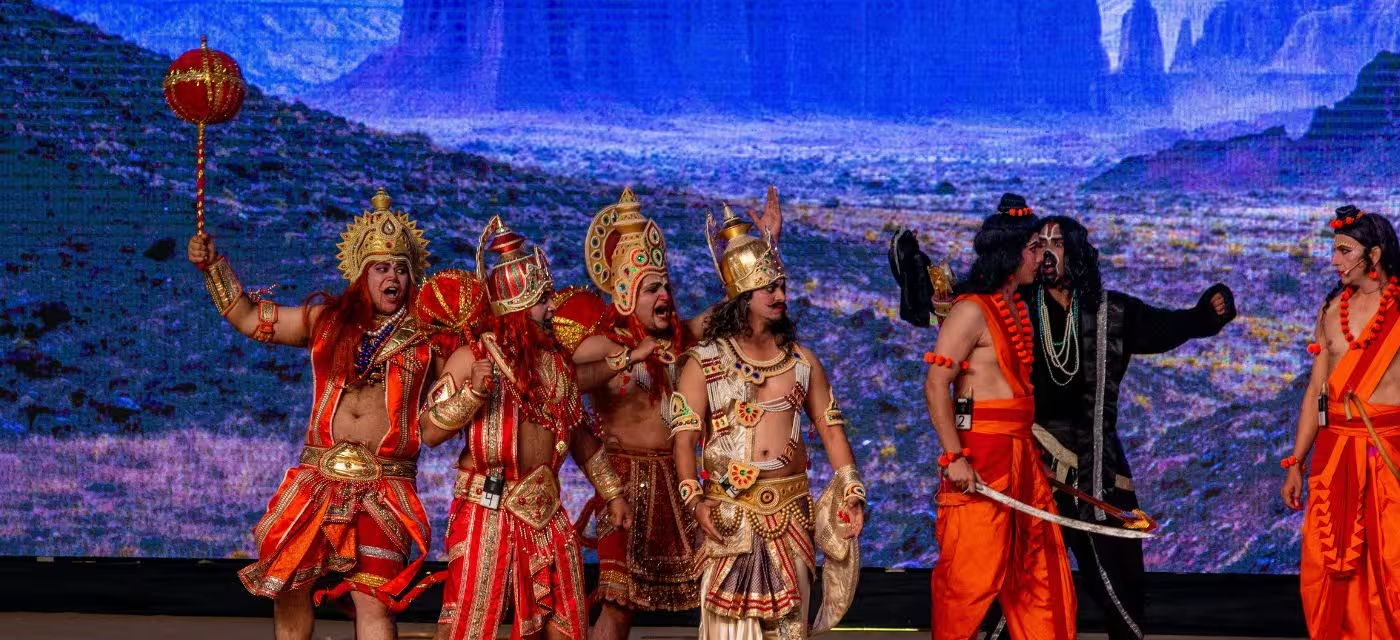
Ramlila (Rama’s ‘divine play/sport’) is the dramatic folk re-enactment of Ramayana, the legendary Sanskrit epic of ancient India devoted to the glory of Rama. This staging, however, is based on Ramcharitmanas – an epic poem version of Ramayana in the Awadhi language, composed by the 16th-century Bhakti poet Goswami Tulsidas.
Ramlila dramatises the story of the life of Rama, prince of Ayodhya, and most importantly, how Rama vanquishes and kills the mighty demon king Ravana, ruler of Lanka, to rescue his wife Sita, who has been abducted by Ravana.
Rama conquers the kingdom of Lanka with the help and support of Lord Hanuman, the quintessential yogi, monkey deity, and ardent devotee of Rama, and his army of monkeys.
The Ramlila performance comprises a series of scenes that include song, dance, narration, recital, and dialogue. It is performed in innumerable towns and cities across northern India during the festival of Dussehra, held each year during the autumn season.
The Ramnagar Ramlila is considered one of the most representative Ramlilas in the region.
The Ramlila at Ramnagar, a small town located on the other side of the River Ganges from the ancient pilgrimage city of Varanasi, was a tradition started by the ruler of Varanasi, Maharaja Udit Narayan Singh, in 1830.
Later, his successor Maharaja Ishwari Prasad Singh took the Ramlila out of the Ramnagar Fort, the residence of the royal family, and into the town.
Though Ramnagar itself is tiny, only five sq. km. in area, it holds a very important place in the hearts of those who belong to Varanasi because it is the erstwhile seat of power of their beloved and revered Maharaja Vibhuti Narayan Singh, or Kashi Naresh.
A Giant Open-Air Stage
The Ramnagar Ramlila is one of the oldest Ramlila performances in the world. It begins on Anant Chaturdashi, a festival in the Hindu lunar month of September or October, and continues for 31 days.
During these thirty-one days, the whole town becomes a giant open-air stage for the performance – a joyous outdoor pageant.
There are different designated locations for each place mentioned in the Ramayana, such as Ayodhya, Lanka, Janakpur, and others. The sets are lavish and the visuals spectacular.
An interesting fact about this Ramlila is that the entire performance is staged under the light of traditional lamps, and characters use their own voices, without microphones – just as it was when the tradition began nearly 200 years ago.
Also, the entire Ramcharitmanas is recited and performed instead of an abridged production.
This is a processional performance. As the play progresses, men, women, and children move along with the performers to the next location, accompanying Rama from his exile to his victorious return to Ayodhya.
They are invited to sing and take part in the narration.
Noting these unique features, UNESCO has acknowledged Ramlila as the “masterpiece of the oral and intangible heritage of humanity”.
It was inscribed in 2008 on the Representative List of the Intangible Cultural Heritage of Humanity.
A Living Tradition
Throughout all 31 days, people from Varanasi go to see the Lila, which is mostly staged late at night.
They walk or take two-wheelers to the Ramlila venue daily from the city after crossing the Ganga. Visitors and tourists from other countries are not uncommon, as people come from different parts of the world to watch the enactment.
Every day, the Lila starts with the aarati ceremony. On some important days, Kashi Naresh and his convoy travel in a parade through the entire town and then take the blessings of Lord Rama and Sita.
Young boys play the characters of Rama and his three brothers and their wives. Roles such as Hanuman and Ravana are played by senior artistes.
During this period, hundreds of sadhus, called Ramayanis, descend on Ramnagar to watch and recite the sacred Ramcharitmanas text.
The preparations for Ramlila begin two months in advance with a dedicated team that also includes priests. They are given the task of choosing the characters from among local actors.
Important roles are often inherited by the same performing families, such as the role of Ravana. The priests recite couplets from the Ramcharitmanas during the enactment.
Kshir Sagar Jhanki
On the opening day of Ramlila, Kshir Sagar Jhanki (jhanki is a tableau of frozen iconic moments) is recreated in the Ramnagar pond.
In this episode, Lord Vishnu is lying on the Shesh Shaiiya (Snake Bed), while Goddess Lakshmi is sitting near him in Kshir Sagar.
Then comes an Akashvani (‘celestial announcement, or voice from the sky/heaven’):
“I will be reborn as Ram in Raghukul for the elimination of demons.”
At the end of each episode, an aarati is performed and people chant “Har Har Mahadev” and “Bolo Raja Ramchandra ki jai”.
The Final Triumph
On the last day, the festivities reach a crescendo as Rama kills the demon king Ravana.
The towering effigy of Ravana, crafted using metal and bamboo sticks and lots of firecrackers, is set aflame by ‘Lord Rama’, who shoots an arrow lit with fire at the tip to burn it.
Ramnagar ki Ramlila is the most traditional Ramlila in the whole world and has been a subject of study by scholars and historians worldwide.
It is an extraordinary theatrical and religious tradition that brings together performers and spectators, people and communities, in a seamless celebration without distinction of caste, religion, or age.
Immerse yourself in the rich and vibrant experience of this visual marvel with its gods, goddesses, kings, queens, sages, demons, and monkeys; effigies, masks, costumes, make-up, and lights; sadhus, pilgrims, tourists, and thronging, surging crowds.
Related Posts