 English
 Deutsch
 Italia
 August 27, 2026 By admin
Onam Festival Kerala Pulikali Onsadhya
THE RETURN OF THE KING
When Maveli, our King, rules the land,
All the peoples form one casteless race.
And people live joyful and merry;
They are free from all harm.
There is neither theft nor deceit,
And no one is false in speech either.
Measures and weights are right;
No one cheats or wrongs the neighbour.
When Maveli, our King, rules the land,
All the peoples form one casteless race.– Maveli Nadu Vaneedum Kalam
(Onam song translated from Malayalam)
THE LEGEND OF ONAM
The story goes that Mahabali, an asura (demon) king who once ruled Kerala, was an exemplar of compassion, benevolence, and good governance. The land prospered and his subjects were happy, peaceful, and content. So popular was the beloved king that even the devas (gods) were jealous of him and felt threatened. They plotted to dethrone him and end his reign.
Lord Vishnu (one of the holy trinity in Hinduism) assumed the form of a vamana (dwarf priest) and went to Mahabali’s court to seek his help. He requested the king to gift him three steps worth of land, to which Mahabali immediately agreed. Then, Vishnu grew in size and covered the entire world in two steps. When he asked the king where he could take the third step, Mahabali, seeing that he was unable to fulfil his promise, offered his head. Vishnu stepped on his head and pushed him to the netherworld.
But Mahabali’s subjects yearned to see him again. Vishnu, moved not only by their loyalty but also Mahabali’s humility, granted him the special privilege to visit them once a year – on Onam – to ensure their well-being.
This is the story of the eternal homecoming of a mythical, righteous, courageous king who has lost his home and land. Onam commemorates and celebrates his return in a joyous annual reminiscence. It recalls the sacrifice of Mahabali, his devotion, his dignity, and his ultimate redemption. Onam welcomes the spirit of a great king and assures him that his people are happy and wish him well.
ONAM
The 10-day harvest festival falls during the Malayalam month of Chingam (August–September). On the first day, festivities begin with Athachamayam, a carnival in Tripunithura town of Ernakulam District.
The procession to the Tripunithura Fort is led by caparisoned elephants, spectacular pyrotechnic displays, and numerous folk art and music performances.
The Vamana Temple in Thrikkakara (literally ‘the place where the lord set his foot’), believed to be the ancient capital of Mahabali’s kingdom, is also a site of revelries.
To welcome the advent of Mahabali, people make exquisite floral designs using fresh flowers (pookalam) in front of their houses. Near the pookalam, they place an idol of Thrikkakara Appan (Lord Vishnu in the form of Vamana) or Mahabali. A song in praise of Mahabali’s illustrious reign is a must on Onam.
THIRUVONAM
The festivities increase with each passing day and culminate on Thiruvonam, the tenth and most auspicious day of Onam.
On Thiruvonam, special prayers are performed in the house; clay-moulded figures of King Mahabali are painted red, decorated, and placed in the front courtyard and other important places in the house; and offerings are made to the deity.
Members of the household, clad in onakodi (new clothes), thank the deity for his bounties and pray for his blessings in the year to come. The male members chant loudly as part of a ritual called Aarppu Vilikukkal. Thereafter, the entire family visits local temples where special prayers are held.
ONASADHYA
Most will agree that the biggest (and best!) highlight of Onam is the onasadhya (or simply, sadhya), a sumptuous multicourse traditional vegetarian meal served after other rituals are completed.
Usually served as lunch, the traditional sadhya consists of as many as 26 different dishes that include parboiled pink rice, side dishes, savoury items, pickles, and dessert spread out on a fresh plantain leaf. The Onasadhya refers to the Sadhya served on the Thiruvonam day, the most auspicious of the four days during the festival.
Before people sit down for the feast, all the food items prepared in the house are placed before the deity as an offering.
The traditional onasadhya should have all the seven tastes – sweet, sour, bitter, salty, pungent, astringent, and alkaline.
Here are some onasadhya essentials:
- Avial: A blend of vegetables, coconut paste, and green chillies seasoned with fresh coconut oil and raw curry leaves.
- Thoran: A dry dish made from minced string beans, cabbage, radish or grams, mixed with grated coconut and sautéed with a dash of red chillies and turmeric powder.
- Olan: Pumpkin or ash gourd and red grams cooked in a thin gravy of coconut milk.
- Parippu: Lentil curry.
- Sambar: Vegetable stew in which any available combination of vegetables are boiled in a gravy of crushed lentils, onions, chillies, coriander, turmeric, and a little asafoetida.
- Kalan: Vegetables in a yoghurt-based curry.
- Pappadam: Large round crisps made from black gram flour.
- Achaar: Mango or lime pickle.
- Inchi kari: A digestive curry made with ginger, green chillies, tamarind, and jaggery.
- Kaaya varuthathu: Banana chips.
- Sarkara varatti: Fried jaggery-coated bananas.
- Puli inchi: A rich brown, hot and sweet chutney.
- Kichadi: Sliced and sautéed cucumber or ladies finger in curd, seasoned with mustard, red chillies, and curry leaves in coconut oil.
- Pachadi: Made with vegetables, yoghurt, coconut, ginger, and curry leaves, and seasoned with mustard.
- Paayasam: A pudding of rice, sweet brown molasses, coconut milk, and spices, garnished with cashew nuts and raisins.
- Pulisseri: Seasoned buttermilk with turmeric powder and green chillies.
- Rasam: A mixture of chilli and peppercorn powders, boiled in diluted tamarind juice.
Onasadhya is more than just a feast. All the dishes are prepared in a holistic way to not only provide a complete, balanced, and nutritious meal but also ensure proper digestion and optimum absorption of nutrients by the body.
ONAM EVENTS
Onam is also the season for a host of cultural and sports events that are held across Kerala by various temples, organisations, and youth clubs.
Classical art forms such as Kathakali (dance dramas on mythological themes), folk dances such as Thiruvathirakali and Thumbi Thullal (both all-women folk dances), Kummattikali (performers wear a costume made of grass and don masks that represent mythological characters), Pulikali (literally ‘play of the tigers’), Ottamthullal (a solo poetic dance performance that takes a jab at the high and mighty), and Thiruvathira pattu (folk tales sung to music) are performed as part of the festivities.
There is a term for sports and games traditionally associated with Onam – onakalikal. Thalapanthukali is a popular ball game played in the southern districts of Kerala. Boat races, tug-of-war, kuttukutu, attakalam and kayyankali (both combat games), and ambeyyal (archery) are other traditional sports.
The Vallamkali (the snake boat race) is another event that is synonymous with Onam. Well-known races include the Aranmula Uthrattadhi Boat Race and the Nehru Trophy Boat Race.
PULIKALI – WHEN THE BIG CATS CONQUER THE STREETS
THE STAGE…
On the fourth day of Onam, Thrissur – cultural capital of Kerala and historic temple town – is transformed as a sea of humanity descends on Swaraj Round.
The circular road in the heart of Thrissur encircles the Thekkinkadu Maidan, a 65-acre hillock on which the Vadakkunnathan Temple, dedicated to Lord Shiva, stands.
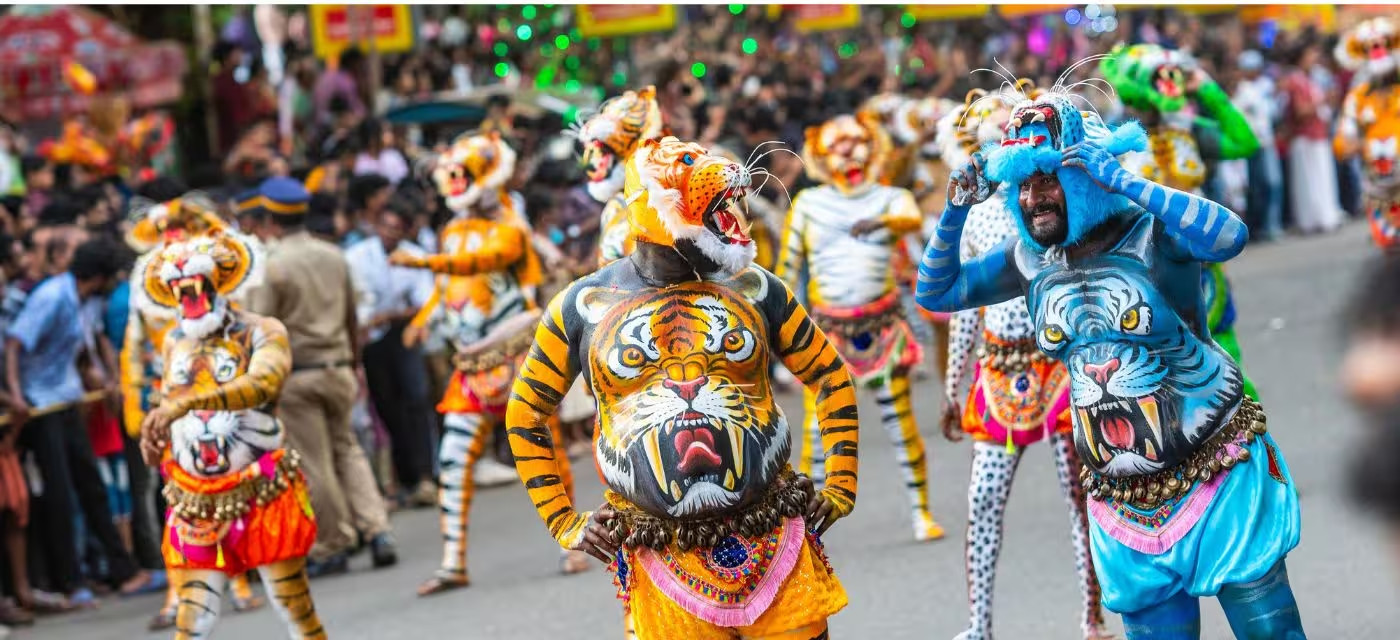
Swaraj Round sets the stage for one of Kerala’s most popular and much-loved performing art forms. For this is the day of the spectacular Pulikali – ‘play of the leopards/tigers’ or ‘leopard/tiger play’.
And believe us, nothing will prepare you for this bewitching extravaganza of people, colours, revelry, music, and dance.
THE SHOW…
Thousands of cheering, happy spectators line Swaraj Round as groups of performers dance in a grand procession down the main street, displaying stunning leopard/tiger body art replete with stripes, rosettes, whiskers, and fangs in intense hues of yellow, orange, black, white, red, pink, purple, and blue naturally extracted from charcoal, earth, spices, and leaves.
Their faces don hand-painted leopard/tiger masks with twinkling electric lights for eyes that glow like amber at sundown. And the surging crowds go crazy as they attempt to join their beloved performers in their unique dance.
TEAM DANCE…
The artistes, comprising men and boys, are divided into teams or ‘sangams’ from numerous villages in the Thrissur district.
They perform a dance on the theme of leopard/tiger hunting, playing the roles of leopard/tiger and hunter, and even enacting scenes depicting leopard/tiger and prey.
The dramatic dance mimics hunting moves and is performed to the rhythm of traditional percussion instruments such as thakil, udukku, and chenda. Eye-catching floats from each village also form part of the procession.
The best-performing team gets a hefty cash prize and the winner is judged on the basis of the best body paint art, float, and dance steps.
BEHIND THE SCENES…
But preparing to be a Pulikali ‘leopard/tiger’ is no child’s play. It calls for intense patience and an arduously long session before the performance.
The make-up for Pulikali is applied using special paints and is said to be extremely hard to remove. A particular combination of tempera powder and varnish or enamel added to a fine colour paste is used to make the paint.
First, the performers get rid of their body hair to create a smooth base for the leopard/tiger body painting. Then, a base coat of paint is applied on them. It takes two to three hours for the coat to dry (apparently in sunlight!).
After that, a second coat of paint is applied with enhanced design to create a three-dimensional effect. Final touches (jingling belted bells, masks, tongues, fangs, etc.) are then added.
The entire process takes nearly seven hours, sometimes more. All this in soaring temperatures.
Several local artists gather to apply paint on the leopards/tigers. It is a meticulous operation and often begins at the crack of dawn.
An interesting aspect of Pulikali is that since performers wear masks, facial expressions are of little significance in the dance performance.
READY TO ROAR…
By afternoon, the Pulikali leopards/tigers come out. They set off in procession, dancing, pouncing, and shaking their bellies to the beat of the drums heralding their arrival through the streets to Swaraj Round.
And the bigger the belly the better! For it shows off the painted snarling leopard/tiger face to greater effect!
The afternoon turns to dusk and the evening wears into night, the dancers glisten with sweat, paint, and excitement under the harsh floodlights, the beats pick up tempo, and dance steps become more energetic…
A CENTURIES-OLD SECULAR TRADITION…
Pulikali is a traditional folk art form of Kerala that is based on the ritual of the leopard/tiger hunt in the hills and forests of the Western Ghats.
Over two centuries ago, the ruler of the erstwhile Kingdom of Cochin and founder of Thrissur, Raja Rama Varma IX (popularly known as Sakthan Thampuran), introduced a dance that he thought would not only infuse majesty and power into Kerala’s iconic harvest festival but also represent the ferocious, free, and untamed spirit of his soldiers.
The dance was Pulikali – a leopard/tiger hunt-themed performance in which men done up in leopard/tiger body art roamed the streets in a feral dance to rustic drum beats.
Pulikali became so popular that even the Muslim soldiers of the British garrison stationed in Thrissur celebrated it with great fervour. The dance, then known as Pulikettikali, later evolved into the present-day Pulikali which continues to commemorate the martial and hunting legacy of the locals.
Pulikali performances take place across the state, although Swaraj Round in Thrissur is the oldest venue and the biggest tourist attraction, drawing people from far and wide.
To witness a performance of Pulikali is an extraordinary and uplifting experience in itself. You will be awed by its sheer spirit and the people’s perseverance to preserve this glorious art form. You will fall in love with its performers.
And discover new-found respect for their patience (AND for the artists who paint them to life) for, believe it or not, it is tough and highly competitive being a Pulikali leopard/tiger.
Onam is a true leveller. The secular character of Onam is unique to this land where, despite changing times and the rigours of the modern world, a centuries-old festival’s spirit of bonhomie that brings together people across class, caste, and faiths in unified revelry and joy… abides.
And it is to imbibe and experience this spirit that you should visit beautiful Kerala during Onam.
Ellavarkum Onasamsakal (Happy Onam to everyone)!
Pulikali is also known as Kaduvakali. Interestingly, in Malayalam, ‘puli’ means leopard while ‘kaduva’ means tiger. Hence, the depiction of both cats in imagery and dance.
Related Posts