 English
 Deutsch
 Italia
 August 27, 2026 By admin
Tea Horse Road Tibet
THE TEA HORSE ROAD: AN ASIAN ODYSSEY OF ENDURANCE AND EXCHANGE
Between the 7th century and the middle of the 20th, an intricate mesh of stone roads and mountain trails covering over 3,000 kilometres ran from the tea-laden mountains of southern Yunnan and Sichuan in China through valleys, forests, gorges, rivers, and sky-high passes onto the Himalayan plateaus to Lhasa, the 12,000-foot-high capital of Tibet; and from there to Nepal, Bhutan, Sikkim, and so on, before reaching the Indian subcontinent.
This highway through the sky was called the Tea Horse Road.
One of the longest, harshest, and most dramatic trade routes of the ancient world and in Asia, the Tea Horse Road (or Southwest Silk Road) was a crucial corridor of commerce and exchange between China and Tibet, linking two different cultures, economies, and kingdoms. It was also the oldest tea trade network in the world.
Few tea drinkers know the story of how tea spread to every nation from its origin in the mountains of China.
HOW IT ALL BEGAN…
It was sometime in the 7th century that the Tubo Tibetan kingdom discovered tea. Initially acquiring a taste for its warmth-inducing and therapeutic properties in a severely cold climate, Tibetan royalty and nomads alike soon developed a craving for it – one that persists to this day! However, Tibet’s high elevation made it impossible for them to grow it themselves.
China had the tea Tibet wanted. In fact, raw tea was considered so precious at the time that it was worth more than porcelain or silk! Tibet also had something China desperately needed: horses. In order to protect its empire, China wanted Tibet’s sturdy steeds for its Imperial Army. They were the best to take into battle against fierce nomadic tribes from the north, predecessors of Mongol emperor Genghis Khan’s troops.
Trade began – Chinese tea for Tibetan warhorses. And that is how the ancient Tea Horse Road got its name.
There were two main routes to Lhasa, from two different sources, both in southwestern China. The longer, and original, began in the tea mountains of Xishuangbanna, close to the Myanmar border, in China’s Yunnan province. Most of it converged first in the town of Pu’er, now called Simao, that gave the tea its name. The second route began in Ya’an, another major tea-growing region, in Sichuan province; it eventually joined the Yunnan route before continuing through the mountains into Tibet.
AN EPIC JOURNEY
Horse, mule, and yak caravans, and human porters inched up the long and unforgiving route, battling blizzards, frostbite, thieves, and hunger upon the world’s highest plateau to transport this treasured commodity in what now places it amongst the greatest odysseys made by man.
Chinese porters, both men and women, regularly carried 70–90 kg of tea from factories and plantations in Sichuan. Then, at a designated point, the tea was sewn into waterproof yak-skin cases and loaded onto the pack animals.
The gruelling journey – anywhere between three to seven months – took them out of China’s bountiful valleys, across the wind-beaten, snow-laden Tibetan Plateau, forded the freezing Yangtze, Mekong, and Salween Rivers, into the daunting Nyainqentanglha Mountains, ascended four killer 17,000-foot passes, and finally descended into Lhasa, where the magnificent Potala Palace, former residence of the Dalai Lama, commanded the view as the caravans neared the holy Tibetan city.
The exchange? A single horse for 60 kg of brick tea.
BRICK TEA
The tea bound for Tibet along the Tea Horse Road was the crudest form of the beverage. The shengcha or green tea loved by the Chinese royals was impossible to keep green and fresh en route, and so zhuancha, fermented Pu’er tea, developed.
The tea bound for Tibet was typically pressed into discus-shaped cakes or bricks, called bing, and wrapped only in bamboo leaves to protect it from the elements. By the 11th century, brick tea had become the prime trading commodity between China and Tibet.
Tibetan brick tea is extremely bitter and least smooth. To this day, it is made from the plant’s large, tough leaves, twigs, and stems. After several cycles of steaming and drying, the tea is blended with glue-like rice water, pressed into moulds, and dried. Bricks of black tea are still sold throughout modern Tibet.
PU’ER TEA
Xishuangbanna in the deep south of China’s Yunnan province is the heart of the Tea Belt, which stretches from Assam to northern Vietnam. It is here that the special Pu’er tea is grown. Starting in the 7th century, this is the tea that inspired and launched the Tea Horse Road.
Pu’er tea’s uniqueness comes from post-fermentation – unlike other teas, it continues to ferment even after packing.
The lightly flavoured tea bricks that left Yunnan were carried on horseback along the Tea Horse Road and continued to ferment along the road, developing a strong flavour and aroma which appealed to Tibetan tastes.
En route, the green tea turned to dark tea, and the taste became vibrant, richer, and fruitier. This final version of the tea, known as Pu’er, became highly sought-after by royalty, nobility, and tea connoisseurs alike, not only for its distinct flavour but also for its health benefits.
BUDDHA ON THE ROAD
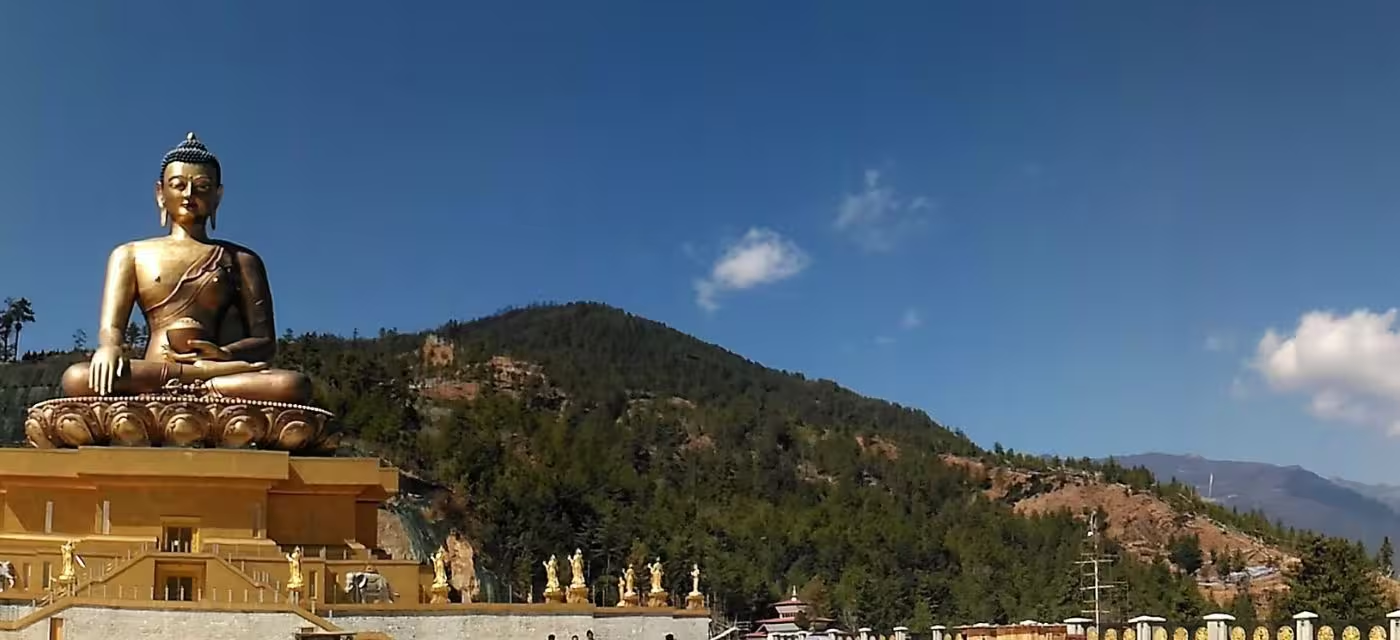
Buddhist monasteries dot the route. Buddhism reached the region at about the same time as the Tea Horse Road began – that is why religion, culture, and tea are deeply interlinked here. Monasteries influenced the trade in Tibet, and the ancient passageway connected the important monasteries.
You can only imagine the length and range of the Tea Horse Road when you discover that it covers, from south to north, all three great schools of Buddhism – Theravada in the south, Mahayana in central Yunnan, and Tibetan Buddhism in the north – resulting in different monastic architectural styles as well as an explosion of imagery, iconography, and ceremony in each region.
PUREBREDS AND FESTIVALS
The spectacular Nagqu Horse Festival celebrates Tibet’s equestrian heritage. At this centuries-old summer gathering on the Tea Horse Road in northern Tibet, jockeys race Nangchen purebreds – long prized for their speed and stamina.
Through centuries of selective breeding, the Tibetans created a choice horse called the Nangchen. Standing only 13.5 hands high, fine-limbed and handsome-faced, with enlarged lungs adapted to life on the 15,000-foot-high, oxygen-deprived Tibetan Plateau, the Nangchen steeds were bred to be tireless and sure-footed on snowy high-altitude passes. These were the horses coveted by the Chinese centuries ago.
Nagqu, 320 km away from Lhasa, is known for its vast, lush, beautiful grasslands, resting high at 4,507 metres. Here, between mid-July and mid-August, Tibetans from across the country arrive in happy hordes. Dressed traditionally and stunningly adorned, they gather here a few days before the opening ceremony of the Festival to set up their tents around the horse-racing tracks.
Combining true competitive spirit and extraordinary performances in a single colourful event, the Nagqu Festival tests the ability of the rider and the power and stability of the horse in short- and long-distance races.
Enjoy marvellous horsemanship and interesting events such as archery competitions, rifle shooting competitions, chopping, wrestling, stone lifting, archery on horseback, tug of war, and Tibetan operas. Yak racing also takes place here; and horses and yaks, decked in colourful cloths and striking ornaments, are the real stars of the show!
Even as the sun goes down, celebrations continue with much singing and dancing around the fire.
The 8th-century Nagqu Festival is not only a venue for Tibetan nomads to compete physically and trade farm products but also a rare chance for tourists to experience the authentic culture, heritage, and cuisine of Tibet.
THE ROUTE
In reality, a complex network of trails that evolved organically, the Tea Horse Road was neither planned nor laid out. You can trace the ancient Tea Horse Road by beginning where it all started – with Xishuangbanna in southern Yunnan.
Next comes the town of Pu’er, which was the collecting point for the tea. The other prominent staging posts on the route were Weishan, Dali, Shaxi, a UNESCO World Heritage Site, Lijiang, a UNESCO World Heritage Site, and finally Gyalthang, modern-day Shangri-La, which is one of the last stops in China before the Tibet Autonomous Region and is nearly 10,000 feet higher than Xishuangbanna.
Borderlands are especially fascinating. They are literally places on the edge, far from the main cities, and with secret parts and possibilities for exploration. Experience a rainbow of cultures on the Tea Horse Road, as you travel through towns that are home to ethnic minority nationalities who were integral to the tea-horse trade. Interacting with them will be the highlight of your journey.
By the mid-18th century, the network of trails was carrying, aside from tea, a dizzying array of goods such as silks, wool, animal hides, fur, gold, silver, salt, and much more.
The Tea Horse Road continued until the mid-20th century, when paved, motorised highways and modern railways replaced caravan travel, making the transport of tea and other goods faster and easier.
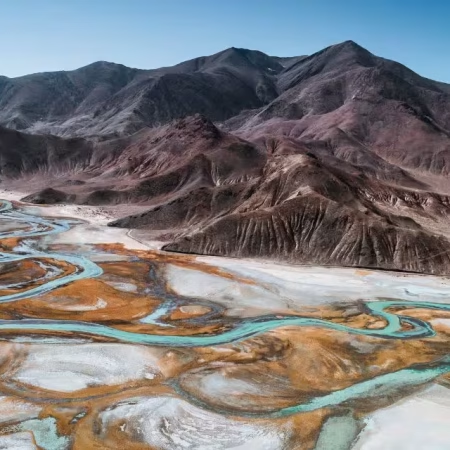
Today, although no longer used as a trade route, this ancient road, plied for 13 centuries by horse caravans, continues to be a treasure trove of outstanding natural beauty and incredible cultural diversity.
Explore this fascinating history of exchange and prosperity against the magnificent background of the region’s landscape that brought this route so close to heaven. For vestiges of the trail reveal grand vistas – and a surprising new exchange.
FOR YOUR INTEREST
Tibetan Butter Tea
Butter tea, known as Po cha, is prepared from churning tea, salt, and yak butter. The tea used is a particularly potent, smoky type of brick tea from Pemagul, Tibet. Butter tea is drunk in quantities and at a frequency that makes it a Tibetan obsession!
Po cha is considered a nutritious drink because of its warming quality and energy-giving high calorie count. It is also said to aid digestion, keep the mind focused, and promote a healthy cardiovascular system.
Although not for the faint of heart, Tibet’s Po cha might be just what you need for your next expedition!
Tibetan Incense
Handcrafted Tibetan incense is integral to Tibetan culture, medicine, and Buddhist practice. Traditional Tibetan medicine draws on Ayurvedic practice and Buddhism from India, making use of solely natural materials such as herbs and minerals that are carefully sourced from the region’s mountains.
An important way of delivering these naturally healing substances is in the form of aromatic incense; and the Tibetan style is famed for its complex formulae that are handed down in a ‘lineage’, often originating in monasteries and Buddhist colleges.
Apart from its therapeutic properties, Tibetan incense is regarded as a source of good energy and positive forces, a protection against evil spirits. It is also said to give clear vision and remove tiredness.
Related Posts