 English
 Deutsch
 Italia
 August 27, 2026 By admin
Rajasthan Desert Blooms Forts places Wildlife
RAJASTHAN – THE DESERT BLOOMS
The word ‘Rajasthan’ (Land of the Kings) is evocative of so many elements in the Indian imaginary – deserts and sand dunes, warrior kings, fortresses, palaces, havelis (mansions), miniature paintings and frescoes, textiles, crafts, traditions of exuberant music and dance, and of storytelling, varied cuisines, festivals and fairs, and novel modes of transportation. Jaipur, Jodhpur, Udaipur, and Jaisalmer may be the most well-known, and perhaps most frequented, cities of this colourful and fascinating state, but there are innumerable other cities, each replete with rich historical detail and nostalgic tales of valour. So vast is the canvas across this state of Rajasthan, that it is practically impossible to enumerate or describe each location within it. We attempt to bring you here a representative sample of Rajasthan’s rich heritage.
The work of angels, fairies and giants… built by titans and coloured by the morning sun… he who walks through it loses sense of being among buildings. It is as though he walked through mountain gorges.
– Rudyard Kipling’s description of Mehrangarh Fort
FORTS
Rajasthan’s imposing fortresses stand testament to the power and independence of the Rajput princely states that flourished in the region from the 8th to the 18th centuries.
The six majestic hill forts in Chittaurgarh; Kumbhalgarh; Sawai Madhopur; Jhalawar; Jaipur; and Jaisalmer are together inscribed as a UNESCO World Heritage Site.
Enclosed within the walls of the forts, some of which are up to 20 kilometres in periphery, are palaces, temples, and major urban and trading centres that often predate the fortifications. Some of the civil and military centres within have survived, as have many of the temples. The forts use the natural defences offered by the landscape: hills, deserts, rivers, and dense forests. They also feature extensive water harvesting structures, largely still in use today.
Within these ‘fort cities’ there grew an elegant and extravagant courtly culture that supported learning, music, and the arts, all made possible because of a long history of royal patronage. Rajasthan’s mighty forts were built, not only to protect the defence garrisons but also to preserve the architectural and cultural glory of the ruling Rajput clans over several centuries.
The 700-acre Chittaurgarh Fort in the Mewar region rests atop a 180-metre-high hill and was originally built by the Maurya kings between the 5th and 8th centuries CE. It was occupied for some 800 years by the Rajputs, with periodic Muslim invasions. Hence, the abundance of Hindu, Jain, and Islamic constructions within. The legendary battles fought here give Chittaur its aura. It housed 70,000 people in its heyday, and faced three sieges, during each of which the women and children committed jauhar, i.e., self-immolation, in the face of defeat and dishonour.
Perched at over 6,233 feet amidst the Aravalli Hill ranges, is the spectacular Kumbhalgarh Fort which was built by Rana Kumbha of Mewar in 1448, and was occupied up until the 19th century. It is the birthplace of the legendary Mewar ruler Maharana Pratap. Kumbhalgarh was conquered only once by the armies of Mughal Emperor Akbar, helped by the kingdoms of Amer and Marwar. Its walls extend for 36 km and it towers at a height of 3,600 feet, affording sweeping views of the dusty plains; inside are precipitous stairs leading to corridors, courtyards, and pavilions.
Ranthambhore Fort (Sawai Madhopur) is situated almost exactly at the meeting point of the Vindhya and Aravalli Hill ranges in the Dhundhar region. Believed to have been built in 944 CE, Ranthambhore is considered one of the strongest forts in the country. Its strategic location helped keep the enemy at bay. The climb up to the fort’s ramparts is worth the effort for the view from the top of the Ranthambhore National Park and its three lakes.
The massive and dramatic Gagron Fort (Jhalawar) lies at the junction of the rivers Ahu and Kali Sindh in Rajasthan’s Hadoti region. Construction of the fort was begun in the 7th century CE, with additions made in the 14th century. Gagron was controlled successively by the Rajputs, Mandu Sultans, Khaljis, Mughals, Kota, and Jhalawar. The fort boasts some gorgeous doorways, arches, and pillars, and affords fabulous views from several vantage points.
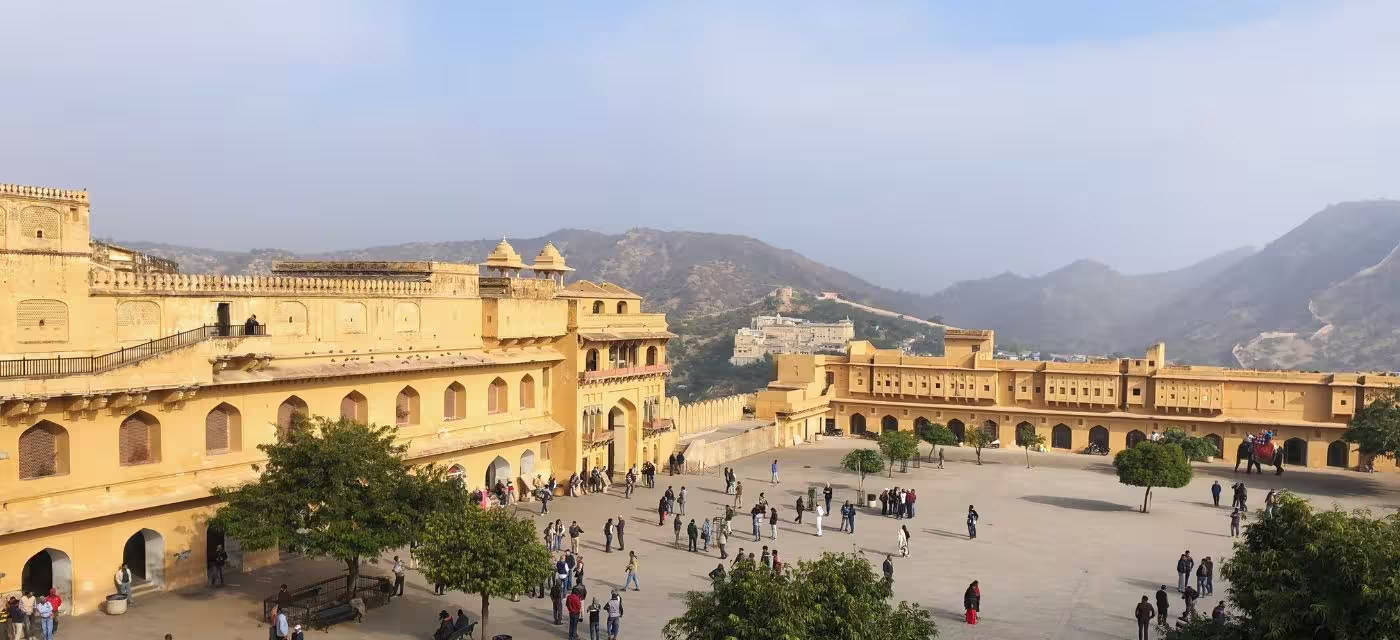
About 10 km north of Jaipur, Amer was the capital of the Kachhwaha Rajputs for 700 years (1037-1727). Amer Fort, the stronghold of the kingdom, is situated atop the city, straddling the hillside. The stunning architecture consists of features such as a beautiful red sandstone hall, a colonnade of pillars, a brilliantly hued archway, an elegant floral ceiling, and a few temples.
A visit to Jaisalmer Fort offers the visitor a blend of romance and adventure. Built from yellow sandstone that seems like blazing gold in the sunlight, the uniqueness of the iconic fort lies in the fact that it has been continuously inhabited throughout its history. Standing on a miniature hill the magnificent fort is well protected: there is a retaining wall at the bottom of the hill, a barricade encircles the hilltop, and the citadel is fronted by its legendary 99 bastions. Many gates lead into the fort, while winding stone-paved passages guide visitors further inside the stronghold. From the main square within, serpentine lanes bustling with shops, hotels, temples, restaurants, houses, and even cattle, lead to different parts of the fort.
PALACES
Rajasthan’s splendid palaces, too numerous to mention each by name here, define the state. We present here but a small selection of this vast canvas of royal heritage.
If you’re visiting Rajasthan and seeking accommodation of an exclusive kind, you will be truly spoiled for choice. With its array of majestic palaces and beautiful, historic havelis — many of which have been painstakingly and luxuriously restored — the land of kings offers a blend of splendour, heritage, culture, and the finest traditions of hospitality that will meet the standards of the most discriminating tourist or guest. Heritage properties are not only the pride of Rajasthan but also a source of revenue for the state through tourism. They showcase the immaculate craftsmanship of a bygone era and some exquisite art and architecture.
Umaid Bhawan Palace, Jodhpur
This magnificent construction, representative of the Indo-Saracenic style of architecture, is made of sandstone and built without the use of mortar. It was built by Maharaja Umaid Singh in the late 1920s. In 1977, his grandson, the erstwhile maharaja Gaj Singh, converted a part of it into a hotel. Today, the palace is divided into three sections: the royal apartments (closed to tourists), the heritage hotel, run by the Taj Group, and a museum.
Rambagh Palace, Jaipur
Jaipur’s most famous hotel (run by the Taj Group) is the royal family’s Rambagh Palace. Originally built in 1835, Rambagh Palace transitioned from being the royal guesthouse and hunting lodge to becoming the residence of Maharaja Sawai Man Singh II and his queen, Maharani Gayatri Devi, in the early 20th century. Today, the beautiful heritage property offers 78 superbly restored grand luxury rooms and suites, once the royal chambers. The palace retains its ornate yet refined splendour, showcasing embellishments such as hand-carved marble ‘jalis’ (latticework), sandstone balustrades, cupolas and ‘chattris’ (cenotaphs), and Mughal Gardens.
Samode Palace, Jaipur
Set among the Aravalli Hills, Samode has for long stood out in the heritage hotel circuit for being exclusive, playing host to royalty, celebrities, and artists, among others. A splendid example of regal Indo-Saracenic architecture, Samode blends the finest of Indian and Mughal styles. The 475-year-old palace, with its glittering mirrors, intricate frescoes, antique wall murals, and windows with stained glass mosaics, is a treasure-trove of some of the best-preserved art and workmanship of the Rajput-Mughal era.
Diggi Palace, Jaipur
Diggi Palace was built in 1860 by Pratap Singh Ji Diggi of the erstwhile ruling family of Diggi principality. In 1991, the palace was converted into a heritage hotel and is famous today for hosting the Jaipur Literature Fest. The two important Indian festivals of Holi (March) and Diwali (October-November) are celebrated with much fervour here, with traditional cuisine, dance and music. All guests are especially invited to experience and participate in these festivities.
Taj Lake Palace, Udaipur
The majestic and magnificent Taj Lake Palace (formerly known as Jag Niwas) is an eighteenth-century summer palace of the city’s erstwhile rulers, and is located on an island in Lake Pichola. Appearing to both rise from the waters and float on them, the Lake Palace is the centrepiece of Udaipur – itself called the ‘Venice of the East’ for its beautiful palaces, serene lakes, glorious temples, and resplendent gardens. The hotel has 65 luxurious rooms and 18 grand suites that afford spectacular views of the neighbouring City Palace, Aravalli Hills, Machla Magra Hills, and Jag Mandir.
HAVELIS
Pretty much off the beaten track, Rajasthan’s Shekhawati region is now gradually receiving attention, and attracting an influx of visitors curious to see its famed frescoed havelis.
The origins of the haveli can be traced to the early 19th century, when wealthy Marwari traders who had earlier moved to the port cities of Bombay and Calcutta in quest of trade returned, either to settle or visit; and began decorating their palatial ancestral mansions with elaborate and exquisite frescoes. Scattered across thousands of kilometres, hundreds of painted havelis sought to outdo one another in opulence, colour, style, and story.
Today, these remnants of grandeur are one of Rajasthan’s best-kept secrets. No two havelis in Shekhawati are similar. The havelis are justifiably famous today because of the painstaking processes, involving different materials, layers, and techniques, in their creation. The walls of each haveli have a story to tell. The brilliant murals on the inner and outer walls, and the ceilings leap to life with intricately rendered scenes from themes such as folk mythology, historical events, religious ideas, erotica, and daily life. Often, the interior walls are seen profusely adorned with mirrors.
Although private properties, several of these ancestral havelis today have been beautifully restored to their former glory and transformed into heritage hotel stays: Piramal Haveli, Roop Niwas Kothi, Dundlod Fort, Morarka Haveli & Uttara Haveli, Ramgarh Fresco Hotel, Sawalka Haveli, Alsisar Mahal (the site of the Magnetic Fields festival), and Narain Niwas Castle; and into museums, mentionably, Seth Arjundas Goenka Haveli, Dr Ramnath A Podar Haveli, and Nandlal Devra Haveli.
These havelis offer rich glimpses of Rajasthani lifestyle – their musical instruments, jewellery, miniature paintings, handicrafts, traditional attire, and artefacts in stone, wood, and marble.
Sprawling mansions that they are, some of these havelis (with a hoary past!) serve as ideal locations for film shoots. A few of them even organise equestrian riding holidays and walking tours across the state.
The prosperous eighteenth-century trading town of Mandawa has well over a hundred havelis, of which the most exceptional murals can be seen in Gulab Rai Ladla Haveli, Bansidhar Nevatia Haveli, Sneh Ram Ladia Haveli, Murmuria Haveli, Double Goenka Haveli, and Mandawa Castle.
NATURE & WILDLIFE
One generally associates Rajasthan, for the most part a desert, with camels and horses – but hold on – it has its share of wildlife too! We take you through some of the state’s national parks and wildlife sanctuaries.
Keoladeo Ghana NP, Bharatpur
Every year, thousands of migratory waterfowl birds, such as the green sandpiper and cranes, visit the Keoladeo Ghana NP during the winter. The park is one of the world’s richest, most fascinating and spectacular bird reserves. Formerly known as the Bharatpur Bird Sanctuary, Keoladeo is recognised as one of the world’s most important bird breeding and feeding grounds. In the 1850s, it was a royal hunting reserve used by maharajas and the British. In 1982, Keoladeo was declared a national park, and in 1985 it was inscribed as a UNESCO World Heritage Site. The park is home to over 370 species of birds, and animals such as the basking python, deer, nilgai, and more. Explore the park on either foot, cycle or rickshaw.
Desert NP, Jaisalmer
The Desert National Park is an excellent example of the Thar Desert’s ecosystem and its diverse wildlife. An area of 3,162 sq.km was declared a sanctuary in 1980 to preserve this fragile ecosystem. The Desert NP comprises undulating sand dunes, jagged rocks, dense salt lake bottoms, and inter-medial areas. The two biggest attractions here are the highly endangered Great Indian Bustard, and the chinkara. The other animals to look out for include the black buck, desert cat, monitor lizard, spiny-tailed lizard, saw-scaled viper, and desert fox. Birds include partridges, sand grouses, bee-eaters, bulbuls, and doves. In the winter, migratory birds such as demoiselle cranes, common cranes, Himalayan and Eurasian Griffon Vultures, Eastern Imperial Eagle, and the Saker Falcon arrive here. Birds of prey include tawny and steppe eagles, long-legged honey buzzards, falcons, and owls.
Sariska NP, Alwar
The Sariska Tiger Reserve, the first tiger reserve in the world to have successfully relocated tigers, was declared a sanctuary in 1955 and became a National Park in 1979. Visitors can look forward to this wonderful elevated forest in the Aravalli Hills, teeming with wildlife and birds. Sariska is home also to jungle cats, rhesus macaque, sambhar, chital, and wild boar. Bird species include sand grouse, harbour quails, and crested serpent eagles. The reserve is home to over 220 species of birds with migratory birds from Europe, Central Asia, and other regions. Go on a Jeep safari to fully explore Sariska’s natural beauty, abundant wildlife, and exotic birdlife.
Kumbhalgarh WLS, Kumbhalgarh
The green tracts of the Kumbhalgarh WLS (2 km from the Kumbhalgarh Fort) divide the regions of Marwar and Mewar. The sanctuary’s diverse topography – with ranges that loom at nearly 3,500 feet and flowing rivers – only adds to its charm. The WLS is home to wildlife such as four-horned antelopes, leopards, panthers, jungle cats, hyenas, jackals, nilgai, sambhar, chausingha, chinkara, hares and sloth bears. There’s a crocodile farm and birdlife at Thandi Beri Lake. You can even observe the wolves here. Jeep safaris are the best way to explore the WLS. The hilly terrain is ideal for trekking and has some popular trails. Remember though, to always go accompanied by a guide or forest guard.
Mount Abu WLS, Mount Abu
The sanctuary sprawls across 288 sq.km. It is a birdwatcher’s paradise, with over 250 species of birds. Wildlife includes the leopard, chinkara, sloth bear, wild boar, and langur. There are nature trails within the sanctuary that make for lovely hikes.
Jhalana Safari Park & Leopard Reserve, Jaipur
Few know that Jaipur is an exciting wildlife destination too. An initiative of the Rajasthan Government and declared a protected area, Jhalana (a 15-minute drive from the centre of Jaipur) is spread over an area of 24 sq.km, and is home to over 20 leopards. Leopards are not easy to spot, because they are stealthy and shy. The small park is immensely rich in flora and fauna, with the rocky Aravallis bordering it on one side and a forest of evergreen and deciduous trees stretching over its boundary. Jhalana is also home to the chital, nilgai, striped hyena, desert fox, golden jackal, chital, Indian palm civet, jungle cat, several panthers as well as a variety of snakes. The park is a bird watcher’s paradise too, home to birds such as the peacock, Indian Pitta, Dusky Eagle, Owl, Spotted Owlet, Indian roller, sikra, hawks, and white-eyed buzzards.
Rajasthan is a compelling mix. Few other states perhaps in India exude such flamboyance of character and joie de vivre which transports the visitor to a world of romance and royal grandeur. Welcome to this land of enchantment. Discover, explore, and experience.
Related Posts