 English
 Deutsch
 Italia
 August 27, 2026 By admin
Jaisalmer Golden City Thar Desert
JAISALMER – PARADISE ON THE WESTERN EDGE
The desert, when the sun comes up. I couldn’t tell where heaven stopped and the Earth began.
– Tom Hanks
Jaisalmer, the ‘Golden City’ of Rajasthan, a sudden spectacle in the famed Thar Desert, is considered one of the most romantic places in India, exotic for foreign as well as Indian tourists. The very name ‘Jaisalmer’ conjures up visions right out of an Arabian Nights fable.
This little remote habitation – remote for its location on India’s westernmost fringe – near the present-day India-Pakistan border, was for centuries a trading outpost, through which trains of camels journeyed across daunting desert terrain to Afghanistan and West Asia, laden with silver and cloth, among other items.
In 1156, Rawal Jaisal, a Rajput ruler, founded the Jaisalmer of today and began the construction of a fort here, to which substantial additions were made by subsequent rulers.
JAISALMER FORT
Jaisalmer Fort, immortalised as an ethereal yellow-sandstone vision, is an iconic symbol of the city. Rising like a castle from the sands of the Thar, the fort is a breathtaking sight – proclaiming its presence with a golden glimmer in the sunlight. The uniqueness of the ancient fort lies in the fact that it has been continuously inhabited by the people of the city throughout its history.
On first sight from the outside, Jaisalmer’s signature landmark looks small – a fragile structure built on a miniature hill. It is only when you approach it that you see how well fortified it really is: there is a retaining wall at the bottom of the hill; a barricade encircles the hilltop, and the citadel is fronted by a chain of 99 imposing bastions.
The first of the many gates that lead into the fort is at Gopa Chowk. Winding stone-paved passages guide visitors further inside the stronghold. Hawapol, the last of the archways, opens into the main square known as Dussehra Chowk, which is right below the Rajmahal.
From here, serpentine lanes bustling with shops, hotels, restaurants, temples, houses, and even cattle, lead to different parts of the fort. The many rooftop restaurants here are great spots where you can enjoy the breeze and the vistas out to the desert.
Beneath the ramparts of the fort, especially to the north, as one walks through the old city, the narrow lanes suddenly reveal here and there splendid havelis (traditional mansions, ornately decorated), all built from the same brilliant-hued sandstone as the fort. No wonder Jaisalmer is described with pride as the Golden City.
The Jaisalmer Fort is inscribed as a UNESCO World Heritage Site.
RAJMAHAL
Rajmahal is the palace of the former rulers. It soars above Dussehra Chowk, the square where the people of Jaisalmer would assemble to meet their king. Rajmahal was constructed over several generations and has structures that are connected by low and narrow passageways, evidently a protective measure against invaders. The main building dates back to the 19th century and is noted for its lattice work.
JAIN TEMPLES
The seven Jain Temples inside the fort are all carved in yellow sandstone and were built in the 15th-16th centuries. The most striking of these is the Parsvanath Temple. The entry to it is through a carved torana (an ornamental archway seen in Hindu, Buddhist, and Jain architecture) with an image of Parsvanath (one of the 22 Jain saints known as teerthankaras) at its summit.
The mandapa (a porch-like structure through a gateway) is a spectacular structure. Its ceiling has a sculpture that depicts a demon-like head with five bodies. As you walk around gazing up at the ceiling, the head seems to connect in turn with each body!
In the tiny Gyan Bhandar, under the Sambhavanath Temple, hundreds of antique, priceless palm-leaf manuscripts and paintings are preserved. The Rishabhdev Temple has beautiful sculptures, especially those of the apsaras (beautiful celestial maidens) on its pillars.
The other important temples are Chandraprabhu, Shitalnath, Shantinath, and Kunthanath.
PATWON-KI-HAVELI COMPLEX
The merchants of Jaisalmer built some of the most lavish and opulently decorated residences in the region, using yellow sandstone. The striking feature of these havelis is the intricate jaali (trellis) work, incorporated to allow ventilation.
The biggest and most remarkable of the havelis is the Patwon-ki-Haveli, a series of five houses adjacent to each other, built by five Jain brothers in the first half of the 19th century. The houses are perhaps the last truly outstanding Indian edifices, constructed with barely any trace of European influence.
The multi-storeyed havelis are constructed in the traditional style of rooms set around a central courtyard. Some vestige of exquisite paintings remains on some walls, while graceful jharokhas (a type of overhanging enclosed balcony typical of the architecture of Rajasthan) open into the courtyard or the street.
The havelis boast good ventilation and are built entirely from stone, which picks up heat very slowly even in the searing sun of the desert, thus keeping the interiors cool.
Two of the havelis are government-run; a ticket grants you access to a few of their empty rooms. Another haveli has been converted into a crafts shop which sells brocades and embroidered textiles. Yet another haveli is a private residence. The privately run Patwa Haveli Residential Gallery is worth a visit.
GADISAR LAKE
Originally called Ghadasisar, this tank – the source of water for Jaisalmer – is located just outside the city. Gadisar Lake was created in the 14th century by Maharawal Gadsi Singh to collect precious rainwater. Today, the Indira Gandhi Canal supplies water to the lake, ensuring it never runs dry.
Gadisar Lake is a tourist attraction and a popular picnic spot. A domed pavilion stands in the centre of the water, and a series of similarly built pavilions and shrines line the lake.
CAMEL SAFARIS
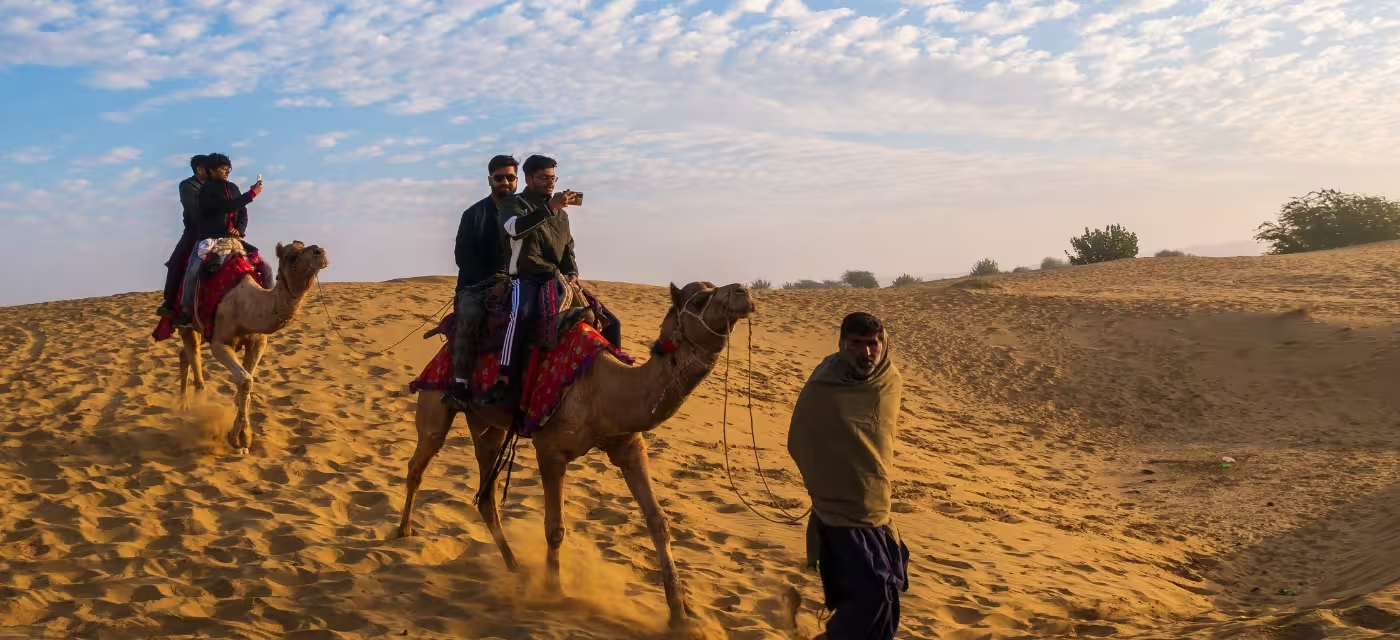
A trip to Jaisalmer would be incomplete without a visit to the vast Thar Desert. You can camp here, enjoy exhilarating camel safaris, or spend the crisp cold of the desert evenings sitting by a bonfire under the magnificent canopy of the desert sky.
A camel safari is an experience comparable to no other. You can take a Jeep to the glorious Sam Sand Dunes, 41 km west of Jaisalmer. About two kilometres long, the silky dunes are among the most picturesque and popular in the region.
Explore the area for an hour or more on camelback and return to your camp or hotel. Alternatively, you can choose to ride for several days, accompanied only by a camel driver and the most basic provisions!
Jaisalmer continues to inspire storytellers, be it through cinema or through still images and books. One of the several films made with Jaisalmer as the centre of their stories is Sonar Kella (Golden Fortress). This celebrated film in Bengali was made in 1974 by the internationally acclaimed director and Oscar Award recipient for Lifetime Achievement, Satyajit Ray.
Sonar Kella is based on his own novel of the same name and was shot in Jaisalmer, catapulting it to global fame.
Heed the call of the camels! Come and experience the romance and adventure of this Sonar Kella!
Related Posts