 English
 Deutsch
 Italia
 August 27, 2026 By admin
Naturalist Wild India Ranthambhore Bandhavgarh
A NATURALIST IN WILD INDIA
Adopt the pace of nature: her secret is patience.
– Ralph Waldo Emerson
Ranthambhore
Situated at the junction of the Aravalli and Vindhyachal ranges, the Ranthambhore Tiger Reserve is a unique combination of natural and historical richness. It was declared the Sawai Madhopur Game Sanctuary in 1955, and was declared a Tiger Reserve in 1973 when Project Tiger was started. It became a National Park in 1981. In 1991, the adjacent Sawai Man Singh and Kailadevi Sanctuaries were added to the Tiger Reserve. The total area of the Reserve is 1473.55 sq. km.
The Ranthambhore Fort was the centre of the Hindu kingdom that was besieged by Allauddin Khilji in 1301 CE; and later he defeated Raja Hamir. This was when the Rajput women committed Sati (an ancient and now obsolete custom in the warrior aristocracy of North India in which a widow would immolate herself on her husband’s pyre or take her own life in another fashion shortly after her husband’s death) to protect their dignity from the invading army.
Later, the Fort once again went into the hands of the Rajputs and became a powerful kingdom. Mughal Emperor Akbar attacked it in 1569 and took over after 40 days of warfare. It was ultimately given by the Mughals to the Kachchawa rulers of Amber (Jaipur State) and it remained with them till 1949 when Jaipur state merged with Rajasthan. The forest surrounding the Fort was the private hunting ground of the Maharaja of Jaipur and the royal family. They preserved the wildlife for hunting which survived long enough to be covered by Project Tiger.
Ranthambhore is famous for its tourist friendly tigers and is one of the top wildlife tourist areas of India. The Reserve also has a good population of leopards, the second largest predator of this forest. However, since both cats are dependent on common resources, and the leopard is weaker than the tiger, the leopard has moved to the periphery of the Tiger Reserve to avoid conflict. Other predators are the hyena, jackal, caracal, and jungle cat.
The Reserve is dotted with several lakes and these lakes support a sizeable population of marsh crocodiles. Over the years their number has increased and the reptiles are not uncommon. The areas with the lakes are prime habitat for the tigers; and often, fights take place between the residents and intruders!
Tigress Machhali, one of the most famous and photographed tigresses of the world, was controlling the area with numerous lakes for long. She was photo documented as she fought and killed a marsh crocodile.
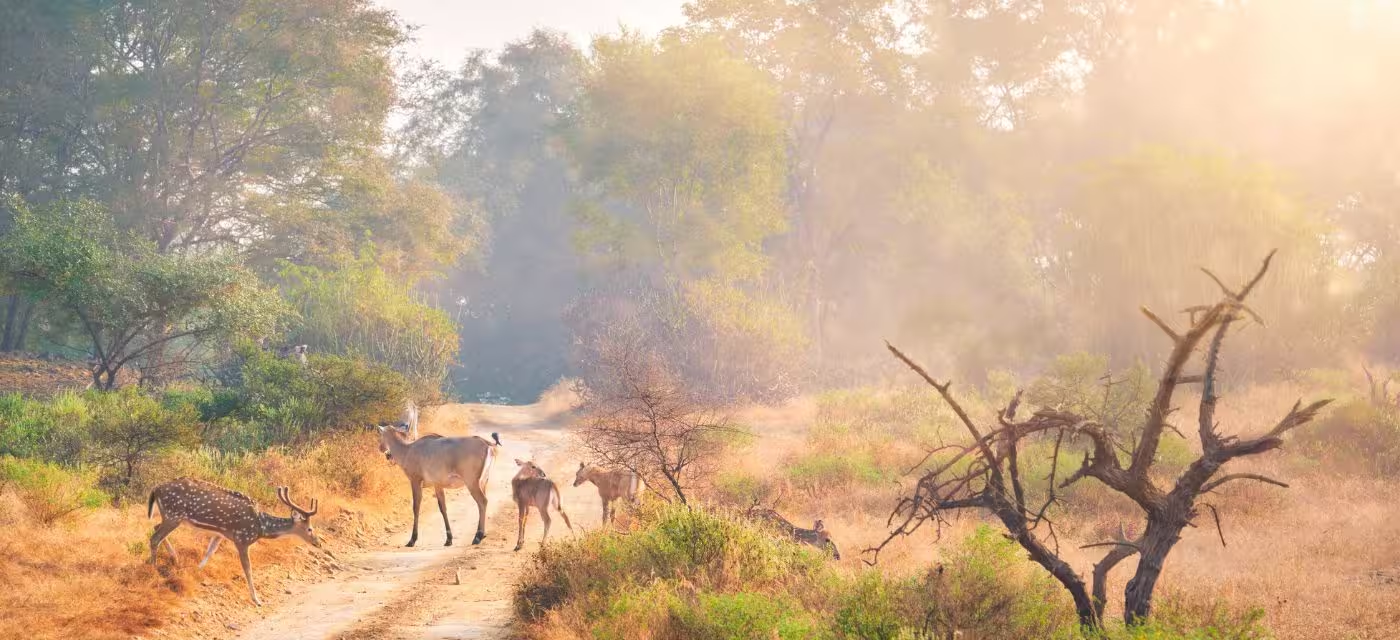
Other fauna here include the spotted deer, sambar deer, chinkara or Indian Gazelle, nilgai or blue bull, wild boar, sloth bear etc.
Ranthambhore is also famous for its avian diversity; it has more than 272 species of birds which are supported by dry deciduous forests, grasslands, and wetlands habitats. The Eastern Imperial Eagle, White Rumped Vulture, Long billed Vulture, and White Browed Bushchat are among the threatened species here.
The main entry point of Ranthambhore takes the visitors to the foot of the Ranthambhore Fort and Jogi Mahal. Near Jogi Mahal one can see India’s second largest Banyan Tree, but nowadays this area is closed for tourists. The Jogi Mahal overlooks Padam Talao which takes its name from the water lilies that grow in it. There are two more ponds called Raj Bagh Talao and Malik Talao. The lakes attract many ungulates which further attract tigers. On many occasions, tourists can witness a tiger chasing his prey in these ponds.
A hike to the Fort is also quite interesting, you can see several troupes of langurs (monkey species) jumping and climbing up its walls; and if you are lucky you can also see a leopard walking silently and stealthily on the ramparts. From the top of the Fort you can look over Padam Talao, and sometimes with a good pair of binoculars, you can even spot a tiger near the pond.
Once you enter the jungle, it starts advertising the presence of the striped predator – with the alarm calls of deer and monkeys; and yes, if you wait with patience you will certainly get good results.
Agra – Ranthambhore: Approximately six hours by road.
Bandhavgarh
Nestled in the beautiful hills and valleys of the Vindhya hill ranges of the Central Indian highlands, Bandhavgarh is a paradise for nature lovers. Although comparatively new, the tiger reserve has a long history. The forest was once owned by the erstwhile Maharaja of Rewa. It was declared a national park in 1968, at which time the park covered an area of about 106 sq. km, the present day Tala Range. In 1984, three more ranges were added to the park namely, Kalwa, Magadhi and Khitauli, with a total area of 448 sq. km. It was upgraded to the status of a Tiger Reserve in 1993.
The main area of the Park is Tala, which is surrounded by 32 hills with a magnificent natural fort at the centre. The fort’s cliffs are 800 metres high, and 300 metres from the surrounding sides. Over half of the area of Bandhavgarh is covered by Sal forests while the rest is a mosaic of mixed dry deciduous forests, bamboo forests, and grasslands. Many natural streams run through the park but only few are perennial; one of them, called Charanganga, has its origin at the base of the fort.
The forests of Bandhavgarh and its surrounding areas have been a centre of human activity and settlement for over 2000 years. The Ramayana (a major Sanskrit epic of ancient India) narrates the life of Rama the legendary prince of the Kosala Kingdom. It is believed that he stopped here (Bandhavgarh) on the way back from Lanka after defeating and killing the demon king Ravana. Two monkey architects are said to have built the Bandhavgarh fort. Later, Rama handed over the fort to his younger brother; and that is why it is called Bandhavgarh (Bandhav means brother and Garh means fort).
There are numerous manmade caves inside the reserve; they are the earliest known signs of human settlement here. The walls of the caves are inscribed in the Brahmi script, which dates back to the 1st century BCE. From that time onward Bandhavgarh was ruled by different dynasties including the Chandela kings of Bundelkhand, and later the Baghel kings who established their dynasty at Bandhavgarh in the 12th century CE.
In Central India, Bandhavgarh is undoubtedly the best place to see tigers in the daytime. Apart from tigers, the other co-predators are leopards and wild dogs. There is also a sizeable population of omnivores such as the sloth bear and wild boar. Two species of monkey, the Northern Plains Langur and Rhesus Macaque are found here in abundance. The prey species mainly consist of deer such as Spotted Deer, Sambar Deer, and Barking Deer. There are two species of antelope found in this reserve namely Nilgai or Blue Bull and Chinkara or Indian Gazelle. Recently the Indian Gaur, the largest species of wild cattle in the world, has been reintroduced here, and is now doing well.
Bandhavgarh is also home to over 250 species of birds including endangered species like the long billed vulture, lesser Adjutant, Sarus Crane, Red Spurfowl, Plain backed thrush, long tailed Minivet, and Racket tailed Drongo.
Over 600 species of flowering plants, 50 Species of Aquatic plants, and 18 species of rare plants including insectivore plants such as Drosera or Sun dew and medicinal plants such as Indian Buch or Sweet Flag, are to be found in Bandhavgarh.
A morning drive to Tala Zone of the reserve first takes you to the elephant camp that lies to the left of the road; going straight down from here, you will see a rocky outcrop with lots of fern and moss; here you might see a leopard…and if you scan the area carefully, you will see a brown fish owl. As you drive ahead, keep a lookout for the Drosera; further down the path is a shrine where local and forest department people pray for the well-being of the forest and wildlife. Soon after that you’ll see a board which says ‘the area of the tiger starts from here’… and you’ll experience a sudden adrenaline rush! From here, take a left turn and you’ll find yourself on the road which leads to the fort. Tourists are not allowed to visit the fort but one can go to see the 10th century statue of the Hindu god Vishnu reclining on his seven-hooded serpent. On the way you can see manmade caves, and if you’re lucky enough, a tiger. Coming downhill, you might hear the alarm calls of the sambar and monkeys; and if you wait patiently, a tiger will emerge from the grasslands or from the forests to quench his thirst.
Returning from all the thrill, excitement, and sightings of your jungle experience, you’ll see, near the exit gate, a board with a tiger’s photograph. It says:
“Perhaps you may not have seen me but please don’t be disappointed I have seen you”.
Khajuraho – Bandhavgarh: Approximately five and a half to six hours by road.
Sur Sarovar Bird Sanctuary & Sloth Bear Rescue Centre
Located 17 km away from Agra is a bird sanctuary (popularly known as Keetham Lake) that is home to over 300 different species of birds. The Sur Sarovar Bird Sanctuary was declared a protected area in 1991. It is one of the most prestigious and well maintained sanctuaries of the Uttar Pradesh forest department. In the Lake are about 21 islands that are exposed in the winter, when the water level goes down. The islands support 30,000 water birds in the winter. The Black crowned night Heron, grey Heron, Eurasian spoonbill, northern pintail, northern Shoveler, Bar Headed Geese, and spot billed ducks are some of the birds found here.
The Sanctuary also houses the world’s largest sloth bear rescue facility, run by an organisation called Wildlife SOS. The rescue centre houses more than 200 sloth bears rescued from the Kalandar community, which uses them as dancing bears. The centre invites volunteers to come and work for the bears, and also organises various fund raising and awareness activities.
Related Posts