 English
 Deutsch
 Italia
 August 27, 2026 By admin
Desert National Park Rajasthan Wildlife
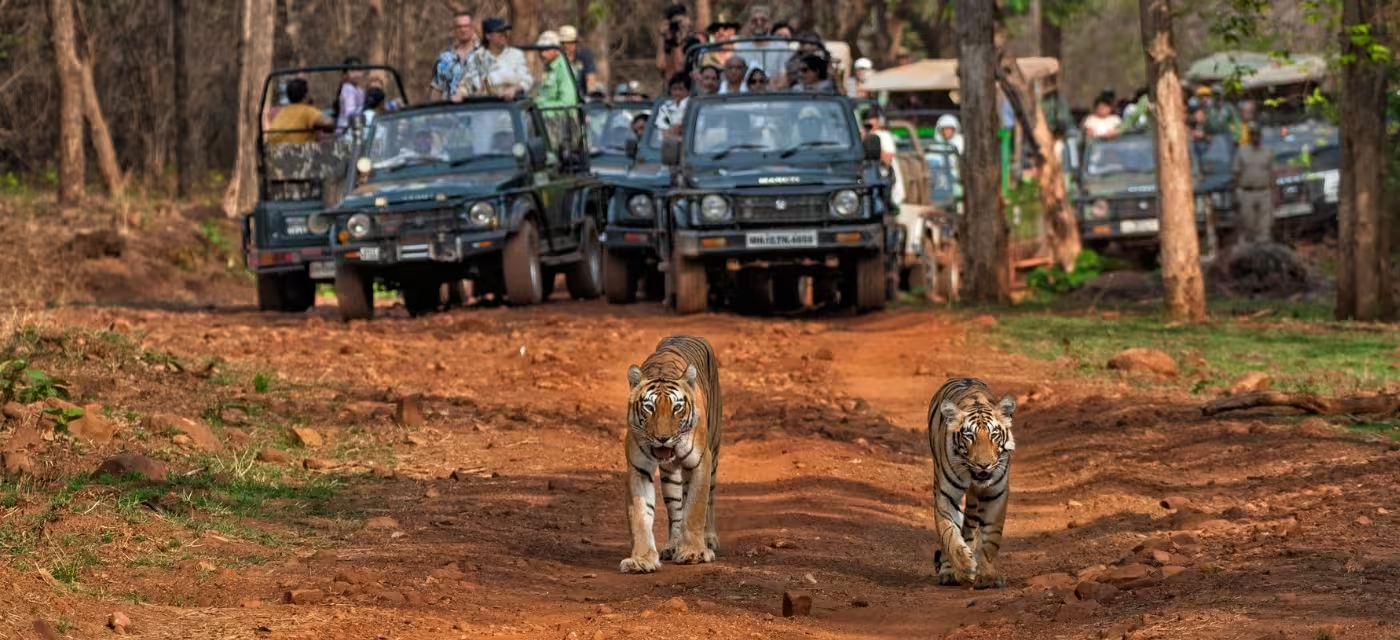
GUESS WHO’S IN THE DESERT…… NATIONAL PARK
Jackson Bentley: What is it, Major Lawrence, that attracts you personally to the desert?
T.E. Lawrence: It’s clean.
– From Lawrence of Arabia
The State of Rajasthan, ‘Abode of Kings’, is famous for its rich culture, distinct heritage, and beautiful art, and attracts tourists from all over the world. But few know that the state is also home to wonderful wildlife including some endemic and rare species.
A major part of the state is covered by desert land. This desert is called the Thar Desert, and is the smallest desert in the world. Despite its modest dimensions, the Thar is thickly populated. It occupies nine per cent of the total geographic area of India and around 208,751 sq. km. in Rajasthan State. Its location at the crossing of the Palearctic, Oriental, and Sahara regions is the reason it harbours great biodiversity.
DESERT NATIONAL PARK
To protect the unique biodiversity of this region, the state government declared an area of around 3,162 sq. km. as a wildlife sanctuary in 1984 and later as a national park, in 1992.
About twenty per cent of the Desert National Park’s area is composed of extensive sand dunes. Craggy rocks and salt lakes are another interesting feature of the park.
The park is best accessed from Jaisalmer, which is 47.2 km from the park and has the nearest airport and railway station. A proposal was submitted in 2009 to declare the park a Natural World Heritage Site for its uncommon diversity.
The Desert NP is one of the most important sites for the conservation of the Great Indian Bustard (a critically endangered species), one of the largest flying birds.
The park is a haven for both migratory and resident birds of the landscape. Several buzzards, eagles, falcons, harriers, kestrels, and vultures are spotted here. Tawny eagles, Short-toed eagles, Laggar falcons, Spotted eagles, and kestrels are the most common among these.
Sand grouse are spotted near small water bodies. Among other species of interest are MacQueen’s bustard, Greater hoopoe lark, Cream Coloured Courser, and six species of vultures including the critically endangered Red-headed or King Vulture.
The park is also important for the White-Browed Bushchat. There are some records of Green Munia as well.
DESERT FLORA & FAUNA
The Desert NP holds the typical desert flora and fauna of the Indian Thar Desert, which is part of the much larger Saharo-Sindian Desert.
Chinkara or the Indian Gazelle is the most common mammal of the region; blue bull and wild pig are the major herbivores. The Golden Jackal, Desert Fox, and in some areas the Indian Fox, are major natural predators.
The Indian Desert Cat is also found in some areas. The Desert Hare and the Long-eared Hedgehog are among the smaller mammals of the region.
A very interesting species of skink, called Desert Skink or Sandfish, is also found here as it swims or burrows through sand down to a depth of thirty centimetres.
There are over 43 species of reptiles including the Spiny-tailed Lizard, Russell’s Viper, Saw-scaled Viper, and the Bengal Monitor.
AKAL WOODS FOSSIL PARK
Nearby, the Akal Woods Fossil Park holds huge fossil remnants of tree trunks of trees such as pine, deodar, and redwood. It indicates a lush green forest that thrived 180 million years ago.
The fossil park has been declared a National Geological Monument of India. Fossils and footprints of pterosaurs have been found in the area nearby.
Related Posts