 English
 Deutsch
 Italia
 August 27, 2026 By admin
Rajasthan Festival Pushkar Nagaur Jaipur
FIESTA ON THE SUNLIT SANDS
Be happy for this moment. This moment is your life.
– Omar Khayyam
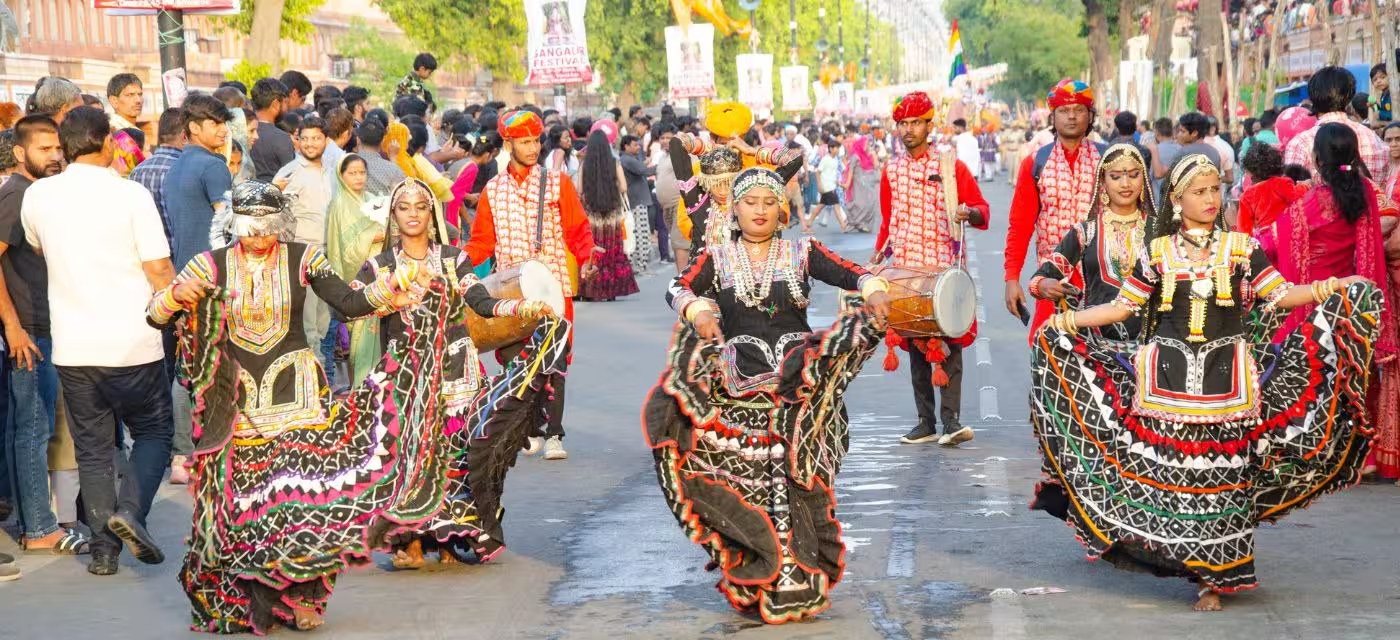
Festivals in India are all about colour, gaiety, feasting, and occasionally, fasting. The state of Rajasthan amply exemplifies the lusty spirit of Indians during these unique and fascinating celebrations. Here is a glimpse of three of Rajasthan’s popular festivals, each unique in its own way.
PUSHKAR MELA
The annual seven-day Pushkar Mela of Rajasthan, essentially a camel-and-livestock fair, held in the town of Pushkar between the months of October and November, is of international fame. It is one of the world’s largest camel fairs organised on the scale of a carnival and draws thousands of tourists from across the globe to this ancient tiny temple town.
The Pushkar Mela is remarkable for being a three-in-one festival – having three different aspects to it, that of religion, rural entertainment, and trade.
The fair, held in the grounds and dunes to the northwest of the town, is marked by races, games, and fireworks. The exhibition ground nearby is the venue for giant wheels, a circus, and eateries and shops.
Pushkar is also unique for its Brahma temple. There are very few temples dedicated to Brahma (the Creator in the Brahma-Vishnu-Siva trinity in Hinduism) in India, and Pushkar is the most prominent amongst them.
Devotees first take a dip in the Pushkar Lake and then visit the Brahma Temple. The crowds at both places can be unimaginably large; and in all likelihood you will find yourself being propelled towards the exhibition ground. The lane to the ground is lined with makeshift shops and the air reverberates with sounds of revelry. Music blares from the circus; young boys dance in drag; and the aroma of earthy spices gently wafts out of the dhabas (roadside restaurants serving local food, often seen on highways), enticing you to stop and grab a bite.
Moving past the village fair, one climbs over small dunes of sand to reach the cattle fair – horses, camels, and cows as far as the eye can reach. Scenes of mendicants playing the ravanahatha (an ancient bowed, stringed instrument played by bards and minstrels of Rajasthan); women and girls doing a dance; folk singers singing in mellifluous voices – all these greet you.
Interesting competitions such as the ‘matka phod’ (breaking the pot), ‘longest moustache’, and ‘bridal competition’ are the main draws at the fair.
The camels, however, are the stars of the show. The camels range from the old and the young, male and female, the undecorated and the bedecked. You can choose between riding on camelback (which can be a daunting experience for the uninitiated) or in a camel cart! Of course, you could always buy a camel but, are you ready to ride back on it?!
If camels don’t grab your fancy, you can get ornate swords, carved bamboo walking sticks and staffs, jootis (traditional Rajasthani footwear), ravanahatha, etc.
NAGAUR SUFI FESTIVAL
Nagaur in central Rajasthan was founded in the 4th century BCE. Its historical significance derives from its geographical location along ancient trade and invasion routes at the edge of the Thar Desert. Nagaur was also an ancient seat where Sufism flourished.
In continuation with its Sufi heritage is celebrated the World Sufi Spirit Festival in the gorgeous Ahichhatragarh Fort at Nagaur every year. The 12th-century fort is a classic example of Rajput-Mughal architecture. The Fort was restored in recent years by the Maharaja of Jodhpur’s Mehrangarh Museum Trust, which hosts the Festival.
In February, musicians, dancers, and poets from across India as well as North Africa, the Middle East, and Central Asia gather here to celebrate their traditions.
During the day, the royal pavilions, gardens, and palaces are yours to explore at leisure.
In the evenings, thousands of flickering oil lamps illuminate the ancient ramparts of the Fort, transporting one to a magical world of enchantment. The Fort’s palaces and courtyards come alive with soulful Sufi music, poetry and dance, and whirling dervishes, all making for a heady brew for the senses.
It may be mentioned here that the Sufi music festival held in the majestic Mehrangarh Fort in Jodhpur, the ancient capital of the Marwar kingdom, is a continuation of the one hosted in Nagaur.
The Sufi Festival at Nagaur/Jodhpur is not only spiritually uplifting but is also an enriching physical experience – that of exploring old-world forts and palaces, the surprises of the desert, and its unique cuisine.
JAIPUR LITERATURE FESTIVAL
Jaipur’s biggest attractions no doubt are its old forts, palaces, and bazaars. But in present-day Jaipur, there is yet another major draw every year.
Come January, authors, scholars, artists, and lovers of literature gather at its Lit Fest (the Jaipur Literature Festival) in huge numbers from across India and the globe. There are exciting book readings, talks by authors, and lively discussions around their books throughout the five-day literary extravaganza.
The Festival provides a significant platform for the free expression of ideas by a cross-section of the country’s noted writers and others including those from the world of academics, politics, business, sports, films, etc.
It takes place in the elegant Diggi Palace, located in the heart of Jaipur. Diggi Palace was built in 1860 by Pratap Singh Ji Diggi of the erstwhile ruling family of Diggi principality. In 1991, the palace was converted into a heritage hotel and is famous today for hosting the Jaipur Literature Fest.
Rajasthan is, as you can see, a many-splendoured land, offering you a kaleidoscope of scenes, sensations, and memories.
Pack your bags now, and ‘ho’ for Rajasthan!
Related Posts