 English
 Deutsch
 Italia
 August 27, 2026 By admin
India Celebrating India
India Celebrating India
India is a country in which every great religion finds a home.
— Annie Besant
Hardly a day goes by in India without a beating of the victory drum in one of its innumerable regional forms, or an obeisance to the myriad facets of the great goddesses, or a splintering of firecrackers in the sky; streets resonating with the stamping of hundreds of feet in their oneness, a gifting of new garments, or a sharing of warm milk and fragrant rice; sacred days that mark blessed beginnings to the new year, fasting and feasting, or nights illuminated by the dancing flames of thousands of lights… In this land of plenty, it is celebration every step of the way.
Ganesh Chaturthi
Where: Maharashtra; also Goa, Tamil Nadu, Karnataka, Telangana, and Andhra Pradesh
When: Late August or early September
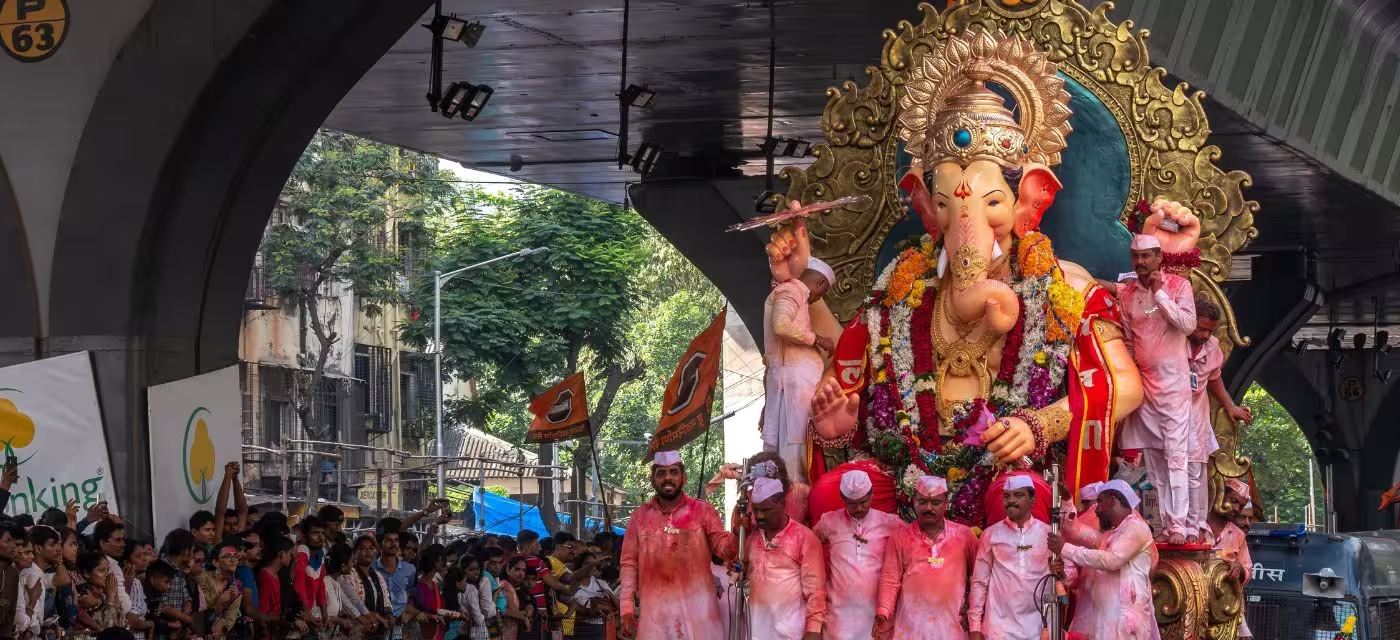
Few festivals in India can rival the celebration, fanfare, hysteria, merrymaking, and staggering scale of Ganesh Chaturthi. The spectacular festival, which is widely observed in Mumbai, Pune, and several other parts of Maharashtra, marks the birthday of the beloved Hindu elephant-headed god, Ganesha (also known as Ganapati or Vinayaka), the son of Lord Siva and Goddess Parvati. Ganesha is revered and worshipped as the Remover of Obstacles, the patron of arts and sciences, and the god of intellect and wisdom. As the God of New Beginnings, he is honoured at the start of rites and ceremonies.
The 10-day festival isn’t merely a private celebration confined only to homes. It is a massive public affair – pandals (temporary structures or stages set up in the open during religious festivals to venerate deities) are erected in practically every corner, the streets are filled with boisterous devotees dancing and chanting in delirious joy, loudspeakers blare out everything from devotional songs to film songs, and local communities compete with each other to bring out the most impressive Ganesha idol and display.
Ganesh Chaturthi takes place in late August or early September and falls in the Bhadrapada month of the Hindu lunar calendar. The first day of the festival begins with prayers to Ganesha along with offerings of a variety of delicacies (this is called prasad) especially prepared for the occasion. Prayers are carried out on a daily basis for the ten days that follow, until the immersion.
Ganesh Chaturthi originated as a public festival in the city of Pune over 125 years ago. It was here that the first public Ganesha idol was installed, on Laxmi Road. Social reformer and freedom fighter Lokmanya Balgangadhar Tilak saw in it an opportunity to unite people from all walks of life on an equal platform and inspire them to fight for freedom during India’s struggle for independence. Ever since, Ganesh Chaturthi has been a festival of large-scale public gathering and is celebrated every year with undying fervour and increasing enthusiasm.
The festival is celebrated in the states of Goa, Tamil Nadu, Karnataka, Telangana, and Andhra Pradesh too, although on a smaller scale than Maharashtra.
If you want to experience an Indian festival on a magnificent scale, then Ganesh Chaturthi in Mumbai it is! Mumbai’s Ganesh Chaturthi festival is the biggest celebration in the city.
Here, at the towering Siddhi Vinayak Temple (dedicated to Ganesha), situated in the neighbourhood of Prabhadevi, a sea of humanity gathers to revere and worship the elephant-headed god during the festival. Elsewhere, in various locations across the city, innumerable idols of Ganesha are finally displayed, as crowds throng to catch a glimpse.
At homes in Maharashtra, families install small clay idols of Ganesha for worship at the start of Ganesh Chaturthi. A ceremony is then performed to invoke Ganesha. Rituals include chanting of Vedic hymns, readings from Hindu texts, prayers, and fasting. The god is worshipped in the morning and evening with offerings of flowers, sweets such as modaka (steamed or fried sweet dumpling stuffed with jaggery, rice flour, and coconut), as it is believed to be a favourite of Ganesha, and various other delicacies. Prayers end with songs in honour of Ganesha, other deities, and saints.
Public celebrations of the festival are hugely popular and are organised by local communities in the city. Ganesha idols and accompanying images are installed in beautifully decorated pandals all over the city.
Staying with a local family or with friends during Ganesh Chaturthi affords you the chance to witness festivities up close, at home. But the most interesting thing to do during Ganesh Chaturthi is pandal-hopping! There is no dearth of pandals to visit in Mumbai and Pune during the festival, and some pandals are more famous and more sought after than others for their historical significance, elaborate and thematic displays, and the type of Ganesha idols they house.
Celebrations here retain their nostalgic charm, attracting millions of believers, visitors, and tourists from all over Maharashtra and the rest of the country every year. People pray, offer flowers, coins, sweets, and delicacies, participate in rituals, sing, dance, and enjoy these unique socio-religious gatherings.
The festival also features cultural activities such as singing, theatre, and orchestral performances, and community activities such as free medical check-ups, blood-donation sites, and donations to the poor.
Lalbaugcha Raja
Lalbaugcha Raja (‘the King of Lalbaug’), famous for its much-acclaimed Ganesha idol, is Mumbai’s most visited pandal and is a favourite among devotees in the city. Lalbaug is the area in which the pandal is located.
The pandal, established in 1934, has been drawing a jaw-dropping gathering of people every year. The Kambli Family of Kambli Arts is the keeper of Lalbaug’s tremendous legacy. Three generations of this family of renowned artists and sculptors have been creating Mumbai’s most legendary, now patent-protected, idol with great love since 1935. The Lalbaugcha Raja is believed to have mystical powers when it comes to fulfilling prayers, hence attracting close to 1.5 million faithful followers during the 10 days.
The elaborate and labour-intensive process of handcrafting the god requires the artisans to put in months of effort. And what a truly stupendous effort it is. It involves highly specialised craftsmanship, handed down from generation to generation, and unstinting attention to detail.
In the weeks remaining in the run-up to one of the city’s biggest and most anticipated festivals of the year, sculptors and artists toil through the night in workshops, racing against time to finish all the idols. Inside the workshops, idols of different sizes, heights (some even 40 feet tall!), and designs sit row upon row, awaiting completion. Their creators are busy organising work supplies, shaping figures out of plaster, assembling them, painting them, erecting scaffolding, and applying the final touches before they are wrapped in plastic and ready to go.
At the culmination of these unforgettable scenes of adoration amidst revelry, on Ananta Chaturdasi (the tenth and last day), the idols of Ganesha are carried ceremoniously in public processions through the streets, to the accompaniment of drums, chants, dance, and music, then brought to a body of water such as the ocean, river, or lake, for immersion.
It is a breathtaking sight to behold! People continue to display euphoric levels of energy even as they bid farewell to their beloved lord by shouting:
“Ganapati Bappa Morya, pudchya varshi lavkar ya”
— Lord Ganapati, please bless us and come back next year.
Christmas
Where: All over India
When: December 25
Christians across India celebrate their faith and hope on December 25 with Christmas – the festival that marks the birth of Jesus Christ. Although Christians make up less than five per cent of India’s population, Christmas is a significant religious occasion in India.
Houses are cleaned from top to bottom in preparation for Christmas and decorations are brought out. The finest cutlery, crockery, and table linen are readied, brass and silverware is polished, and wreaths of holly, ivy, and mistletoe are put up.
Traditionally decorated Christmas trees wear strings of sparkling lights, glass baubles, tinsel, and a star right on top. Giant stars, fairy lights, red, gold and green streamers, golden trumpets and bells, pinecones painted in gold and silver, Santa figures, snowmen, angels, and paper lanterns adorn homes and streets, welcoming all at Christmas time.
Red, white, and pink poinsettias – the Christmas flower – provide brilliant splashes of colour in gardens and on front porches and verandahs. Special care is given to setting up beautifully decorated Christmas cribs that hold nativity statues of the Holy Family and other characters from the Bible. Hanging up the Star of Bethlehem outside one’s front door is of the utmost importance, as is the ritual lighting of candles.
A typically well-laden Christmas table will have traditional Christmas fare – Christmas cake and plum pudding; delectable confections such as doughnuts, mince pies, tarts, toffees, chocolate fudge, jujubes, guava cheese and banana cheese, and rosa cookies. All these ‘labours of love’ are made weeks in advance, stored away safely, and served on Christmas Day.
Wining and dining are very much a part of Christmas celebrations – ginger wine, rum punch, grape wines, etc. are still prepared at home by many people. Visitors arrive with gifts and are served all the celebratory fare along with a glass of wine – mulled wine is a Christmas evening favourite.
Church services play a big role in the celebration. Preparations typically start on Advent Sunday. Churches start planning their celebrations and Mass, and families start preparing weeks in advance. Carol-singing competitions are organised in churches, community centres, and various other venues. Choir recitals, choral fests, and door-to-door carol singing, plays, games, parties, and other fun-filled activities are organised by cathedrals and churches. Christian clubs hold special Christmas dinner dances and parties with live bands in attendance.
But the most enduring and memorable tradition of Christmas Eve is the Midnight Mass. Churches start their services with carol singing, after which the Mass is held. After the service, everyone socialises, feasting together and wishing each other a Merry Christmas.
On Christmas morning, churches hold Mass; families and friends enjoy Christmas lunches and dinners, giving thanks for all their blessings at the end of another wonderful year.
Goa
Goa, with its large Catholic population, is wonderful for a traditional Christmas in India. The tiny state’s many elegant old Portuguese-era churches brim over with people and Christmas cheer. The Fontainhas Latin Quarter in Panjim is a superb place to enjoy Christmas celebrations.
Kolkata
The captivating historic city in India’s East is renowned for its Christmas celebrations. Park Street dazzles with strings of lights and other decorations. Flurys, the legendary 1927 tearoom, bakes delicious Christmas cakes and its special Christmas menu offers a range of tempting Christmas treats.
The Kolkata Christmas Festival, organised in collaboration with West Bengal Tourism, lights up Park Street with food and culture stalls, Christmas carols, and choirs.
The exquisite Saint Paul’s Cathedral (1847), with its Gothic Revival architecture, is where you should go for Midnight Mass on Christmas Eve. For an unforgettable community Christmas celebration in Kolkata, do visit Bow Barracks – it’s where most of the city’s Anglo-Indians live.
Mumbai
Mumbai has a vibrant Catholic community, especially in the western suburb of Bandra. But you can experience traditional Christmas celebrations in any part of the city because it is dotted with churches where you can attend a Midnight Mass.
These churches, notably Saint Thomas’s Cathedral, Holy Name Cathedral, Saint John’s Church, Gloria Church, Saint Michael’s Church, Mount Mary’s Basilica, Saint Peter’s Church, Saint Andrew’s Church, and Lady of Immaculate Conception, are all renowned for their services on Christmas Eve; and each Mass is attended by thousands of people.
Matharpacady, a charming 200-year-old East Indian Catholic village hidden in the lanes of Mazgaon, is beautifully decorated for Christmas and illuminated in the evenings. Make time for a heritage walk here during the festival.
Elsewhere, Christmas is also celebrated with great fervour by the substantial Christian population in India’s Northeast region (Meghalaya, Nagaland, and Mizoram) and in South India, in the state of Kerala, and in cities such as Bengaluru and Chennai.
Lumbini Festival
Where: Nagarjunasagar Dam, Hyderabad, Telangana; also Visakhapatnam, Andhra Pradesh
When: December (three days in the second weekend of December)
Lumbini or Lumbini Grove, situated in the Rupandehi District on the edge of Nepal’s border with India, is a Buddhist pilgrimage site. It is the place where Siddhartha Gautama, the Lord Buddha, the founder and preacher of Buddhism, was born in 623 BCE. Lumbini is one of the holiest and most important Buddhist pilgrimage sites in the world.
The Buddha preached love, serenity, compassion, forbearance, peace, and freedom from all desire – universal messages that are practised and revered by millions of Buddhists all over the world even today.
Over 2,000 years on, the significance and ancient heritage of Buddhism is honoured every year with the Lumbini Festival, aptly named after the Buddha’s birthplace.
The three-day festival, organised by the Andhra Pradesh Tourism Development Corporation, is celebrated every year at the Nagarjunasagar Dam in Hyderabad, which is the acting capital city of Telangana State as well as Andhra Pradesh State in South India. The northwestern portion of Andhra Pradesh was separated to form the new state of Telangana in 2014.
The Lumbini Festival marks especially the importance of Buddhism in Telangana and celebrates its rich and ancient Buddhist heritage. For those who are unaware of the splendid Buddhist culture of this part of India, the Andhra Pradesh/Telangana region reveals a treasure house of Buddhist sites.
It was a great centre for Buddhists centuries ago when the spread of Buddhism was at its peak in the country. Buddhism thrived in coastal India for centuries and was exported along the trade routes from Odisha and Andhra Pradesh to Ceylon, and Southeast and East Asia.
Nagarjuna (2nd century CE), one of the most important Buddhist philosophers who taught at Nalanda University and founder of the Madhyamaka school of Mahayana Buddhism, was responsible for a great deal of Buddhist activity in southern India, his place of origin.
The archaeological relics at Nagarjunakonda (Nagarjuna Hill) were excavated and transferred to this island hill when the Nagarjunasagar Dam in Guntur District was constructed.
The Festival remembers and commemorates the simple yet beautiful teachings and philosophy of the Buddha with various activities, theatre events, plays, and music. It also makes adequate arrangements for the thousands of tourists and pilgrims who come from all over India and the world to attend the event with great faith.
The Nagarjunasagar Dam is specially illuminated during the Festival. Celebrations take place with great grandeur and joy. The occasion is also a chance for local painters, artisans, craftspeople, and sculptors to showcase their skills. The exquisite works on display here not only represent outstanding workmanship but also take visitors back in time – to ancient Buddhist history; to an era of great peace and prosperity.
The Lumbini Festival affords visitors the chance to not only explore Telangana’s rich history and cultural legacy but also to revisit the enduring glory of Buddhism in India.
While the Festival has events dedicated to religious activities, it is not a religious festival by any means. It is, in fact, a window for tourists to the arts, crafts, culture, and cuisine of Telangana/Andhra Pradesh. Visitors can enjoy food fairs, sporting events, cultural programmes, exhibitions, and even fashion shows – quite unlike what you would normally expect from a Buddhist festival!
The gorgeous port city of Visakhapatnam in Andhra Pradesh is equally famous for its Lumbini Festival celebrations. During this time, the city is gloriously decorated and presents a facet never seen otherwise.
The Lumbini Festival is also a wonderful time to explore the many tourist delights of Telangana and Andhra Pradesh in places such as Hyderabad, Secunderabad, Visakhapatnam, Tirupati, and Kurnool.
Hola Mohalla
Where: Anand Pur Sahib, Punjab
When: March
Crowds of friendly, cheerful faces break into a spontaneous dance to the beat of the dhol (drums). The vivid colours of new clothes adorning children, women, and men gleam in the bright March sun. Blaring loudspeakers vie for attention as they issue invitations to partake in a langar (free community meal).
Members of a Sikh warrior clan are resplendent in their unusual headgear and blue attire as they hold the crowds spellbound with their daring martial feats. Welcome to Hola Mohalla!
Every year, for seven days in the month of March, the holy town of Anandpur Sahib in Punjab hosts an extraordinary festival that celebrates the martial skills of the Sikh community.
Hola Mohalla was started in 1701 by the tenth Sikh Guru, Gobind Singh, as a gathering of Sikhs for military exercises and morale-boosting mock demonstrations by his regiments on the day following the Hindu festival of Holi.
Guru Gobind Singh wanted his people to celebrate the festival to reaffirm fraternity and brotherhood and remind them of “valour and defence preparedness”, concepts dear to him, especially at a time when he was defending the Sikhs from the invasions of the Mughals and hill chieftains.
During the three-day festival, mock battles are held followed by kirtan (spiritual songs), story narrations of valour in prose and verse, music, and poetry competitions.
The Nihang Singhs (members of the Sikh army founded by Guru Gobind Singh), attired in their traditional martial costumes, carry on the martial tradition with displays of daring feats such as Gatka (mock encounters with real weapons), tent pegging, bareback horse-riding, and standing erect on two speeding horses.
They demonstrate their superb skills in archery, sword fencing, horse-riding, and shooting. Battles are enacted and ancient cannons fired to focus on the training required for war.
The Nihangs, originally known as Akalis, still carry the military air and valourous style that was bred during the lifetime of Guru Gobind Singh. They comprise a distinctive order amongst the Sikhs and stand out for their dark blue loose apparel and large, peaked turbans adorned with quoits and insignia of the Khalsa and rosaries, all made of steel.
They are always armed, usually seen mounted, carrying weapons such as swords, daggers, spears, rifles, shotguns, and pistols. Nihang signifies the credo of the clan – freedom from fear of danger or death, readiness for action, and non-attachment to worldly possessions.
These courageous swordsmen warriors of the vanguard assemble in thousands at Anandpur Sahib in March every year to celebrate Hola Mohalla. The most spectacular event here is the magnificent procession of the Nihangs on horses and elephants, and on foot, sporting a variety of traditional and modern weapons and demonstrating their considerable prowess.
For visitors to Anandpur Sahib, langars (voluntary community kitchens) are organised by locals as a part of sewa (community service). Raw ingredients such as wheat flour, rice, vegetables, milk, and sugar are contributed by the villagers living nearby. Some women volunteers cook while others clean the utensils.
Traditional cuisine is served to people seated in rows on the ground. No one will go hungry if people share – that is the message of the langar.
Early morning prayers at the gurdwaras (Sikh institutions) mark the beginning of the festival. The Guru Granth Sahib (Holy Book of the Sikhs) is venerated. Verses are read from the scriptures and kirtans are sung. The Karah Prasad (sacred offering) is distributed to the gathering after it has been consecrated by the Guru.
At noon, men and women, irrespective of caste and creed, eat together at the guru ka langar.
Hola Mohalla is unique and distinct from other festivals for how the Nihangs have attempted to preserve its original traditional form that has been strictly observed by the Akalis for over four centuries.
The festival’s immense historical, socio-religious, and military significance has helped create a greater awareness of Sikh heritage as well as promote community tourism.
Jamshed-i-Navroz
Where: Across India; especially in Maharashtra and Gujarat
When: August
For Zoroastrians, or Parsis as they are commonly known in India, the most important social and religious festival is Jamshed-i-Navroz.
Famous for its industriousness, enterprise, hospitality, sense of humour, and delicious cuisine, this micro-community celebrates the significant days in its calendar with great fervour.
Zoroastrianism, one of the oldest known monotheistic religions, was founded by Prophet Zarathustra some 3,500 years ago in Persia (ancient Iran) and was the dominant religion there until the rise of Islam in the 7th century CE.
Faced with forced conversions, scores of Persian Zoroastrians fled to India and arrived on the coast of Gujarat on India’s western border. Their honesty, diligence, and adaptability ensured that they were soon integrated into the fabric of Indian society.
Jamshed-i-Navroz or Navroz (meaning ‘new day’) is celebrated every year to herald the Parsi New Year. Navroz is considered highly auspicious and is celebrated with great pomp and splendour.
The festival is named after the legendary King of Persia, Jamshed, who is said to have introduced the solar calculation in the Parsi Calendar.
The Parsis in India celebrate their New Year using the Shahenshahi calendar, which does not account for leap years; this means the festival has moved about 200 days from its original day of the Vernal Equinox and is now celebrated in the month of August.
Navroz is preceded by ten days of prayers and remembrance of the dead, known as Muktad. Families remember their departed loved ones and ask for their blessings.
To welcome the souls, agiyaris (Parsi fire temples) are fragrant with flowers and illuminated with diyas (lamps) in ornate silver vases on marble tables. Priests in flowing white robes and turbans chant the ancient Avestan (the language of Zoroastrian scripture) prayers, seated before the leaping flames of fire in an afargan (chalice), as the sweet scents of sandalwood and myrrh waft through the air.
Malido (sweet delicacy) is laid out in silver trays as a repast for the celestial visitors. Later, this chasni (sacred offering) is distributed amongst the family.
The last five days of the calendar are known as the Gathas (hymns or poetic compositions composed by Zarathustra). Going to the agiyari and listening to these powerful hymns being recited by the priests strengthens faith and the bonds of religion.
The very last day of the year is known as Pateti. The word ‘patet’ means to repent. Thus, the last day is spent in introspection and awareness of one’s misdeeds and mistakes, to atone for them with a sincere heart and vow to become a better Parsi in the coming year.
After 10 days of prayer and penitence, dawns Navroz, the New Year, filled with fun, food, family, friends, and good wishes!
Traditionally, during Navroz, courtyards, if any, are swept and washed; homes are cleaned to a sparkle and decorated; torans (decorative door hangings) are hung up on the doors to welcome visitors with the beauty and sweet fragrance of flowers; and intricate designs with chalk and a dabba (box of coloured chalks) are made on the doorsteps and entrance of the home.
New clothes are a must for Navroz, and every member of the household, from family to help, is gifted a brand-new set of clothes.
But the undisputed king of Navroz is the spread on the table! And what a spread it is. Tables are laden with traditional Parsi delicacies such as rich creamy ravo topped with fried almonds and raisins, dhansak, meethi sev dahi, prawns, farcha, machchi no patio, berry pulao, lagan nu custard, and other sumptuous preparations.
Many a toast is raised to the New Year and to the happiness and prosperity of the community.
The day begins with a visit to the agiyari, where Parsis pray and make offerings of sandalwood to the eternal flame that burns within the sanctum sanctorum. The rest of the day sees the community coming together to celebrate over food, visiting family and friends, and exchanging festive greetings and gifts.
Navroz celebrations begin early in the morning and could go on till midnight. And included in this hospitality and bonhomie are non-Parsi friends; all come to wish their Parsi friends and add to the spirit of communal harmony and good times that this charming community is known for.
For Parsis, celebrating Navroz in its true sense means walking on the righteous path and staying true to their credo – good thoughts, good deeds, and good words.
Then they have observed Navroz in the best possible way.
Navroz Mubarak!
Mahamasthakabhisheka
Where: Sravanabelagola, Hassan, Karnataka
When: February
Every 12 years, the small town of Sravanabelagola in Karnataka in South India is transformed into a sea of humanity as thousands of faithful followers and visitors from India and around the world gather here. The occasion – the celebration of the Mahamasthakabhisheka.
The Mahamasthakabhisheka or the head-anointing ceremony is one of the biggest and most significant festivals of the Jain community; it is an essential part of ancient Jain culture and tradition.
It honours Bahubali, the first of the twenty-four Jain Tirthankaras (spiritual teachers), and is performed on the magnificent 57-foot-tall monolithic statue of Gommatesvara Bahubali that stands at the summit of Vindhyagiri Hill at Sravanabelagola.
Sravanabelagola has been a centre of Jain religion, art, and architecture for over 2,000 years.
The statue of Gommatesvara Bahubali, the centrepiece of the ceremony, is believed to have been consecrated around 983 CE. The colossal statue stands upright in the posture known as kayotsarga (motionless contemplation) and depicts the prolonged meditation of Bahubali.
He is exquisitely sculpted, with all the ‘signs of a great man’ such as long earlobes, broad shoulders, and long arms. His face embodies great inner peace and vitality. The Gommatesvara statue is one of the largest free-standing statues in the world.
The custom of celebrating the anointment ceremony also began in 983 CE.
The preparation for the Mahamasthakabhisheka begins around 18 days before the due date. On the main day of the festival, the worship of Gommatesvara begins early morning. The statue is anointed with purified water and sandalwood paste as an act of reverence.
Priests chant divine hymns as devotees carrying 1,008 specially prepared pots ascend the 650 steps to reach the top of the statue. They then pour water on it, chanting mantras while doing so.
The statue is anointed with coconut milk, milk, saffron paste, rice flour, sugarcane juice, turmeric paste, vermillion, jaggery, clarified butter, sandalwood paste, dates, poppy seeds, rice, and a variety of fresh flowers.
Gommatesvara is also offered precious stones and gold and silver coins as a mark of respect. He is showered with flower petals too.
The ceremony continues for around 10 hours, during which countless devotees show their devotion to the Lord.
The last Mahamasthakabhisheka took place in 2018 and was the 88th celebration of the ceremony.
Hanukkah
Where: Across India; especially in Mumbai, Kochi, Kolkata, and Delhi
When: December
Hanukkah, also known as Chanukah, the Festival of Lights, or the Feast of Dedication, is an eight-day Jewish observance that commemorates the re-dedication of the Second Temple of Jerusalem.
Hanukkah is a relatively new addition to the Indian Jewish tradition, which evolved separately from those of the Ashkenazic and Sephardic Jews. Indian Jews started celebrating Hanukkah only around 200 years ago, but it has come to be a beloved and joyous holiday in India.
The festival usually takes place in December. Hanukkah (the word means ‘dedication’) honours one of the greatest miracles in Jewish history. It reminds the Jewish people of a time over 2,000 years ago in Jerusalem, Judea (ancient Israel), when the Jews were victorious in a battle against the Seleucid Greeks to practise their religion freely.
There was only enough sealed consecrated olive oil left to sustain the eternal flame in the Temple for one day. Miraculously, the oil burned for eight days, leaving them time to find a fresh supply.
This is why Hanukkah lasts for eight days and why light is so significant and integral to the celebration.
The Menorah
The Menorah is one of the oldest symbols in Judaism.
Central to the meaning of Hanukkah is the symbolic lighting of the Menorah. Since Jewish tradition prohibits the use of a seven-lamp Menorah outside of the Temple, the Hanukkah Menorah, called Hanukiah, therefore has eight main branches, plus the raised ninth lamp set apart as the shamash (‘servant’) light to kindle the other lights.
During Hanukkah, one candle on the Hanukiah in every home is lit by families on each night of the holiday until it is incandescent with light on the eighth night. The lighting of each candle represents the original oil lamp that burnt for eight days in the Temple.
Indian Jews traditionally light an oil lamp, as in ancient times, instead of a candle during Hanukkah.
In India, the eight days of Hanukkah are busy and happy; people go to each other’s houses to light the Hanukkah lamps or gather to celebrate with family and friends in local synagogues. It is a beautiful way to unite the community and keep the tradition alive.
Children too receive gifts and are told stories of Hanukkah and the miracle.
Hanukkah is also a time for traditional and celebratory food. It is a time to eat and enjoy foods fried in oil in remembrance of the miracle of the oil that burned for eight days.
Deep-fried potato pancakes (‘latkes’ in Yiddish and ‘livivot’ in Hebrew) and round doughnuts filled with jelly or custard (‘sufganiyot’ in Hebrew) are traditional Hanukkah treats around the world.
In India, however, the cuisine, already famous for fried specialities, has contributed its own recipes that are fine reminders of the miracle of the oil.
The Bene Israel (Maharashtrian Jews) community has a culinary tradition of fried foods such as dahi wadas, samosas, jalebis or kanda bhaji, batata bhaji, piaju, and gulab jamun.
Indian Jews may celebrate Hanukkah very differently from the Jewish communities in Israel, the United States, or elsewhere in the world today. But the true meaning of Hanukkah resonates deeply with the Indian Jewish communities because India has, in fact, also been the site of great miracles – a refuge for Jews from all over the world.
The history of the Jews of India is as much about faith and refuge as it is about survival and identity.
According to religious tradition and several historians, the Bene Israel Jews of Bombay (now Mumbai) arrived in India centuries ago, fleeing the Hellenist occupation and persecution of Judea. They were shipwrecked off the coast of Bombay.
But even as they assimilated and integrated themselves into the village communities along the coast, they held fast to the faith and customs they remembered from the homeland.
Much later, towards the middle of the 18th century, a wave of Jewish merchants – called the Baghdadi Jews – arrived from Aleppo, Baghdad, and Basra due to their trade links with the British East India Company.
At first, they settled in the west coast port of Surat in Gujarat. But as the British presidencies of Calcutta (now Kolkata) and Bombay (now Mumbai) developed, the Jewish merchants soon moved to these fast-growing commercial centres.
Bene Israel is the largest of several Jewish communities in India, with an estimated population of 4,000; other communities are settled mainly in Kochi (likely the most ancient Jewish settlement), Kolkata, Chennai, Delhi, Andhra Pradesh, Manipur, and Mizoram.
Today, the Jewish population that remains in India has shrunk to about 5,000. Many Indian Jews have immigrated to Israel over the last six decades or so.
In India, the Jewish communities flourished, both on their own and as part of the broader Indian context. For Jews in India today, Hanukkah is a time to celebrate that benefaction and freedom.
Eid al-Fitr
Where: Across India
When: May
Eid al-Fitr (“the feast of breaking the fast”) is one of Islam’s most important festivals and is celebrated on the first day of Shawwal to mark the culmination of the month of Ramazan or Ramadan, the Islamic holy month of dawn-to-sunset fasting.
Eid al-Fitr, as it follows the fasting of Ramadan, is seen as a spiritual celebration of Allah’s provision of strength and endurance.
Amid the reflection, rejoicing, joy, and blessing, Eid is a time for charity too. Charity to the less privileged is a highly emphasised value in Islam.
The day of the festival begins early with the distribution of an obligatory monetary contribution called Zakat al-Fitr to the needy. Zakat is often also given in the form of new clothes and food items such as rice or wheat.
Zakat is followed by prayers. Believers gather for the congregational Eid prayer in mosques and specially consecrated open grounds where they thank Allah, whose grace and blessings have enabled them to complete the preparatory month of Ramazan – a time that reaps both spiritual and worldly benefits.
Eid al-Fitr is celebrated on the first day of the 10th month in the Islamic calendar. As the Islamic calendar follows the lunar cycle, it also means that the festival dates can vary each year.
The night before Eid is known as Chaand Raat or ‘night of the moon’. People go shopping with their families. Women, especially younger girls, often apply the traditional Mehndi (henna) on their hands and feet and wear colourful bangles.
It is a time of official receptions and private visits. Muslims are encouraged to forgive and seek forgiveness. People greet each other saying “Eid Mubarak,” meaning “Blessed Eid”, and with formal embraces.
Gifts are often given – new clothes are part of the tradition – and children receive small sums of money, called Eidi, from their elders.
A traditional Eid al-Fitr, also called “sweet Eid”, spread is an epicurean delight and a sheer indulgent affair.
Special feasts are held for relatives, and an array of delicious celebratory foods and sweet dishes prepared at home are eaten while families and friends reunite in celebration.
Some holiday favourites include:
- Sheer Khurma – sweet milk pudding with vermicelli topped with nuts and raisins
- Kimami Sewaiyan – vermicelli and milk with lotus seeds, almond, coconut, cashews, and raisins
- Mutton Korma – mutton curry with aromatic masalas, cashew nut paste, rose water, and saffron
- Biryani – fragrant rice dish layered with succulent pieces of meat and spices
- Nihari – slow-cooked mutton stew
- Haleem – mutton stew
- Sheermal – slightly sweet and chewy flatbread made with ghee, sugar, and saffron-enhanced milk
- Seekh Kebab – spicy minced meat mixture
- Bhuni Raan – mutton dish made with fried mutton leg
- Shaahi Tukra – made with milk, breads, nuts, ghee, sugar, and thick cream
India is a melting pot of diverse cultures, faiths, languages, cuisines, and communities and therefore has a unique festival calendar that is crowded with fairs and festivals from every nook and corner of this beautiful country.
You may, of course, get to witness the most popular religious festivals, but do try and experience the festivals that bring out the little-known indigenous cultures of India too.
And if you’re looking for more, then there are a number of secular festivals that celebrate music, dance, art, literature, and yoga – elements that are integral to this land’s history and social fabric.
We promise you will come away enthralled.
Related Posts