 English
 Deutsch
 Italia
 August 27, 2026 By admin
Kerala for Beginners
KERALA FOR BEGINNERS
Paul Zacharia
No one realises how beautiful it is to travel until he comes home and rests his head on his old, familiar pillow.
– Lin Yutang
Whatever was the force that heaved Kerala up from under the ancient seas, it bestowed on this little strip of land a combo-geography – almost a package deal – that has at least four distinct identities, each inviting in its own way. An end-to-end sea-coast with beaches, cliffs, estuaries, cities, towns, and remnants of a fabled maritime history; backwaters and lakes with islands, waterways and isolated habitats a la Waterworld; hilly midlands with lush-green farms and fields, bustling towns, cities and villages, and sleepy interiors; and the Western Ghats – the Sahya Mountains – home to dense tropical forests, wildlife, grasslands, plantations, mists, and cold.
Add to it 44 rivers and their meandering paths, several thousand streams and rivulets that crisscross the land and – though not strictly geography – two spirited monsoons, a salubrious winter and a hot, steamy summer under blue skies and flying clouds.
That is the basics of Kerala: sea, backwaters, midlands, mountains one behind the other. You can pick one and lay yourself back, or depending on how adventurous you are, have a bit of all of them – a nature cocktail – hitting the ground running.
This sun-and-rain-drenched, north-to-south strip of tropics fringing the Arabian Sea is arguably one of the most beautiful places in India. It is only 580 kilometres long. Its southern end lies 55 kilometres north of Cape Kanyakumari in Tamil Nadu, and the northern, 24 kilometres south of the coastal city of Mangaluru in Karnataka. The high mountains of the Western Ghats make up the eastern border, shared by Tamil Nadu and Karnataka. From the mountains to the sea, the distance shifts between 35 to 120 kilometres – they can almost hear each other.
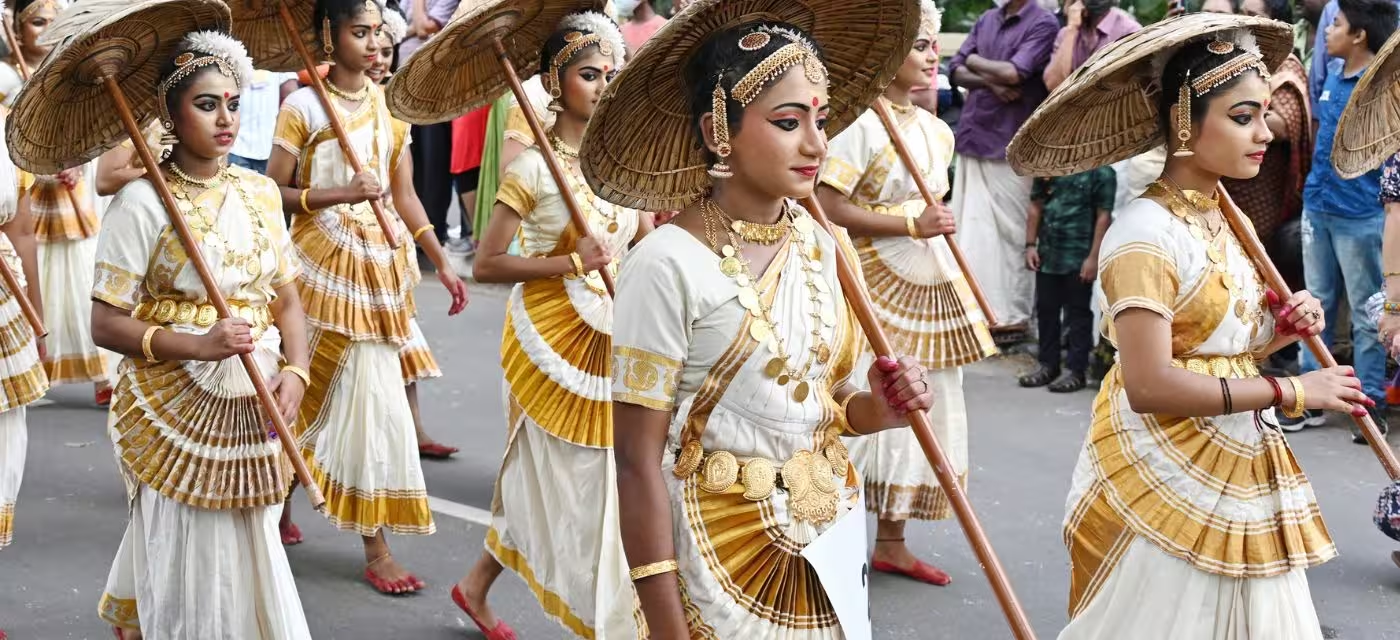
That brings us to the people who live on this land, also famously known as God’s Own Country. There are 35 million Malayalis occupying this green paradise, making up 96 per cent of the population. They are called Malayali because their mother tongue is Malayalam. It is a language that grew out of ancient Tamil centuries ago and was historically shaped by several influences including Arab, Jew, Syrian, Sanskrit, Portuguese, Dutch, and English – all maritime except Sanskrit.
The tribes, the most ancient inhabitants of Kerala, speak their own individual dialects. People who speak Tamil, Kannada, Tulu, Konkani, Gujarati, and Telugu – to mention a few – constitute the remaining four per cent of the population. Add to it around four million – mostly Bengali – migrant workers without whom a big chunk of life in Kerala would grind to a halt in a matter of minutes.
God’s Own Country therefore is a nice potpourri of people – as befits a godly place. Befittingly again, for centuries it has also been a melting pot of three religions – Hinduism, Islam, and Christianity – living in near-exemplary coexistence, withstanding every pressure you can imagine. This simple underlying harmony keeps Kerala surging and vibrant.
And finally, getting to this corner of India is child’s play. Because Malayalis are spread all over India and the world and they like to visit their homeland as often as possible, Kerala is well connected to the rest of India and the world. Some trains go to places so distant that it takes 70–80 hours to finish the run. And four international airports – Thiruvananthapuram, Kochi, Kozhikode, Kannur – packed into a space of 580 kilometres make everything all the more simple. Put in some mind-boggling politics and you have Kerala for a start.
So, varoo! aswadikkoo!Come! Enjoy!
Related Posts