 English
 Deutsch
 Italia
 August 20, 2026 By admin
Trail of Lord Buddha
THE TRAIL OF LORD BUDDHA
Born into affluence – literally a prince among men – he searched for answers to the eternal questions, “What is it all about? What is the meaning of life?” The answers he found have resounded with billions of people over the last 2500 years. Of course the prince was Siddhartha Gautama, later to be recognised as The Buddha, The Enlightened One.
His teachings on compassion and the impermanent interdependence of all phenomena, spread from Egypt to China before the first century BCE, yet were so obliterated in India by the end of the Medieval period that scholar/administrators of the British Empire first thought that the Buddha was born in Africa, based on his curly top knot, seen in South and Southeast Asian sculptures.
You are too concerned with what was and what will be. There is a saying: Yesterday is history, tomorrow is a mystery but, today is a gift…that is why it is called the present.
– Master Oogway to Po in Kung Fu Panda
LUMBINI (NEPAL)
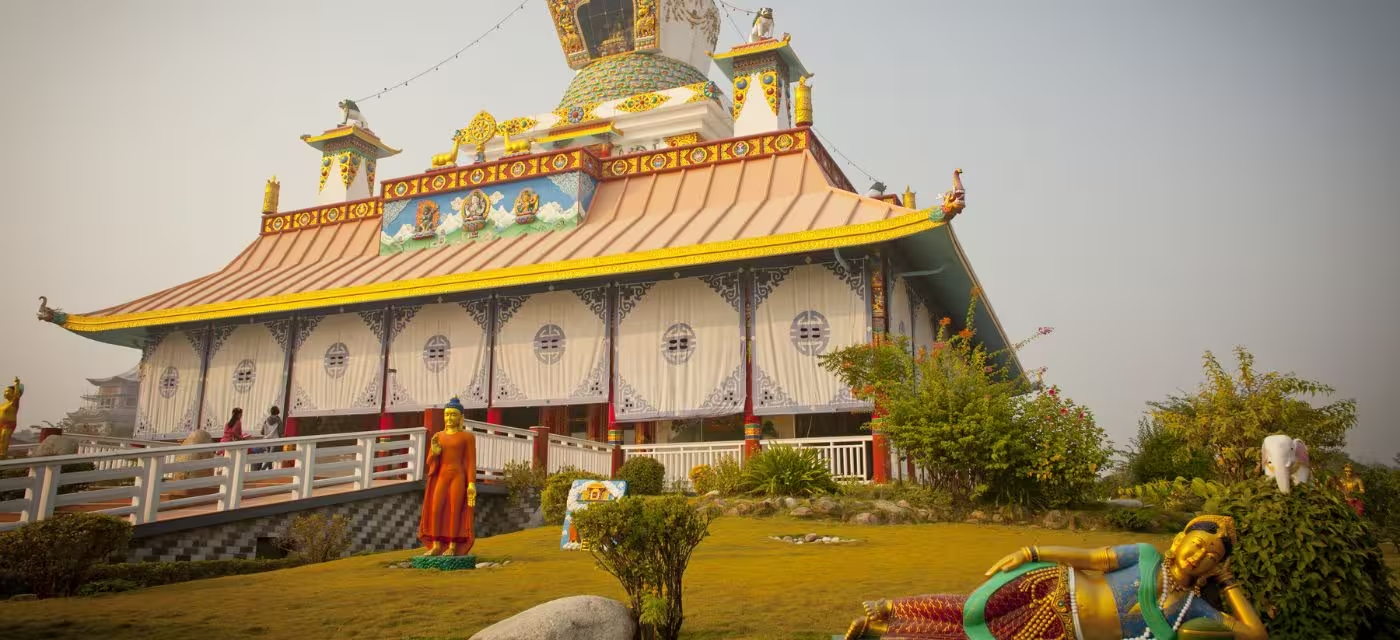
This Indian prince was actually born in what is now Nepal. His mother, Queen Mayadevi, was en route to her parental kingdom in 563 BCE and gave birth to this great being in Lumbini. According to tradition, earlier Buddhas were also born and achieved ultimate Enlightenment in the region. Lumbini has ruins of ancient monasteries, a sacred Bodhi tree, and an ancient bathing pond where the Buddha’s mother presumably took the ritual dip prior to his birth, and where he had his first bath. The Mayadevi temple is visited by thousands of Hindus during the full moon of Baisakh (April–May) to worship Queen Mayadevi as Rupa Devi, the mother of an incarnation of Vishnu, Preserver of the Universe.
Asoka, emperor of the Mauryan Empire, visited the Buddha’s birthplace in the 3rd century BCE; and you can still see the pillar declaring the village tax free. In 2001, a Peace Pagoda was built by the Nipponzan Myohoji. The entire holy site of Lumbini is bordered by a large monastic zone in which only monasteries can be built; no shops, hotels or restaurants. One can take a boat tour in the canal between the various monasteries on either side of this UNESCO World Heritage Site.
BODH GAYA (BIHAR)
Bodh Gaya is the most important of the main four Buddhist pilgrimage sites related to the life of Gautama Buddha, along with Lumbini, Sarnath and Kushinagar. It is a moving experience to sit under the same Bodhi tree where he meditated until he attained enlightenment. If you are lucky, an auspicious leaf may fall in your lap!
After mastering the highly evolved meditation practices available in first millennium BCE India culminating in six years of extreme asceticism, the Buddha came to the realisation that such extremes could not release him from the bonds of existence. Following a middle path between austerities and luxury, the prince – prophesied to become either the greatest king or the greatest teacher the world would know – became a guide to relieve the suffering of existence.
The town of Bodh Gaya buzzes with visitors from across the globe. Every variety of Buddhist practice from Myanmar, Nepal, Sikkim, Sri Lanka, Taiwan, Thailand, Tibet, and Vietnam have centres for monks, nuns, laity, and guests built to reflect the architectural style and decor of their respective countries. There are also innumerable hotels, guest houses, restaurants, and shops open late into the evening with treasures to take home. If you have time to stay, there is an International Meditation Centre offering Vipassana and the Root Institute’s frequent Mahayana short courses, among others.
Even a day’s visit will leave images etched in memory of the magnificent Mahabodhi temple, built under the Gupta Empire, 6th century CE after the first by Emperor Asoka when he visited in 250 BCE. The 50-metre temple adjoining the Bodhi Tree is protected by inner, middle, and outer circular boundaries. Within the complex are six other sacred sites related to the Buddha’s enlightenment, numerous ancient votive stupas, and the sacred Lotus Pond. There is a sense of peace and beauty as one circulates at two or three levels, stopping to contemplate or meditate at will. Congregations of various schools of Buddhist practice are given scheduled weeks for offering teachings directly in front of the Bodhi Tree. There is a super museum for those interested in knowing more of the history of this UNESCO World Heritage Site.
SARNATH (UTTAR PRADESH)
The Deer Park, Sarnath is where Gautama Buddha taught the First Turning of the Wheel of Dhamma to his disciples, the five fellow ascetics who realised he had not given up but found a truer path. Located close to Varanasi in the state of Uttar Pradesh, the Deer Park is also where the Buddhist Sangha came into existence. If you are here on the Buddha’s birthday, Buddha Purnima (the full moon of May), there is a once-a-year-only opportunity to see the relics of the Buddha in a procession that accompanies a splendid fair. Any time of the year you can see the surviving Dhamekh Stupa covered in stone engravings of many scripts, the pillar of Emperor Asoka who visited and founded many institutions here, ruins of various ancient branches of Buddhism as well as gorgeous temples built by many nations.
NALANDA, RAJGIR (BIHAR)
H.H. the Dalai Lama refers to himself as a son of India in gratitude for the profound Buddhist teachings transmitted to Tibet by scholar/translators from Nalanda University. One has to see this vast archeological site in Rajgir to imagine the thousands of students from across Asia studying philosophy and other subjects from the 5th century on. There is a museum that exhibits the Nalanda University seal, sculptures, and other remains found on the site.
VULTURE PEAK, RAJGIR (BIHAR)
Rajgir is the place where the Buddha taught the Transcendent Perfection of Wisdom (Prajna paramita), at the Vulture Peak, 16 years after his enlightenment, to an assembly of 5,000 monks,nuns, and laity, as well as innumerable bodhisattvas. This teaching is known as the second turning of the Wheel of Dhamma and focuses on understanding the meaning of ‘emptiness’, sunyata, which is the ultimate nature of phenomena. This is also the place where Buddha Shakyamuni tamed the wild elephant unleashed by his jealous cousin Devadatta. In Rajgir, King Bimbisara offered the Veluvana Bamboo Grove to the followers of the Buddha. The site was ideal for a monastic order, being not too near the city, calm, and enjoying mild air and cool water. Thus it was suited to the practice of meditation, and here Shakyamuni passed the first rainy season retreat following his enlightenment. He was to return to this place for several rainy season retreats later in his life. The final journey of Buddha’s life, which ended with the mahaparinirvana at Kushinagar, began at Rajgir.
In the nearby Saptparni Cave, also known as Shaptaparna Cave, the First Council—an assembly of 500 monks presided over by Buddha’s great disciple and spiritual heir Mahakashyapa—met under the patronage of King Ajatasatru and compiled all the Buddha’s teachings from memory.
SHRAVASTI (UTTAR PRADESH)
This ancient capital city hosted many sanghas, or gathering of the Buddhist congregation where the Buddha both taught and performed legendary miracles. It is believed that you will be blessed if you mediate under the Ananda Bodhi tree under which Buddha himself passed a night. Peaceful Jetavana is one of the most famous of the ancient Buddhist monasteries or vihara where the Buddha passed 19 of 45 monsoon seasons.
PATALIPUTRA (NOW PATNA) (BIHAR)
During the reign of Emperor Asoka in the 3rd century BCE, Pataliputra was one of the world’s largest cities, with a population of 150,000–400,000. Asoka’s brutal expansionism culminated in his victory over Kalinga (modern day Odisha), with 100,000 killed, 150,000 deported, and many times more dying later of injury and starvation. A guilty conscience was the turning point that pushed him to embrace the fairly new philosophy of Buddhism, promote it throughout his empire, and lead the dissemination far beyond South Asia.
SANCHI (MADHYA PRADESH)
Some of the finest early Buddhist art awaits you at Sanchi in Madhya Pradesh,known for its stupas, monasteries, temples, and pillars dating from the 3rd century BCE to the 12th century CE. The famous Sanchi Stupa may be the oldest stone structure in India and was originally built by Emperor Asoka. Its design was copied for the dome of the Imperial Presidential Palace in New Delhi. The four exquisitely carved gateways encircling the Stupa depict the stories and teaching of the Buddha, including various previous incarnations, miracles, and symbols: the lotus representing his birth and aspiration, the tree his enlightenment, the wheel derived from the Wheel of Dharma taught at his first sermon, and the footprints and throne marking his presence.
The Asoka Pillar near the southern gateway is known for its aesthetic proportions and balance. Even the 5th century CE Gupta temple is appreciated as one of the earliest known exiles of temple architecture in India. There is even a mammoth Buddha SL carved out of a single block of stone that contained all the food distributed amongst the monks. One should not miss the Sanchi museum which houses the lion capital of the Asoka Pillar that is India’s national emblem. If time permits, the sacred relics of the Satdhara Stupa are enshrined in a glass casket of a modern monastery a few kilometres away.
AJANTA AND ELLORA CAVES (MAHARASHTRA)
From Sanchi, just outside of Madhya Pradesh’s capital Bhopal, one travels onward to the Ajanta and Ellora Caves near Aurangabad in Maharashtra. The legendary Ajanta rock-cut caves date from the 2nd century BCE to the 7th century CE. Imagine the amazement of the British officer chancing upon them at a time when few colonialists believed India had any verifiable ancient culture. Please give a full day to explore the lifelike frescos vividly painted in some of the 30 caves; while others impress with their stone carving and architectural design. The Ellora rock-cut cave temples date back to the 10th and 11th centuries and are frankly mind boggling as you try to figure out how one could possibly carve a huge temple complex from the top down!
NAGARJUNAKONDA, AMARAVATHI, AND Salihundam (TELANGANA/ANDHRA PRADESH)
Travelling southeast toward Telangana/Andhra Pradesh reveals a treasure house of Buddhist sites. Nagarjuna, one of the most important Buddhist philosophers teaching at the Nalanda University and founder of the Madhyamaka school of Mahayana Buddhism, was responsible for a great deal of Buddhist activity in his place of origin. The archaeological relics at Nagarjunakonda (Nagarjuna Hill) were excavated and transferred to this island hill when the Nagarjuna Sagar Dam in Guntur District was constructed. The great stupa at Amaravati, built in phases between the 3rd century BCE and around 250 CE has wonderful sculptures, many in museum collections in India and abroad. The stupa and adjoining museum offer breathtaking examples of this pre-eminent art form that flourished over six centuries and is considered one of the three major schools of ancient Indian art, along with Mathura and Gandharan. Atop a hill on the bank of the River Vamsadhara one can explore Salihundam, one of the main Buddhist excavation sites in India showing remains of the Mahayana, Theravada, and Vajrayan Buddhism stupas, relic caskets, and shrines built between the 2nd and 12th centuries. Buddhism thrived in coastal India for centuries and was exported along the trade routes from Odisha and Andhra Pradesh to Ceylon, Southeast and East Asia.
NAMDROLING NYINGMAPA MONASTERY, BYLAKUPPE (KARNATAKA)
Today in South India you can visit the second largest Tibetan settlement in the world outside of Tibet after Dharmashala in a place called Bylakuppe in the Mysuru district of Karnataka. 3000 acres (12 sq. km) were generously given by the government in 1960 to create the first ever Tibetan exile settlement. Four more settlements make Karnataka the state with the largest Tibetan refugee population, continuing a millennia long tradition of welcoming refugees. Among the many splendid monasteries, don’t miss visiting the Namdroling Nyingmapa Monastery, home to 5000 monks and nuns, a junior high school, and religious college along with a hospital. It is the largest teaching centre of the Nyingma lineage of Tibetan Buddhism in the world.
DHAULI (ODISHA)
Moving up the east coast of India to Odisha opens another world of ancient and modern Buddhist monuments. Dhauli is believed to be the location of the devastating Kalinga (Odisha) War that motivated Emperor Asoka to embrace Buddhist philosophy. Here you find the earliest Buddhist sculpture of Odisha, a rock-cut elephant above Asoka’s edicts expressing his concern for the welfare of the world. A stunning white marble Japanese peace pagoda crowns the hill, built in the 1970s by the Japan Budha Sangha and the Kalinga Nippon Buddha Sangha.
RATNAGIRI, UDAIGIRI, AND LALITGIRI HILLS (ODISHA)
The ancient Chinese traveller to India, Hiuen Tsang or Xuanzang, referred to Pusipokili, the location of the Pushpagiri University which he compared to Nalanda in Bihar. This ancient university site includes Ratnagiri, Udaigiri, and Lalitgiri hills revealing monasteries, stupas, relics, seals, stone tablets, and statues with more under excavation. Ratnagiri is called the hill of precious gems while Lalitgiri is the red hill and Udaiyagiri, the hill of the rising sun. Ratnagiri was established by the Gupta kings in the 5th century CE and you can see two monasteries, a large stupa and many small votive stupas built till the 13th century. In Ratnagiri’s main ancient monastery you can easily see the architectural style of Odisha that later inspired the stupas of Borobodur in Indonesia. The larger excavation site of Udaiygiri reveals glimpses of what was once a prominent centre of Buddhism between the 7th-12th centuries CE: a massive stone Buddha, stepwell, stone carved gates and a large round Chaitya Griha (prayer hall) flanked by smaller stupas.
The most sacred of the three hills is Lalitgiri as a tooth relic of the Buddha was found in a casket filled with gold and precious stones during the excavation of the Chaitya Griha and four monasteries. The casket can be seen in the site museum. All three of these Buddhist sites that were part of a huge university community can be seen in one long day before returning to Bhubaneswar. Odisha is rightly called the land of temples and the entire region was once filled with Buddhist temples, stupas, and monasteries. There is no other deity in the Hindu pantheon except Odisha’s Lord Jagannath, Ruler of the World, who is treated as the Buddha’s incarnation.
TAWANG (ARUNACHAL PRADESH)
Visiting the second largest monastery in the world in the 3000-metre high town of Tawang in India’s Northeast state of Arunachal Pradesh was on my bucket list for years. Getting there is a challenge, first flying to Assam and then another day over land to enter Arunachal Pradesh and start the journey upward. As I followed the land route taken by HH the Dalai Lama a week earlier, exploring old and new monasteries along the way, I treasured every breathtaking view driving through the clouds.
The Tawang Monastery was established in 1680 at the request of the 5th Dalai Lama. There are 65 residential buildings for the Gelug monks with a 282-metre long compound wall around the whole three storied complex. Visiting the Dukhang, the assembly hall, your eyes rise toward the second floor to see the top of the 18-feet high gilded Buddha, seated in the lotus position. Next to the Buddha image there is a silver casket that holds a special thangka of the goddess Palden Lhamo, which is the guardian deity of the monastery. A building that had escaped fire and damage over time adjoins the 2002 renovated main temple revealing the life and art of earlier times. The monastery has a huge library and its own printing press, where wooden blocks and local paper are used to print Buddhist texts. The young monks, mostly from the Monpa community, are taught English, Hindi, Math, and Buddhist teachings in their school. Not to be missed is the museum with fascinating and precious temple and traditional artifacts.
RUMTEK (SIKKIM)
The largest monastery in the state of Sikkim in India’s Northeast, Rumtek is easy to reach from the state capital Gangtok. It was originally built by the 12th Karmapa Lama in the mid-1700s and the ruins were completely rebuilt by the 16th Karmapa when he fled Tibet in 1959. Here, he installed the sacred items and relics brought from his monastery in Tibet. It is a magnificent temple and publications clearly explaining details of iconography and symbols used in paintings are unavailable elsewhere.
PEMAYANGTSE MONASTERY (SIKKIM)
The Pemayangtse Monastery is part of the Buddhist religious pilgrimage circuit starting with the first monastery at Yuksom known as the Dubdi Monastery, followed by Norbugang Chorten, Tashiding Monastery, the Rabdentse ruins, the Sanga Choeling Monastery, and the Khecheopalri Lake. Founded in 1705, Pemayangtse is one of the oldest and finest monasteries of Sikkim. The monks are chosen from the Bhutias of pure Tibetan lineage and the Head Lama had the unique privilege of anointing the Chogyal monarchs when Sikkim was still an independent kingdom. This Nyingma order (established in the 8th century CE by Padmasambhava) monastery at 2000m stands amidst a view of snow-capped mountains; it has a notable collection of ancient Buddhist statues, scriptures, and paintings.
DHARAMSHALA (HIMACHAL PRADESH)
Dharamshala, actually nearby McLeod Ganj, became world famous as the first settlement in India for HH the Dalai Lama and Tibetans in exile. You can attend scheduled teachings by His Holiness and translations in multiple languages are available on FM radios available locally. The Kalachakra temple monastery of the Dalai Lama is directly in front of his residence and he generally teaches there surrounded by beautiful thangkas and statues. Don’t skip the Tibet Museum with a capsule view of Tibetan people and history. It’s easy to cover all of McLeod Ganj by foot to visit the Tibetan Library, Tibetan Institute of Performing Arts, and myriad shops and cafes. The Tibetan Children’s Village is a bit out of town but, well worth a visit and supporting by buying from their handicrafts store in town.
Chonor House is the best place to stay, almost adjacent to HH the Dalai Lama’s residence. It is a branch of the Norbulingka Institute which trains craftsmen in museum quality techniques of Tibetan art so each room is decorated according to a unique Tibetan theme with coordinated murals, appliquéd fabrics, hand-knotted carpets, and carved and decorated wooden furniture. The institute outside of town is an elegant and peaceful place to stay to escape the backpacker bustle of McLeod Ganj.
TABO MONASTERY (HIMACHAL PRADESH)
Tabo Monastery, at an altitude of 3280m can be discovered in the secluded Spiti Valley of Himachal Pradesh, higher than Lahaul to the west and Kinnaur to the south. Founded in 996 CE, it is the oldest continuously operating Buddhist enclave in both India and the Himalayas blending Indian and Central Asian characteristics. Mesmerising frescos of the Buddhist pantheon cover every wall along with priceless thangka paintings and sculptures. Above the monastery there are a number of caves carved into the cliff face and used by monks for meditation. HH the Dalai Lama held Kalachakra ceremonies here in 1983 and 1996.
LADAKH
Last, and definitely not least in our overview of Buddhist sites in India, is the high-altitude desert region of Ladakh, referred to as a mini Tibet. Buddhism reached Tibet from India via Ladakh and there are ancient Buddhist carvings all over the region. Mani walls, chest high structures of engraved stones bearing the six-syllabled Sanskrit mantra Om Mani Padme Hum, mark the approach to Buddhist villages usually crowned with a large monastery or tiny hermitage.
Hemis is one of the largest and most famous as well as one of the richest monasteries in Ladakh belonging to the Drukpa order. Its annual festival celebrating the birthday of Guru Padmasambhava coincides with summer tourist season features the colourful masked Chham dance meditation practice by monks.
The Thiksey Gompa resembles the Potaala Palace in Lhasa. There is a 40-feet high Maitreya Buddha (future Buddha) seated on a lotus, rare statues, and swords displayed in the 10 temples of the 12-storied monastery. Its annual festival is celebrated in October-November.
TheAlchi Monastery is built on the banks of the River Indus on flat ground instead of on a hilltop. Built in the middle of the 12th century by the Tibetan translator Rinchen Zangpo, it is renowned both as the oldest centre of Buddhist learning in Ladakhand for its amazing artistic treasures. In one of its three main structures, the Sum-tsek, a four-armed Bodhisattva rises to a height of two stories with the Maitreya Buddha, Avalokiteshvara, and Manjushri on the ground floor. A couple of Bollywood movies have also been shot at Alchi.
Shey was built as a palace in the capital city in 1655 and later transformed into a monastery with a three-story high gilded copper statue of the Shakyamuni Buddha. A continuously lit wax bowl burns in front of the statue to inspire and motivate visitors to value integrity and spirituality. Shey is en route to Thiksey and Hemis. The Stok Monastery was founded in the 14th century and has a notable library including all 108 volumes of the Kangyur. Around two kilometres from the monastery is the Stok Palace, built in 1820 and still the summer home of the Ladakh royals from the Namgyal dynasty of Ladakh.
Historical and living sites of Buddhism connect the spiritual geography of what is now called India. Indians now flock to ‘Nalanda Shiksha’ teachings in Hindi and English by HH the Dalai Lama just as he offers focused teachings for Buddhists from other national and linguistic groups. Followers from across the world also visit India to hear the 17th Karmapa, Ogyen Trinley Dorje, head of the Karma Kagyu, the largest sub-school of the Kagyu, when he is in Bodh Gaya, Dharamshala and elsewhere.
Daily direct flights bring Buddhists from Southeast Asia to the best known sites. Going beyond these to explore the archeological, artistic, and spiritual heritage across the country will provide you with experiences to treasure for a lifetime – or more!
Related Posts