 English
 Deutsch
 Italia
 August 27, 2026 By admin
Gujarat

Gujarat
A Treasury of Warmth, Charm, and Adventure
“Anybody who goes to a foreign country thousands of miles away, should have the strength to find peace in his or her own mind.”
— Mohandas Karamchand Gandhi
If there is one state where you can see India in all its colours, it is Gujarat. There are three distinct regions: the industrial mainland (comprising North, South, and Central Gujarat), the Saurashtra peninsula, and magical Kutch – part desert, part marsh. Gujarat lies on the western coast of India with a coastline of 1,600 km bordering the beautiful Arabian Sea.
Its layered history, dating back to the ancient Indus Valley Civilisation and spanning centuries of successive Hindu, Buddhist, and Islamic dynasties, along with its geographic diversity and strategic location has made Gujarat a melting pot of cultures and confluences.
This dazzlingly diverse state will delight those who love to take the road less-travelled as it reveals gems and meaningful journeys hidden from the tourist hordes. Among its national treasures, Gujarat counts the Asiatic Lion; the state is the last natural habitat of this majestic beast.
Gujarat is replete with vibrant, colourful festivals. The most energetic of these is Navratri, or ‘Nine Nights’, held around October/November. For nine nights in a row, sleep takes a backseat as the entire state is transformed into a fairground and millions of Gujaratis immerse themselves in celebration and dance.
We bring you special glimpses into this extraordinary land that is a grand celebration of life.
Archaeological Trail
Dholavira
In 1967-68, the ASI stumbled upon the archaeological site of Dholavira and found the largest Harappan city yet that preserved the extensive material remains of seven distinct cultural phases spanning a period of 2000 years – from development to maturity to decay. Not even the first-discovered sites of Harappa and Mohenjodaro can lay claim to such rare distinction.
Located in the salt flats of the stunning Great Rann of Kutch, Dholavira was built in three tiers – divided into a citadel, and an upper and lower town. Historical records show trade with Mesopotamia; Dholavira was the link in the trade routes from the Indus Valley to the port of Lothal.
One of the most significant discoveries in Dholavira was the town plan – an ancient marvel – that comprised a highly sophisticated network of stormwater drains connecting to a main artery, which in turn fed a reservoir.
The other important find was a ‘signboard’ containing ten large Harappan pictoral letters. The IVC’s script is yet to be deciphered and continues to be one of the world’s great mysteries, making the Dholavira ‘signboard’ a discovery of great value.
The site, which has been systematically excavated only since 1990, has yielded archaeological treasures such as terracotta pottery, beads, gold and copper ornaments, seals, fish hooks, animal figurines, tools, urns, and some imported vessels. It offers unique glimpses into the pioneering Harappan mind that created one of the earliest and best planned water conservation systems in the ancient world.
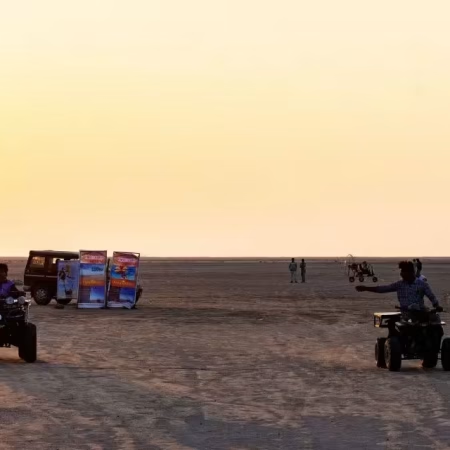
The journey to Dholavira is in itself breathtaking, taking you across the saline desert lands of the Great Rann, home to wildlife such as the chinkara gazelle, nilgai (the largest antelope in Asia), flamingos, and other exotic bird life.
Dholavira (discovered over a decade later) is estimated to be older than Lothal.
Lothal
While the two great cities of Mohenjo-daro and Harappa – of the ancient Indus Valley Civilisation (IVC) – were discovered in the 1920s in present day Pakistan, it was only in 1954 that the site of Lothal (“Mound of the Dead”), a once-flourishing port trading with Egypt, Mesopotamia, and Persia, was discovered along the Gulf of Khambat in Gujarat.
The discovery of this great port – the only one of its kind – marked a milestone result in the search for the IVC’s legacy in India. The discovery of Lothal (along with hundreds of other IVC sites found strewn across Rajasthan, Delhi, Haryana, and Gujarat) revealed the vast spread of the Bronze Age civilization beyond the Indus Valley.
Lothal was excavated from 1955-1960 by archaeologist S R Rao of the Archaeological Survey of India (ASI). Lothal is said to date back 3,700 years and is home to what is believed to be one of the oldest docks in the world. The site is surprisingly close to Ahmedabad, just 85 km away. It is located along the River Bhogava, a tributary of the legendary River Sabarmati and only 30 km from the Gulf of Khambat.
Lothal was a thriving centre of trade and industry, famous for its advanced town planning, superbly constructed underground sanitary drainage system, and a remarkable precision of standardised weights and measures.
The people of Lothal were experts in science, engineering, pottery, ornament-making, and metallurgy; apparently, the largest collection of archaeological artefacts from the IVC in India comes from Lothal, and among the most fascinating finds are their metal tools, weights, measures, seals, beads, and ornaments.
The Lothal site has been nominated as a UNESCO World Heritage Site.
UNESCO World Heritage Sites
Ahmedabad
Gujarat’s capital is Gandhinagar but, its premier city is Ahmedabad, 25 km away. Ahmedabad (Amdavad to locals) is named after its founder Ahmad Shah I, the Second Sultan of the Gujarat Sultanate, and is Gujarat’s largest city.
Ahmedabad, famed as a textile centre since the 15th century, especially flourished in British times and was hence called the ‘Manchester of the East’. Ahmedabad’s Old City is a maze of pols (residential areas designated by large gateways), mosques, wooden Jain temples, subterranean stone stepwells (called vav), and houses with ornately carved wooden balconies and window screens, and has some of the country’s finest medieval Islamic architecture.
Modern Ahmedabad, just across the River Sabarmati spanned by four bridges, is a showpiece of superbly designed contemporary architecture.
In July 2017, the Historic City of Ahmedabad or Old Ahmedabad, was declared India’s first UNESCO World Heritage City.
The superb Calico Museum was created in 1949 by the Sarabhai family (scientist Vikram Sarabhai, considered to be the father of the Indian space programme, and his danseuse wife Mrinalini Sarabhai) and is housed in their fabulous haveli (ancestral mansion).
Calico is the premier textile museum of the country and houses a distinguished and comprehensive collection of textiles and artefacts. Its outstanding collection of Indian fabrics documents and showcases the history and technique of handcrafted textiles in India spanning five centuries.
For an introduction to the urban heritage of the Old City, take a Heritage Walk – your route will take you through winding lanes and you will see bird feeders and traditional rainwater collection systems.
On the way take in iconic sites such as:
- Swami Narayan Mandir, a fine example of Maratha and Jain temple architecture
- Doshiwada ni Pol, the 90-year-old, 40-room haveli with carved cherubs, gabled roofs, Gothic windows and zigzag wooden stairs – all overlooking a central courtyard
- The dilapidated 15th-century Bhadra Citadel
- The magnificently domed 15th-century tomb complex Badshah no Hajira, which houses the graves of Ahmed Shah I and his heirs
- Jama Masjid, a glorious yellow sandstone mosque built by Ahmed Shah II in 1424
- Siddi Saiyyad Mosque, renowned for its intricate stone latticework
- Teen Darwaza, a ceremonial gateway built by Ahmed Shah
Le Corbusier (the renowned Swiss-French architect, designer, painter, urban planner, and writer) was invited to Ahmedabad in the mid-20th century by the mill owners to design their villas as well as some public buildings.
The Sanskar Kendra, Villa Sarabhai, Villa Shodhan, and Mill Owners’ Association Building were designed by Le Corbusier.
American architect Louis Kahn designed the IIM Ahmedabad.
The Premabhai Hall, Tagore Memorial Hall, and Institute of Indology were designed by B. V. Doshi, the noted Indian architect who worked under both Corbusier and Louis Kahn.
Ahmedabad has the unique distinction of being the only place in the world with buildings designed by two 20th-century architectural masters, Louis Kahn (American) and Le Corbusier (Swiss-French).
Ahmedabad’s famous dining halls serve mouth-watering Gujarati thalis (traditional course platter) but for an even more immersive food experience, visit the recreated Gujarati village of Vishalla – here, lounge on charpais (a traditional woven cot) and feast on a thali.
Around Ahmedabad
A little outside Ahmedabad lies the elegant Hutheesingh Jain Temple. The white marble temple, dedicated to the 15th Jain Tirthankara, was built in the late 19th century by Sheth Hutheesing, a wealthy merchant.
Around 19 km from Ahmedabad is the 16th-century Adalaj Vav in the quiet village of Adalaj. Built by Queen Rudabai of the Vaghela dynasty, the impressive five-storied stepwell was not just a cultural and utilitarian space, but also a spiritual refuge. It once served as a resting place for pilgrims and caravans along their trade routes.
It is the only stepwell in Gujarat with three entrance stairs. Adalaj is a spectacular example of Indo-Islamic architecture and design, with its intricate ornamentation and beautiful carvings of mythological scenes on its walls.
Lying to the southwest of Ahmedabad, on the north bank of an enormous reservoir built by Qutubuddin Ahmed Shah, the 15th-century Sarkhej Rauza group of monuments is an outstanding complex, blending Islamic, Hindu, and Jain architectural styles to showcase unique craftsmanship and construction.
Kankaria Tank, lying south east of Ahmedabad, was begun in 1446 by Qutubuddin Shah. The 34-sided polygon is surprisingly large enough to resemble a circle. In the centre is a garden island, connected to the shore by a causeway.
To the west of Kankaria are Armenian and Dutch tombs and graves (1615-1700) marked by obelisks, pyramids, and pavilions.
Champaner-Pavagadh Archaeological Park
Champaner, a medieval capital of Gujarat, is India’s only complete and unchanged pre-Mughal Islamic city.
Set amidst a spectacular landscape, it is a treasure trove of prehistoric (chalcolithic) sites, magnificent mosques, fortifications, religious buildings, residential precincts, and the remains of palaces, homes, and water works, from the 8th to 14th centuries CE.
The Kalikamata and Lakushila temples at the summit of Pavagadh Hill see a steady stream of pilgrims throughout the year.
Champaner-Pavagadh’s structures represent a perfect blend of Indo-Islamic architecture that showcases a distinct style of art, carvings, and lattice work.
Some of the complex’s most stunning structures are Khapra Zaveri no Mahal, Amir ki Manzil, Saat Kaman, and Shahi Masjid.
The ‘forgotten’ city of Champaner-Pavagadh was designated a UNESCO World Heritage Site in 2004.
Rani Ni Vav (in Patan)
Anhilvada Patan was the glorious capital of the Solanki dynasty of Gujarat from 942-1304 CE, shining as a centre of trade, learning, and architectural achievements.
Patan is also famed for its patola and mashru weaver communities. The woven patola sarees are known for their beauty and workmanship. The Salvis are the most famous weaver families of Patan, committed to protecting and conserving the dying art of hand-weaving.
This beautiful old town boasts Jain temples and carved wooden houses but is especially noted for the 11th-century Rani ni Vav.
The exquisitely sculpted Rani ni Vav (Queen’s stepwell) was commissioned by Rani Udayamati in 1063 in memory of her husband King Bhimdev I.
The steps begin at ground level, leading you down through several pillared pavilions to reach the deep well below. There are over 800 elaborate sculptures among seven galleries.
The central theme is the Dasavataras, or ten incarnations of Vishnu, including that of the Buddha. These are accompanied by other religious and celestial figures.
Rani ni Vav was inscribed as a UNESCO World Heritage Site in 2014.
Heritage & Architecture
Modhera
A little over 100 km from Ahmedabad, on the banks of the River Pushpavati in the Mehsana District, lies the village of Modhera.
Here is the wondrous Sun Temple, dedicated to Surya, the Hindu Sun God. Known for its genius in design, execution, and construction, the magnificent 11th-century temple was built by King Bhimdev I of the Solanki dynasty of Gujarat.
The sheer profusion of figures, religious and erotic, will leave you spellbound.
The three main components of the temple complex are two halls (shrine hall and assembly hall), and a reservoir. The halls have beautiful intricately carved exteriors and pillars.
Absolutely breathtaking is Surya Kund, a deep, symmetrical stepped tank that has steps leading to the bottom and numerous small shrines.
Interestingly, the entire Sun Temple and its pavilion seem to rest on the spine of innumerable richly sculpted elephants set along the base.
Modhera is also noted for the Modhera Dance Festival, an annual three-day classical dance festival, held here in the third week of January against the stunning backdrop of the Sun Temple.
Palitana
Located five kilometres from Bhavnagar (the city serves as a base to visit both Palitana and the Velavadar National Park), Palitana is one of the most sacred places of pilgrimage for Jains and is famed for its extraordinary cluster of marble Jain temples – over a thousand of them – that crown the twin summits of the Shatrunjaya Hills.
The temples here have been built since the 11th century CE, though most of them date back to the 16th century, many having been destroyed by invaders in the interim.
Exquisitely carved, the temples offer great views from the top. There are more than 3,500 steps all the way up the four-kilometre path to the top!
The main temple here is dedicated to Adinath – the first Jain Tirthankara.
Somnath
Located in the Junagadh District of Gujarat, Somnath is most famous for its grand Siva temple, the Somnath Jyoturlinga Temple.
Once marvellously wealthy, the temple was originally built between 320-500 CE but was plundered and destroyed several times for its treasures.
The present structure of the shrine was completed in 1961. Built in the Chalukyan style, the beautiful sea-facing temple has an ambience of wonderful light and space.
Especially worth experiencing here is the aarati (Hindu ritual of worship, in which the flame from wicks soaked in oil or clarified butter, or camphor, is offered to one or more deities, as adoration).
Ambaji
Ambaji is a tiny temple town. The heart and soul of this pilgrimage hotspot is the Ambaji Temple.
The temple is rather unique in that the sanctum does not house an idol of the resident deity Amba – the ‘mother goddess’ but a symbolic yantra (Shakti Visa Shree Yantra) – a gold-plated disc that has 51 sacred letters on it.
The yantra is kept in a cave-like space known as the gokh and is dressed by the priests in such a way as to look like the mother goddess.
The ‘original Shaktipeetha’ (significant shrines and pilgrimage destinations in Shaktism, the goddess-focused Hindu tradition) is believed to be three kilometres away, in the Ambaji Temple on Gabbar Hill.
Devotees can take a trolley service to the tiny open-air shrine in a few minutes or climb a flight of some 900 steps to the summit.
The other well-known temples in the area are the five marble Kumbhariya Jain Temples and the Neminath Temple.
Dwarka
Dwarka is considered to be one among the seven most sacred Hindu teerthas (pilgrimage sites and holy places in Hinduism as well as Jainism) and is believed to be the place where the beloved god Krishna settled with his Yadava clan after leaving Braj, where he once lived and ruled.
Also known as the Trilokasundara Temple, the Chalukya-style Dwarkadheesh Temple has been constructed with local stone.
The aaratis performed here are quite special, paying obeisance to the beautiful black idol of Krishna.
Behind the temple, the River Gomti flows into the sea. Nearby is a lighthouse that offers lovely panoramic views.
Other temples here include the Siddheshwar Mahadev Mandir and Bhadkeshwar Mahadev Mandir.
Udvada
Udvada is a pastoral town in coastal Gujarat, home to charming cottages and placid cattle.
In Udvada stands the Iranshah Atash Behram, the spiritual centre for Parsis and Zoroastrians, believed to be their oldest consecrated fire, established here on October 28, 1742.
While the fire temple (the place of worship for Zoroastrians/Parsis) is off limits for non-Zoroastrians, the little streets and bustle of old Udvada are fascinating.
You can explore the town’s heritage by way of its old Parsi houses that reflect a distinct culture. These quaint homes have double porches, little alleys running behind, with their own private wells.
Only a tiny community of Parsis continue to live here.
Navsari
Here is a little gem on the Parsi pilgrimage circuit of Gujarat.
Navsari was the home of the Iranshah for 250 years. Today, this town, located on the southern Gujarat coast, is still home to the Vadi Darb-e-Mehr, believed to have been consecrated in 1151.
It is the oldest extant fire temple outside Iran, as well as the oldest, and for some Parsis, the most venerable, revered initiation centre for martab, the qualification needed by priests to perform the higher liturgy.
Junagadh
With a name that means ‘Old Fort’, Junagadh lies in the Girnar foothills in the Saurashtra region of Gujarat, and is simply brimming with centuries of rich history and heritage spanning dominant periods of Jainism, Hinduism, Buddhism, and Islam, all of which left deep imprints on the city.
From temples dotting the hills above to spectacular ancient stepwells down deep in the earth to a magnificent fort to a Gothic-style palace to elegant mosques and tombs to second-century Buddhist caves, Junagadh excites and impresses with sheer individuality no other place can match!
Dominating the city, the sprawling ancient Uperkot Fort is believed to date back to the reign of the Mauryan emperor Chandragupta Maurya around 320 CE.
The fort is accessed through a narrow gateway with an ancient archway. The western wall inside the fort has two cannons (tope) named Neelam and Manek! Neelam Tope was cast in Egypt in 1531, and is 17 feet long.
Dating back to around 250 BCE, Emperor Ashoka’s 14 Rock Edicts are located on the route to the Mount Girnar Hills.
The Edicts are carved into an enormous rock in the Brahmi script in the ancient Pali language. They contain moral and ethical (not religious) precepts for living a virtuous life, respecting others, and creating a just society.
The Rock Edicts in Junagadh are one among several that Ashoka had carved in stone across India when he renounced violence and converted to Buddhism.
The ancient Buddhist Caves around Uparkot are actually three separate sites of rooms carved out of stone that were once used as Buddhist monks’ quarters.
The Caves are decorated with artwork on the pillars and carvings of Buddhist spiritual motifs; each set of caves is divided by stories. The cave groups, with their intricately carved gateways, halls, sculptured pillars, and sanctums are classic examples of rock-cut architecture.
To the east of the caves are two spectacular stepwells believed to date to the 11th century – Adi-Chadi Vav, which spirals down 100 feet to a broad well, and Navghan Vav, that plunges even deeper to 170 feet.
The 19th-century Mahabat Maqbara is perhaps the most bizarre structure in Junagadh. The tomb was built by Bahadur Khan III for his father Mahabat Khan II.
Next to it is the intricate Bahauddin Maqbara (built 1878-92) with its graceful corkscrew towers.
The 19th-century Maqbara of Naju Bibi shows off a distinctly indigenous Junagadh architectural style and sports a dome that can only be described as other worldly!
Junagadh Palace, the mid-19th-century home of the nawabs of Junagadh, has a bazaar in front with Gothic arches standing next to Indo-Islamic gateways and surrounded by a European clock tower.
The 19th-century Jumma Masjid is almost ballroom-like, with its Gothic arches and chandeliers.
Girnar Hill dominates the skyline of Junagadh at 3,000 feet.
The historic Jain temple complex of Girnar are 3,700 steps up the cliff, past a few caves, after a forest. The majestic complex looks like a 16th-century fortress clinging to the cliffside.
The most architecturally striking structure here is the Vastupala Temple.
Siddhpur
Siddhpur has rows and rows of palatial wooden 19th-century townhouses – painted in subtle pastel shades and built three-four storeys high.
Most of them were built by Gujarat’s flourishing mercantile Muslim community. Many of them now remain locked for a large part of the year, giving the town a deserted look.
Don’t miss the Rudra Mahalaya, also known as Rudramal, in Siddhpur. You can see the mystifying ruins of this 12th-century temple complex with tantric overtones.
Gondal
Situated in the Saurashtra region of Gujarat, the former princely state of Gondal still holds the air of a bygone royal era with its beautiful palaces and living spaces.
It stands testament to the work of the great visionary ruler Sir Bhagwatsinghji who introduced tax reforms and compulsory education for women, and stopped the practice of purdah (female seclusion) at a time when it was strongly practiced by royal families in the 19th century.
To get an idea of Gondal’s fascinating history and progressive maharaja, visit the Naulakha Palace.
And do go and see the Vintage Car Collection. The royals of Gondal also loved cars – their passion led to a grand collection of automobiles which are now displayed in the museum in the palace premises.
Morvi
Morvi may today be a bustling manufacturing centre noted for its ceramic and clock-making industries, but this town in Gujarat’s Rajkot district holds an astonishing array of built heritage – such as the Rajput-style Willingdon Secretariat, the engineering marvel of Julto Pul (suspension bridge), the Green Chowk (modelled on European town-planning principles), and the Art Deco Palace and Nazarbag Palace, among others.
Morvi owes its rich architectural heritage to its erstwhile status as one of the most prosperous princely states in India, ruled by a progressive clan of Jadeja Rajputs.
But hands down the most stunning of Morvi’s treasures is the breathtaking Darbargadh Palace – the sprawling 19th-century structure overlooking the River Machhu was damaged in the 2001 earthquake but has been painstakingly restored by Princess Uma Morvi.
Vadodara
Fondly called Baroda, Vadodara is acknowledged as the cultural capital of Gujarat.
This distinction can be mostly credited to Sayajirao Gaekwad III, a visionary ruler of Baroda State in the late 19th century.
The Gaekwads, one of several powerful Maratha clans who rose to power in the late 17th century and established an extensive empire covering most of present-day India, ruled over Baroda from 1721 to 1947.
Sayajirao was truly progressive – he made primary education free and compulsory, abolished child marriage and untouchability, constructed a railroad system, and began the iconic Bank of Baroda to promote commerce.
Sayaji Baug, opened in 1879 on the banks of the River Vishwamitra to offer Baroda’s people both recreation and education, stands testament to this great ruler’s vision.
The 113-acre park boasts Grecian statues around the Victorian-style bandstand, deer in the large zoo, a botanical garden, an aquarium, a planetarium, and the History of Health Museum.
But the real gem of Sayaji Baug is the Baroda Museum and Picture Gallery, whose treasures include an Egyptian mummy, the skeleton of a 71-foot blue whale, and art by European masters.
Sayajirao brought his eclectic influences to the impressive and dramatic Laxmi Vilas Palace, the home he built in 1890 and named after his wife.
The palace is a fabulous blend of East-West architectural styles. The durbar room is lit by massive stained-glass windows illustrating stories from the epics!
And the throne room is adorned with the beautiful art of the famous painter-royal from South India – Raja Ravi Varma.
The Maharaja Fateh Singh Museum in the grounds has a collection too, of paintings by Raja Ravi Varma.
The Old City is home to the Pratap Vilas Palace, Nazar Baug Palace, Tambekar Wada (a wooden haveli), Nyayamandir Court, and Suryasagar Lake.
The campus of the Maharaja Sayajirao University (1881) is replete with majestic buildings and small museums.
Related Posts