 English
 Deutsch
 Italia
 August 19, 2026 By admin
In the Forest of the Gonds Chhattisgarh
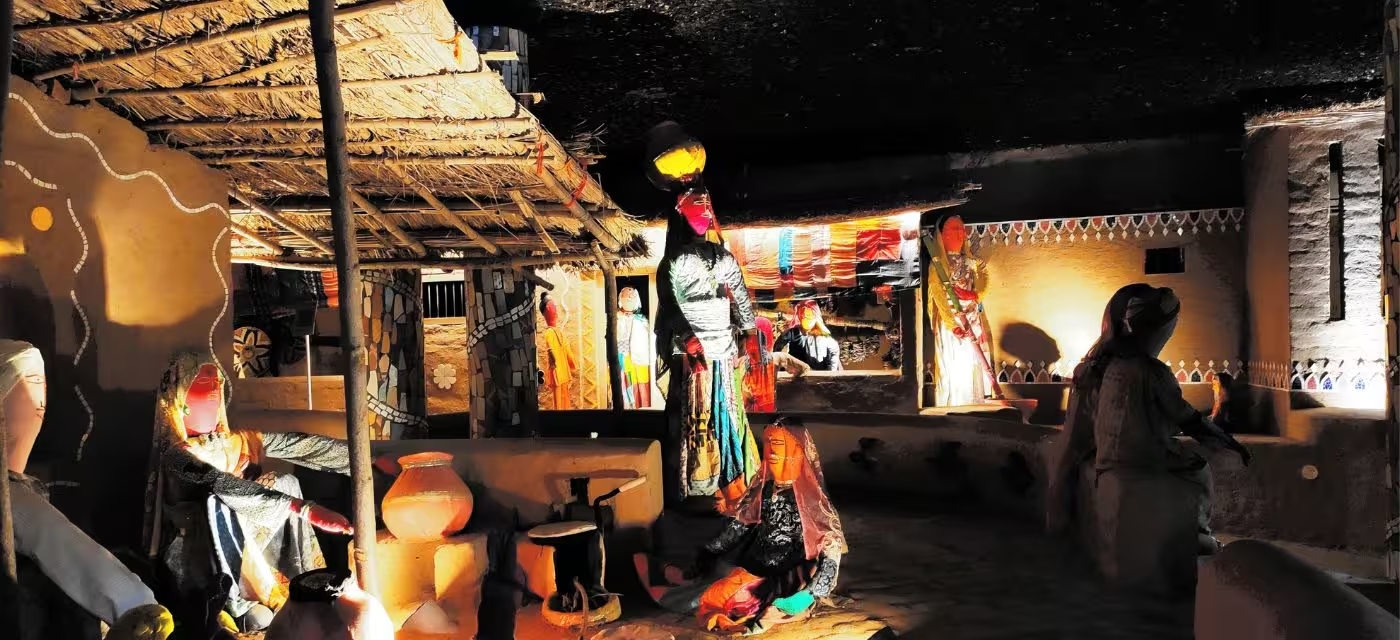
In the Forests of the Gonds
“Twenty years from now you will be more disappointed by the things you didn’t do than by the ones you did. So throw off the bowlines, sail away from the safe harbour. Catch the trade winds in your sails. Explore. Dream. Discover.”
— Mark Twain
If you’re planning a holiday in India, it’s time to move beyond the familiar itinerary and travel into the heart of the country.
Deep in Central India lies Chhattisgarh — a land of dense forests, remarkable wildlife, fascinating tribal heritage, ancient monuments, traditional crafts and spectacular natural beauty.
Welcome to Chhattisgarh
Chhattisgarh came into existence as a state on November 1, 2000, after being carved out of undivided Madhya Pradesh.
The state is bordered by Odisha, Jharkhand, Madhya Pradesh, Uttar Pradesh, Maharashtra and Telangana, with Raipur as its capital.
With around 42% forest cover, Chhattisgarh is among India’s important biodiversity regions. Its forests support diverse wildlife, distinctive flora and birdlife, as well as abundant non-timber forest products.
But its natural wealth is only part of the story.
Chhattisgarh also possesses an extraordinary cultural heritage of literature, performing arts, festivals and traditional crafts — from painting, woodcarving and bell-metal work to bamboo crafts and tribal jewellery.
Ancient temples, Buddhist sites, palaces, caves and prehistoric rock art further enrich the landscape.
Bastar – The Tribal Heartland
Perhaps the most famous region of Chhattisgarh, Bastar is a tribal-dominated region blessed with exceptional natural and cultural wealth.
Its forests preserve centuries-old traditions, festivals, crafts and ways of life.
The Bastar tribes are particularly renowned for their expertise in metalwork, creating beautiful figurines of tribal deities, animals, oil lamps and carts.
The Gonds of Bastar are especially well known.
For travellers interested in responsible and culturally sensitive exploration, Bastar offers an opportunity to discover an important living heritage of Central India.
Jagdalpur
The ideal base for exploring Bastar is Jagdalpur, situated on the banks of the River Indravati.
The town provides access to some of the region’s most fascinating cultural and natural attractions.
Must See
Zonal Anthropological Museum
An excellent introduction to Bastar’s distinctive tribal culture and traditions.
Bastar Palace
Once the headquarters of the erstwhile princely state of Bastar, the palace reflects the grandeur of a bygone era.
Its architecture features delicate carvings and intricate etchings. The main visitor’s room has been converted into a museum displaying portraits, ornate singhasans or thrones, and palangs or royal beds.
Beautiful gardens surround the palace.
Dalpat Sagar Lake
A lovely place for boating, particularly during winter.
Danteshwari Temple
Situated close to the lake, this temple is dedicated to Danteshwari, the six-armed black deity associated with the Kakatiya kings of Bastar.
Barsur
Barsur lies along the Bastar-Dantewada border and carries the legacy of the Kakatiya rulers.
King Annam Deo established his rule here in the 15th century.
Today, the area is known for the remains of an ancient temple complex.
Among its remarkable structures is a Shiva Temple with twelve stone pillars bearing carved figures.
The Mama Bhanja ka Mandir, standing around 50 feet tall, features remarkable carvings that resemble bells hanging from chains.
The landscape is also dotted with menhirs — stones and slabs representing different aspects of life, alongside colourful wooden staffs decorated with animal heads.
For travellers interested in history and traditional art, Barsur is a fascinating detour.
Chitrakot
Here, the River Indravati leaves Bastar and plunges nearly 94 feet into a ravine.
The result is the spectacular Chitrakot Waterfall.
Its distinctive horseshoe shape has made it one of the most recognised natural attractions in Chhattisgarh.
Chitrakot also offers a quieter experience beyond sightseeing. Once associated with anthropologist Verrier Elwin, the area is ideal for peaceful walks and angling while taking in the surrounding landscape.
Kawardha Palace
Also known as Raj Mahal, Kawardha Palace was the residence of the erstwhile ruling family of Kawardha.
Built in the 1930s by Maharaja Dharamraj Singh, the palace occupies 11 acres of landscaped gardens surrounded by fields and forests.
The magnificent Durbar Hall, more than 80 feet high, features a towering dome and gold-leaf filigree.
Visitors can also enjoy royal suites, verandahs, gardens and extensive views of the surrounding greenery.
Excursions to nearby attractions and local folk performances can also be arranged for guests.
Bhoramdeo Temple
Around 16 km from the palace lies the ancient Bhoramdeo Temple.
Dating to the 10th century, the temple is often compared with the Khajuraho temples of neighbouring Madhya Pradesh.
Named after the tribal deity Bhoram, the temple stands amid trees and wildlife.
Its façade is covered with intricate relief sculptures, while the inner sanctum creates a striking contrast of darkness and silence.
Achanakmar Wildlife Sanctuary
Established in 1957, Achanakmar Wildlife Sanctuary covers more than 500 sq km of lush forest.
The sanctuary lies amid the Mekhal Range, where the Vindhya and Satpura ranges meet.
Safaris generally take place in the morning and evening and require a guide.
Wildlife includes:
- Deer
- Wild boar
- Bear
- Tiger
- Leopard
- Striped hyena
- Jackal
- Sloth bear
- Indian wild dog
- Antelope
- Mountain gazelle
- Blackbuck
For wildlife enthusiasts, Achanakmar offers the chance to explore one of Central India’s less-explored forests.
Barnawapara Wildlife Sanctuary
Named after the villages of Bar and Nawapara, Barnawapara Wildlife Sanctuary was established in 1976.
Its forests are supported by abundant rainfall, streams, rivulets and numerous watering holes, creating excellent conditions for wildlife.
The sanctuary is home to:
- Leopard
- Antelope
- Mouse deer
- Sloth bear
- Indian wild dog
- Jungle cat
- Porcupine
- Tiger
- Giant flying squirrel
- Palm civet
- Civet cat
Birdwatchers can look for more than 150 species, including the golden oriole, racket-tailed drongo, heron and barbet.
Reptiles include monitor lizards, cobras, kraits, pythons and rat snakes.
Exploration should be undertaken with a guide.
Chhuikhadan
Described as one of Gondwana’s best-kept secrets, Chhuikhadan reveals a fascinating combination of royal heritage and rural life.
The Chhuikhadan Palace has been transformed into a heritage stay.
Built across seven acres, the palace features concentric walls and buildings surrounding the central Kesar Mahal.
Its beautifully painted rooms reveal two contrasting influences. Raja Bhudar Kishore Das commissioned artwork based on both religious themes and European lifestyles.
The surrounding village provides another glimpse into local traditions.
Farmhouses feature traditional mud architecture, often decorated with white and coloured lime-wash.
Visitors staying at the palace may also have opportunities to meet local weavers and potters and observe their traditional crafts.
Guru Ghasidas National Park
Formerly known as Sanjay National Park, Guru Ghasidas National Park was renamed in honour of the region’s influential social reformer.
Its relatively unexplored character is one of its greatest attractions.
The park consists of mixed forests of teak, sal and bamboo, supporting a wide variety of animals and birds.
Its importance extends beyond its own boundaries because it forms a significant wildlife corridor linking the Bandhavgarh and Palamau tiger reserves.
Dense forests, streams, undulating terrain and the possibility of encountering tigers make this a destination worth discovering.
Kanger Valley National Park
Established in 1982, Kanger Valley National Park is among the most spectacular natural landscapes of Chhattisgarh.
Located around 27 km from Jagdalpur, the park lies along the River Kolab and takes its name from the Kanger River flowing through the valley.
Its wildlife includes:
- Tigers
- Leopards
- Wild cats
- Mouse deer
- Jackals
- Rhesus monkeys
- Macaques
- Sloth bears
- Giant flying squirrels
- Otters
- Civet cats
- Striped hyenas
- Wild pigs
- Cobras
- Pythons
- Crocodiles
- Monitor lizards
But one of its most celebrated inhabitants is the hill mynah, also known as the Bastar Mynah and recognised as the state bird of Chhattisgarh.
Tirathgarh Falls
Near Kanger Valley are the magnificent Tirathgarh Falls, where a broad stream cascades across massive rocks.
The surrounding landscape allows visitors to walk, climb and explore the area around the waterfall.
A temple dedicated to Shiva and Parvati lies near the foot of the falls. The word tirath, meaning pilgrimage, is associated with the name of the falls.
Kanger Dhara and Dandak Caves
At Kanger Dhara, water rushes powerfully through the rocks, creating another dramatic natural spectacle.
From here, a series of steps leads towards the Dandak Caves, where visitors can see a distinctive stalactite Shiva lingam known as Patala Linga, accompanied by a perennial spring.
Kutumsar Caves
Perhaps the most extraordinary underground attraction in the region is Kutumsar Caves.
Entering through a narrow vertical opening, visitors descend into darkness before the guide’s torch reveals an extraordinary subterranean world.
Stalactites and stalagmites, formed over long periods by dripping underground water, create remarkable natural formations.
Some formations resemble familiar figures and objects, including an elephant’s trunk and Ganesha, while another is revered as a Shiva linga.
Kanker
The Kanker Royal Palace stands among hills and gardens and retains the character of a colonial-era residence.
Built during the early 20th century and rebuilt in 1937, the palace was once known as Radhanivas Bagicha.
It remains associated with the erstwhile royal family of Kanker.
Today, the heritage property provides a base for exploring the region.
Experiences include:
- Tribal village tours
- Forest excursions
- Boating safaris
- Angling
- Jeep safaris
- Wildlife sanctuary visits
Udanti Wild Buffalo Wildlife Sanctuary
Created specifically to protect the wild buffalo, Udanti Wildlife Sanctuary covers around 247 sq km.
The sanctuary can be explored in a day and is rich in wildlife and birdlife.
A watchtower rising around 370 feet above sea level provides an excellent vantage point.
Below it lie lakes and streams, including Nagesh Talab, whose clear waters create a striking contrast against the surrounding greenery.
Sitanadi Wildlife Sanctuary
Spread across approximately 556 sq km, Sitanadi Wildlife Sanctuary combines dense forests with serene waters.
Established in 1974, the sanctuary supports diverse wildlife and birdlife.
Its watchtower, situated around 635 metres above sea level, offers expansive views of the surrounding landscape.
The tower is surrounded by seven mountains, each named after one of the Saptarishis, the seven sages of Hindu mythology.
Morning and evening safaris are conducted with guides.
For wildlife enthusiasts seeking lesser-known destinations, Sitanadi offers considerable potential as a Central Indian wilderness experience.
Discover Chhattisgarh
Chhattisgarh is a destination for travellers willing to go beyond the conventional.
Its dense forests preserve remarkable biodiversity.
Its rivers create dramatic waterfalls and landscapes.
Its palaces reveal forgotten royal histories.
Its temples preserve ancient traditions.
Its villages continue generations-old crafts.
And its tribal communities remain an important part of the state’s cultural identity.
With its growing focus on eco-tourism, rural tourism, tribal culture, fairs, festivals and unexplored travel circuits, Chhattisgarh is steadily emerging on India’s tourism map.
For those looking to discover a different side of India, the forests, rivers, palaces and tribal heartlands of Chhattisgarh offer an unforgettable journey.
Do visit.
Related Posts