 English
 Deutsch
 Italia
 August 20, 2026 By admin
Hornbill Festival Nagaland
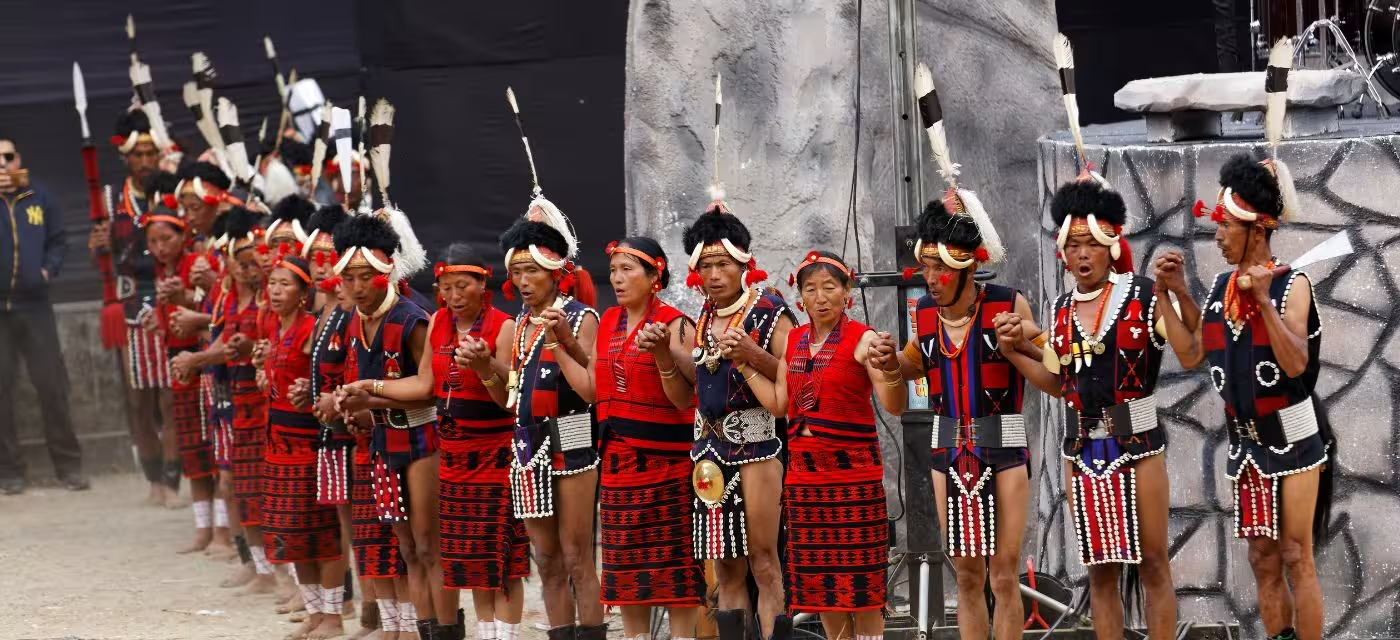
THE HORNBILL FESTIVAL: CELEBRATING THE NAGA SPIRIT
Travelling to Nagaland to experience the Hornbill Festival should be high on anyone’s bucket list. Nagaland had been challenging to reach in the past in terms of distance, transportation options, and government permits. Today, travel restrictions have been lifted, multiple flights get you there in a jiffy, and the Hornbill Festival brings together so many distinct tribes to celebrate and share culture that it is not to be missed.
The Festival is named after the Great Indian or Pied Hornbill, the large and colourful forest bird depicted in many Naga myths, fables, folklore, songs, and dances. History has it that the Great Pied Hornbill, considered to be the king of birds, was revered as a symbol of courage; its feathers could only be worn by a warrior and its image used by chiefs.
Nagaland itself is a tropical mountainous state which Lonely Planet calls “The Wild East.” Myanmar (Burma) on the eastern border, Assam to the west, and Manipur to the south were the settings for centuries of raids and counter-raids, including the collection of heads by successful warriors. Arunachal Pradesh and part of Assam crown the northern border.
The entire North-East region of India consists of the contiguous Seven Sister States of Assam, Arunachal Pradesh, Meghalaya, Manipur, Mizoram, Nagaland, and Tripura, and a “Brother” – Sikkim. There is an astounding mix of racial types – Mongoloid, Indo-Burmese, Indo-Iranian, and Aryan. The peoples, languages, customs, cultures, crafts, and cuisines change every 50 kilometres.
Nagaland itself has 16 major Indo-Mongoloid tribes and numerous sub-tribes speaking languages that are not understood even a relatively short distance away. It is hence convenient for all, visitors and locals alike, that English is the official state language.
Traditional festivals revolve around the lunar calendar and agricultural seasons to propitiate animistic spirits that inhabit villages and jungles. The folk religions connect the fertility of Mother Earth to purification and rejuvenation. After fasting, feasting plays a major role in social bonding among communities. Meat is essential and which portion of meat is given to whom is of great significance.
Christianity arrived in Nagaland in the early 19th century via the American Baptist Naga Mission. Today, Nagaland is known as “the only predominantly Baptist state in the world” and Christians constitute over 75 per cent of the state’s population.
THE HORNBILL FESTIVAL
The first Hornbill Festival, in the year 2000, was established by the state government to begin on December 1 – National Statehood Day.
The Festival runs for ten days, from December 1–10. The venue of the Festival is the Kisama Naga Heritage Village, combined from two villages, Kigwema (KI) and Phesama (SA), and MA, which means village.
This is located about 10 kilometres from Kohima – the capital city – which comfortably accommodates most visitors.
There are 16 entrances symbolising the different tribes of Nagaland. Each tribe has constructed an impressive morung to showcase their individual cultures.
Traditionally, morungs were located at the entrance to a village as dormitory barracks for post-puberty and unmarried tribesmen. This not only served to guard the village but also inculcated the training and values of the community for both war and peace.
The architecture sports massive bamboo and wooden totem images and glorious rooftop designs. Inside could be found trophies from battle, including human heads taken from raids. Many had space for log drums carved out of whole trees, which the young men could play in unison for festivals, messages of warning, or before going to war.
These drums resonate through the Kisama Village during the Hornbill Festival to call you to what is happening inside a morung – food, warmth, and easy camaraderie.
CULTURE, MUSIC AND TRADITIONS
All the tribes and sub-tribes of Nagaland, and even tribes of neighbouring states, participate all day and into the night in a huge variety of events.
There are indigenous games and a series of competitions in a variety of activities. Cultural performances of folk dances, song, and drama begin as early as nine in the morning, while the evening Hornbill National Rock Concerts draw participating bands from across the country and abroad.
Of course, there are numerous displays of handicrafts, handloom, and jewellery at the crafts bazaars.
The spectacular bead and stone jewellery of the different tribes are irresistible, as are the distinctive warrior shawls woven in bold colours from vegetable-dyed homespun wool and cotton.
The traditional wrapped garments of both men and women are created using hip or loin looms. These portable looms can be attached in front to any structure and in back around the hips, so the warp and weft results in a long but narrow fabric that is joined to another, to be worn by women as a full attire covering waist to ankle or chest to knee.
An amazing Night Market follows the evening rock concerts, so you don’t even have to squeeze in shopping between events during the day!
MORE THAN A FESTIVAL
Fashion shows creatively translate traditional handloom into modern design statements.
For others, the draw will be to the cycling and motor sport events. For families, there is a children’s carnival.
If this isn’t enough to fill your day and night, be sure to visit the floral galleria and see the orchids and other tropical flowers displayed.
Feature-length films and documentaries from the region and beyond are showcased in a film festival; and then, of course, there are the food courts.
A TASTE OF NAGALAND
Nagaland prides itself on its cuisine, and non-vegetarian specialities include pork bamboo shoot gravy, smoked pork anishi (fermented colocasia leaves), and fish with dried bamboo shoot.
Alongside or between meals, there is plenty of Nagaland’s famous zutho (fermented rice beer) to enjoy – drunk best out of tall bamboo tumblers.
A major highlight of the Festival is the Naga chilli-eating competition and pork-eating festival. Join the huge crowds for this or join in, but beware, the chillies are among the hottest in the world!
PLAN YOUR VISIT
Try to book your accommodation in Kohima or Kisama early, before everything is booked.
You can reach the venue by booking a taxi. Be sure to get a valid pass to park the vehicle when you get your entry ticket, before passing through the security check – and have a great time.
If you want an even bigger cultural extravaganza, attend the Manipur Sangai Festival from November 20–30 and, after the closing ceremony in Imphal, Manipur, it’s just a four-hour national highway drive to reach Kohima for the Hornbill Festival.
Related Posts