 English
 Deutsch
 Italia
 May 14, 2025 By admin
History of Indian Jewellery
The Fascinating History of Indian Jewellery
History of Indian jewellery is as old as the history of the country itself. Around 5000 years ago, a desire to adorn themselves lead to the origin of jewellery. Since then, Indian women and men wore jewellery with much aplomb.
Historians believe that material used for making jewellery improved with the passage of time. It probably began with ivory, copper to semi-precious stones and then to silver, gold and precious stones.
However, what is intrinsic to our design heritage is the use of the flower as well paisley motifs which appealing Indian jewellery designs even today.
As time passed by, people learnt the art of polishing metals such as gold and silver and learnt to extract semi-precious stones and gems from the mines. As empires rose and fell, kings wore jewellery that made them look like Gods.
Every big and small piece of adornment like rings, earrings, bangles, chains, crowns, anklets, etc. were made of gold and precious stones.
The significance of jewellery in the country is evident from the fact that jewellery holds a pride of place in all auspicious occasions.
Though the trend of men adoring themselves has now faded away, many of them still use earrings, bracelets, pedants, etc. However, it is the Indian women for whom jewellery holds utmost significance.
In India, jewellery is considered auspicious for women. Jewellery design is so versatile in India that it varies from state to state. However, some basic jewellery is common among all the women across India.
While the designs in solid gold jewellery of Tamil Nadu and Kerala are inspired by nature, the Meenakari and Kundan styles of jewellery making have been influenced by the Mughal dynasty.
Then there is a huge range of silver beads found all over India, especially in Rajasthan, Gujarat, Madhya Pradesh and Himachal Pradesh. Their availability leads to the development of the bead jewellery, popular till date.
India is home to various kinds of jewellery art, ranging from Meenakari and Kundan to stone and bead work. The craft of cutting and polishing precious and semi-precious stones and giving them a dazzling face is something artistic.
Emeralds, rubies, garnets, amethysts, corals, sapphires, and turquoises are stones that are paired with gold and silver jewellery.
Kundan jewellery is something that can be described as art on gold. It is a Mughal-inspired art of setting precious stones like diamonds, rubies, and emeralds in gold and silver jewellery.
In Meenakari, enameling is done to protect gold and floral pattern coloured in red, blue and green attracts the attention.
Silver jewellery is not far behind in popularity, particularly because of its affordability, making it popular among low income group people. Jhumka, hansli, chokar, nath and bracelets made of silver are quite popular among women in India.
In short, the range of jewellery in India is wide as well as varied. Be it gold, silver of diamond, you will find everything in the country.
An Indian bride is deemed incomplete without sixteen adornments and jewellery forms an essential part of these adornments. On the main wedding day, every bride is expected to look her best.
There are a number of items in the jewellery which covers her entire body. These items are specially prepared to compliment her bridal attire.
Some of the Most Popular Jewellery Varieties Are:
Maangtika
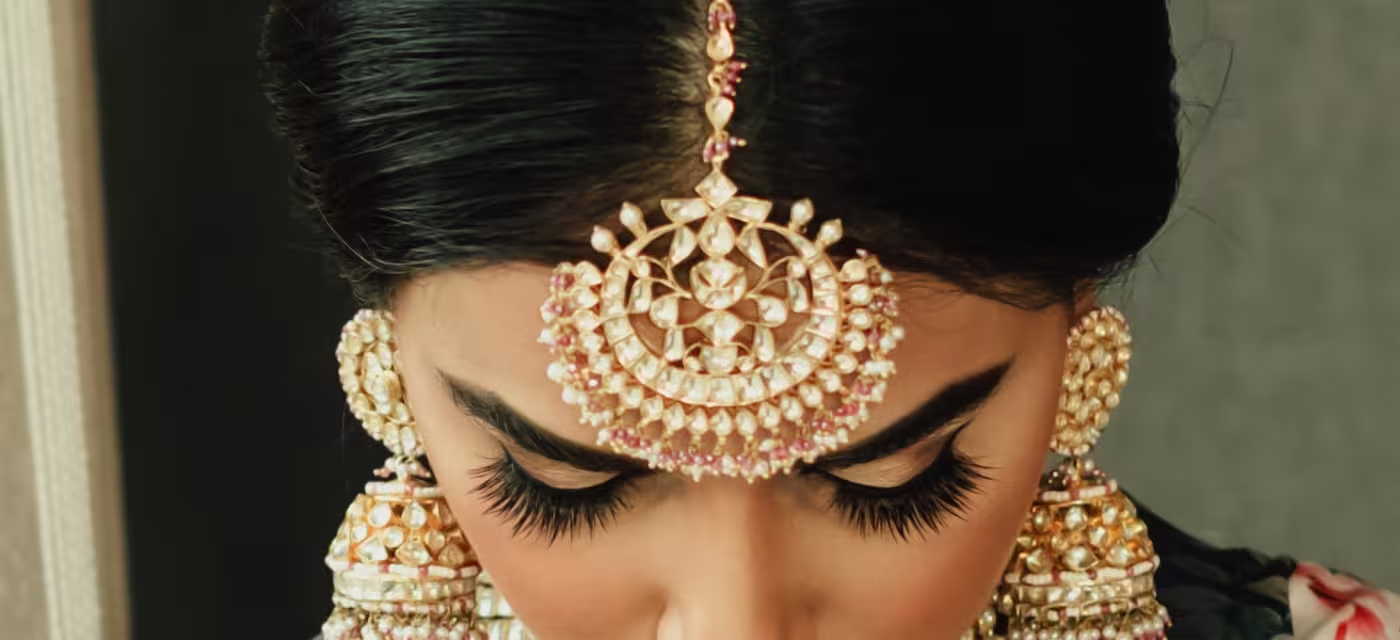
It is worn on the forehead by the bride. This is a reason why most of the bridal hair styles bear centre parting. This is done in order to accommodate the maangtika.
This can be in different shapes and studded with different precious and semi-precious stones. It usually consists of a string a with a centre piece attached to one end.
In varied cultures, the form of the maangtika varies. It is even seen as a crown in some regions.
Necklace
Necklace is the most eye catchy piece of jewellery, worn by the bride. It comes along with matching ear rings and nose piece.
Moreover, attention is paid that it complements the colour of your attire and neck line. A choker is deemed perfect for such an occasion, coupled with a long necklace.
Ear Rings
The ear rings usually match the necklace. You can choose between varieties like long heavy ear rings or short loops, from antique ear rings to small studs, depending upon your wedding outfit’s colour and design.
Nose Ring
This is another essential jewellery item to be worn by the bride. It is also chosen keeping in mind the colour and design of the ear rings.
The traditional nose piece is known as ‘Nath’, which consists of a studded nose ring with a long chain hooked up in the hair.
In case the nose is not pierced, there are nose studs available, which can be temporarily worn by the bride for the ceremony.
Bangles
Bangles are the symbol of the nuptial rituals. As a result, the bride wears both gold as well as glass bangles on her wedding day.
The glass bangles are mostly of the colour of the wedding dress. However, the gold bangles are the ones gifted by the mother in law.
Related Posts