 English
 Deutsch
 Italia
 August 27, 2026 By admin
Journey to the Mountains of Faith Tibet
JOURNEY TO THE MOUNTAINS OF FAITH
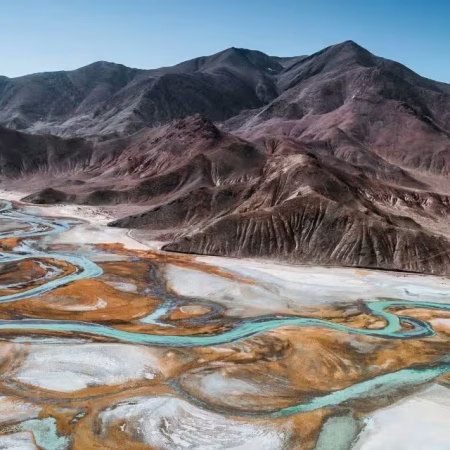
Range upon range of spectacular snow-topped mountains tower over vast expanses of arid plains, turquoise lakes shimmer in the golden sun even as they rest in the icy shade of primeval glaciers, snaking highways make their way through lofty passes draped with colourful prayer flags that flutter without pause as winds sweep unchecked, and the north face of the world’s highest peak is illuminated with magnificent mountain light – this is exquisite geography. And humbling.
Welcome to Tibet
We have a saying in Tibet: If a problem can be solved there is no use worrying about it. If it can’t be solved, worrying will do no good.
– Heinrich Harrer, Seven Years in Tibet
Described simply as the ‘Roof of the World’, Tibet is the highest region on the earth. Tibet sits in the heart of Asia, right between India and China. Some consider it to be the far eastern edge of Central Asia, while others classify it as East Asia. Tibet shares borders with Nepal, Bhutan, Burma, and China (which occupied Tibet in 1959).
Tibet’s extreme high-altitude mountains are the source of many of Asia’s great waters, including the Indus, Sutlej, Yarlung Tsampo (which becomes the Brahmaputra in India), Salween, Mekong, Yangtze, and Yellow Rivers.
The Tibetan Plateau has an average elevation exceeding 4,500 metres and is regarded as the world’s highest and largest plateau, with an area of 2,500,000 square kilometres. Home, also, to some of the world’s tallest mountains, Tibet has the ability to astound, transform, and inspire even the toughest of travellers.
Sky-high Lhasa – Tibet’s traditional capital as also the capital of the Tibet Autonomous Region – is the centre of ancient Tibetan tradition and Tibetan Buddhist pilgrimage. Once a “forbidden city”, Lhasa retains its air of mysticism, spirituality, and old-world charm. Wander the fabled mountain city and explore its extraordinary mix of winding alleyways, backstreet temples, markets, squares, and the old town.
At 12,139 feet above sea level, the dramatic Potala Palace dominates Lhasa’s stunning skyline. The 13-storied complex monument, rising to a height of above 117 metres, is the highest palace in the world. The seventh-century structure was originally commissioned by Tibetan king Songtsen Gambo; eventually, though, it was expanded and became the winter palace and home of the Dalai Lama when the monastic order came to govern Tibet. But when the 14th Dalai Lama fled to India during the 1959 Tibetan uprising, the Chinese government took over and converted the grounds into a museum.
Enclosed within massive walls, gates, and turrets built of rammed earth and stone, the White and Red Palaces and ancillary buildings of the Potala Palace rise from Red Mountain in the centre of the Lhasa Valley at an altitude of 3,700 metres. The White Palace holds the main ceremonial hall with the throne of the Dalai Lama. The Palace contains over 1,000 lavish rooms, labyrinthine corridors, nearly 10,000 painted scrolls, 698 murals, thousands of exquisite sculptures, carpets, canopies, curtains, porcelain, jade, and fine objects of gold and silver, as well as a large collection of ancient sutras and important historical documents.
The Red Palace serves as the administrative area. Inside, you can see the gilded burial stupas of eight Dalai Lamas, hundreds of sacred Buddhist scrolls, and numerous shrines. Butter lamps light the hallways and monks silently keep watch to ensure that decorum is maintained.
Inscribed as a UNESCO World Heritage Site in 1994, the Potala Palace is one of the most famous and enduring spiritual sanctums in the world.
The climb up the steps of the Potala Palace may be arduous, but it is worth every bit the effort just for the spectacular views from the top.
For Tibetans, the most sacred and important pilgrimage site is the Jokhang Temple Monastery in the old town of Lhasa. Therefore, do make it one of your primary points of call whilst in Tibet.
Founded in the seventh century CE in order to promote Buddhism, the beautiful Temple is the oldest of its kind in Tibet, and is a UNESCO World Heritage Site. Painted in deep hues of red and gold, the geomantic complex comprises an entrance porch, courtyard, and hall flanked by accommodation for monks and storehouses on all four sides. Constructed of wood and stone, the structures are superb examples of the Tibetan Buddhist style of architecture, with influences from China, India, and Nepal. Inside are housed over 3,000 images of the Buddha and other Buddhist deities and historical figures, alongside several other treasures and manuscripts. Murals depicting religious and historical scenes adorn the walls.
An inner shrine houses the country’s holiest and most revered figure – the Jowo Rinpoche – a seated Buddha installed when Buddhism was adopted by Tibetan royalty in the seventh century. Buddhism is an integral part of the lives of modern Tibetans and remains the most important defining element of their culture.
You can tell how deep and unshakeable their faith is when you see lines upon lines of pilgrims waiting outside the Temple, in preparation for their special journey. Around the Temple, too, you will find worshippers prostrating in prayer, turning their prayer wheels, or bowing before Buddhist icons. The experience is fascinating, inspiring, and beautiful.
Drive to the outskirts of the city, around two kilometres west of the Potala Palace, to visit Norbulingka, the former summer palace of the Dalai Lama. Constructed in the 18th century, Norbulingka stands on the bank of the Lhasa River, amidst lush greenery. A vast, leafy garden integrates four palace complexes and a monastery, as well as other halls and pavilions, into the layout, showcasing exceptional design and architecture.
Norbulingka was also a religious, political, and administrative centre, having been a place for philosophical debates, contemplation, and for signing political agreements.
Norbulingka is a UNESCO World Heritage Site.
Through the beauty of their architecture, uniqueness of layout, and rich design, all set against an extraordinary landscape, the ensemble sites of the Potala Palace, Jokhang Temple Monastery, and Norbulingka are outstanding embodiments of Tibetan culture, religion, and governance.
Once you have finished exploring these three iconic sites, you can immerse yourself in the timeless atmosphere of old Tibet at Barkhor, Lhasa’s traditional market. The immensely popular Barkhor Market (Bazaar) is the main square of Lhasa. Vibrant, colourful, and selling everything from fresh produce to fragrant incense, Barkhor is where you can find (and haggle for!) delightful traditional Tibetan handicrafts, Buddhist artefacts, carpets, paintings, sculptures, and much more, to pick up as souvenirs or gifts.
We recommend heading out to the outskirts of Lhasa on day trips to truly experience the heart of Tibet’s ancient faith and culture in three of the country’s greatest Gelugpa or Yellow Hat (one of the five main traditions of Tibetan Buddhism) monasteries: Drepung, Sera, and Nechung.
Some five kilometres from Lhasa is the Sera Monastery, founded in 1419. It sits in the prettiest and most charming atmosphere, at the base of Mount Purbuchok. Sera Monastery was once an important centre for learning where around 5,000 to 6,000 monks also resided. Currently, around 550 monks are said to be living in the Monastery. The most intriguing feature here is the nine-metre image of Maitreya which was erected in 1419. In the courtyard of the Monastery, witness resident monks animatedly debate Buddhist philosophy as they pitch their knowledge against each other.
Explore the Drepung Monastery, perched on Mount Gambo Utse. Once home to some 10,000 monks, Drepung is still one of the most impressive monasteries in Tibet. Wander through its dark, centuries-old halls; listen for the lilting, booming chants of monks at prayer.
A 10-minute walk downhill from Drepung will bring you to the Nechung Monastery, historically known as the former seat of Tibet’s State Oracle until 1959. The Nechung oracle was considered the protector of the Buddhist state and the Dalai Lamas would make no important decision without consulting him. Nechung has a distinct air, different from the other monasteries; perhaps because it has long been associated with matters such as exorcism, possession, and pre-Buddhist rites.
Another noted monastery, around 50 km east of Lhasa, is the historic Ganden Monastery (founded 1417), one of the most important monastic sites in Tibet and the first Gelugpa monastery. Destroyed by China’s Red Army in 1966, Ganden is once again a working monastery where some 400 monks now study. Two koras (pilgrim circuits) offer stupendous views over the crisscross Kyi-chu Valley.
Travelling westward from Lhasa, experience the distinctive culture of western Tibet and the traditional Tibetan way of life in local villages. On the way you will see the brilliant turquoise waters of Lake Yamdrok, cross two spectacular high passes, and experience a jaw-dropping hanging glacier before you reach Gyantse.
Historically Tibet’s third-largest city, Gyantse, with its imposing ancient dzong (fortress) and city walls, retains the air and charm of old-world Tibet.
Here, explore the Pelkor Chode, a complex of monasteries and temples in which all four major sects of Tibetan Buddhism are worshipped. Work started on the complex in 1418 and was completed in 1425. Remarkably preserved, many statues and paintings inside date back to the time of its founding.
The centrepiece of the complex is the stunning Kumbum (or Tashi Gomang Chörten). The Kumbum has nine floors or tiers and each tier has 76 unique chapels that contain various Buddhist images. Construction began in July 1427 and was probably completed in 1439. In Tibetan Buddhism, the term Kumbum means having 100,000 images and refers to a particular style of stupa construction in which chapels are housed in ascending symmetrical stories.
Shigatse, the second-largest city in Tibet, is at a crossroads between its history as an ancient Tibetan settlement and the encroaching modernity of contemporary China.
Shigatse is home to the massive Tashilhunpo Monastery. Inside, a maze of around 39 amazing chapels and shrines linked by mysterious alleyways and steep staircases welcome you. You cannot miss the huge Maitreya Chapel coated with gold; its workmanship is certainly impressive.
Here are a few very special Tibet experiences that you should definitely make a part of your Tibet itinerary if possible:
The North Face of Mount Everest
Discover and experience some of the most magnificent mountain vistas on Earth on a journey across the Tibetan Plateau to the storied North Face Base Camp of Mount Everest. Seldom visited, the Tibetan side of Mount Everest gives a clear, sweeping view of the mountain – simply out of this world. The sight of the soaring crags of Everest is an unforgettable, extraordinary, awe-inspiring experience.
The Everest Base Camp (EBC), elevation 5,200 metres, is nearly 800 kilometres southwest of Lhasa. The classic route connecting Lhasa to the North Face Everest Base Camp is one of the most fantastic overland journeys on the planet. It takes you through some of the most spectacular regions of Tibet – pristine high-altitude lakes, rivers, glaciers, farming valleys, and the Himalayas – and rare yet insightful glimpses of Tibetan culture, faith, and way of life, until finally you are face to face (literally!) with the world’s highest peak!
Do note that you can drive all the way to the Tibet side of the EBC. However, trekking is also possible for those interested.
Take fantastic photographs of the loftiest peaks on the earth and catch the sunrise in all its glory on Mount Everest. Three kilometres north of the Base Camp is the Rongbuk Monastery, thought to be the highest monastery in the world. Here, you could participate in a special private butter lamp ceremony and interact with the monks if you wish.
Overland journey from Lhasa, Tibet to Kathmandu, Nepal
Undertake a fantastic overland journey from the barren Tibetan Plateau to the lush foothills of Nepal (around 1,100 km) – the gradual yet thrilling descent, flanked by towering summits, takes you down to over 9,000 feet.
Along the way, visit historic cities, see pilgrimage sites, witness the phenomenal natural beauty around you in timeless lakes and glaciers, discover remote mountain villages, and take stunning images of people and daily life on the plateau, watch the sunrise over Mount Everest, and take in panoramic views of the Himalayas…all this and more await you till you reach the Tibetan border town of Kyirong. This is where you will cross over into Nepal and later proceed to the Kathmandu Valley.
Trip to Mount Kailash
Mount Kailash is a 6,638-metre-high peak in the Kailash Range which forms part of the Trans-Himalayas in the Tibet Autonomous Region. The mountain is located near the twin lakes of Manasarovar and Rakshastal, close to the source of some of the longest Asian rivers: the Indus, Sutlej, Brahmaputra, and Karnali (a tributary of the Ganges) in India.
Mount Kailash is considered sacred in four religions: Bon, Buddhism, Hinduism, and Jainism.
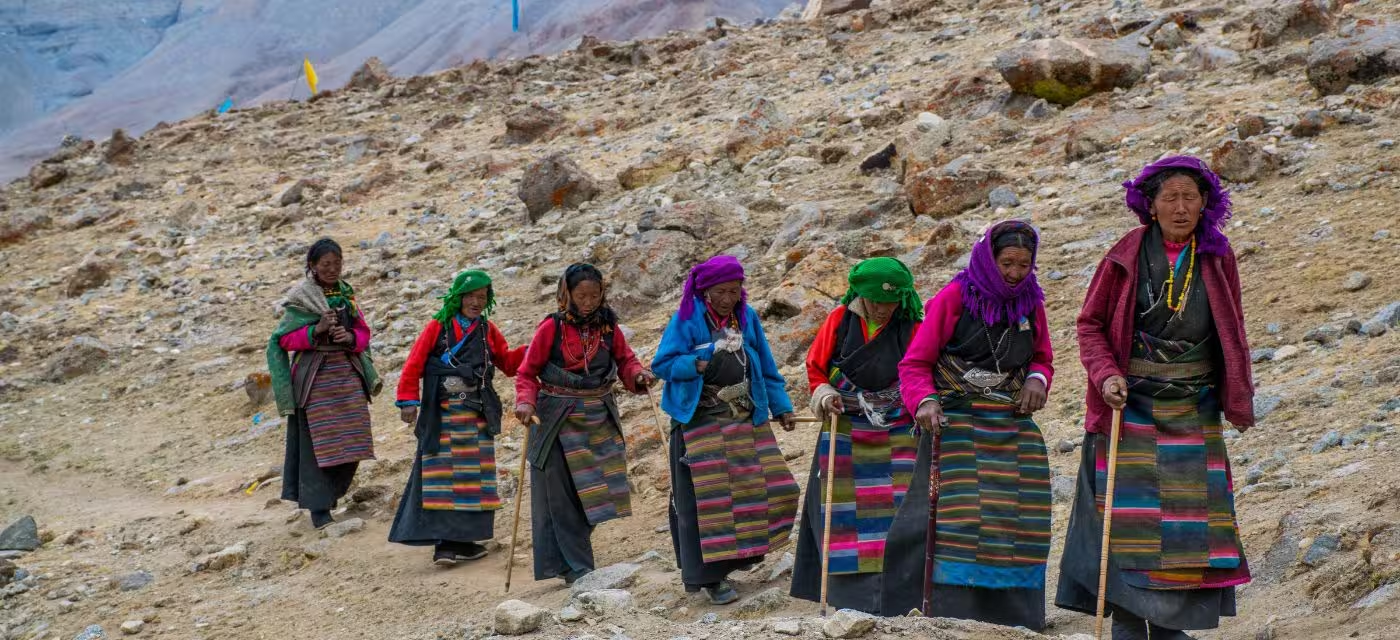
You cannot travel all the way up to Tibet and NOT attempt a kora (pilgrim circuit) around this exceptional Himalayan pyramid of rock and snow whose surreal four-sided summit has never been scaled. Commanding the region with its sheer physicality and spiritual aura, Kailash, for centuries, has been beckoning the faith of pilgrims and travellers, who circumambulate it in homage.
You can set out for Mount Kailash from the Tibetan town of Darchen, the starting point for pilgrimages in the region.
Jaw-dropping yet serene beauty. Phenomenal views of the world’s highest mountains. Woolly yaks. Ruddy complexioned nomads. The unexpected flavour of po cha or butter tea. Rare, endangered, and exotic wildlife. Epic overland journeys on some of the world’s most remote and primitive roads. Magnificent monasteries and monks in meditation. Aromatic incense sticks and glowing butter lamps. Thangkas and mandalas. The lilting chants of prayers. Extraordinary faith and devotion. Vibrant festivals. Warm homes and touching hospitality. Unique cuisine and distinctive culture. And…home to some of the nicest people you may get to know – for despite decades of political turmoil, immense hardship, and struggle for survival, they surprise, delight, and move you with their sheer simplicity, endless patience, complete tolerance, great generosity, and deep spirituality.
Welcome to Tibet.
IMPORTANT VISA AND INTERNAL PERMIT FORMALITIES BEFORE DEPARTURE:
- While entering Tibet via China, Chinese visa must be obtained in the home country. Tibet permit is issued and delivered in the Gateway cities of China. A scanned copy of passport and copy of Chinese visa should be sent at least 20 days prior to arriving in the Gateway cities in China.
- Before entering Tibet via the Gateway city of Kathmandu, Nepal, clients must spend at least 4 nights in Kathmandu (working days) for the final processing of Tibet visa as per the visa working days, i.e. Monday, Tuesday, Wednesday, Thursday, and Friday.
- Following documents are required to apply for Tibet permits:
a) Clear, colour scanned copy of passport must be provided at least 20 days prior to arrival.
b) Chinese Embassy visa form. (It needs to be filled up and sent in advance.)
c) 1 colour passport (MRP) size photo (once clients arrive in Kathmandu).
d) Original passport (once clients arrive in Kathmandu). - The client’s passport must match the copy which was provided for permit formalities in advance. Passport must be valid for more than 6 months and it must be an ordinary passport.
- There is no need to carry a Chinese visa for entering Tibet via the Gateway city of Kathmandu. Likewise, Tibet visa will also be valid for China Mainland. For travelling to China, the programme in China and length of stay must be intimated in advance to facilitate visa application for China.
- There should not be any splitting or extending of Tibet visa for further journey to China or in China. This is extremely complicated and Chinese authorities may refuse this. So, the journey must be carefully planned and organised before booking the trip to avoid problems in future.
- Chinese Embassy is closed during festivals; however, the Embassy accepts visa applications in advance and issues visas after verification of the original passport. An urgent visa fee has to be paid and all necessary documents provided.
- In Tibet, briefing is a must in order to provide any latest information, especially about sensitive issues. In-depth trip briefing is provided by a Tibetan expert. The last-minute briefing is highly recommended.
Related Posts