 English
 Deutsch
 Italia
 August 20, 2026 By admin
Malvani Cuisine konkan Coast
COAST TO COAST – A KONKAN KITCHEN
India’s ribbon-like western coast is lined by palm-fringed beaches, many relatively unexplored. Home to charming fishing villages, the beautiful Konkan belt has the twin advantage of the magnificent Western Ghats mountains (known as the Sahyadri ranges here) looking down upon it on one side and the gorgeous yet tempestuous Arabian Sea lapping its shores on the other.
The Konkan Coast is renowned for and synonymous with its exquisite seafood preparations. Therefore, the best way to appreciate the bounty of India’s fishing villages is to embark on a culinary journey through the region.
“There was nowhere to go but everywhere, so just keep on rolling under the stars.”
– Jack Kerouac
MALVANI CUISINE
It is here, in the valleys of the Sindhudurg District of Maharashtra, that you will come across Malvan, a picturesque town.
And the famed Malvani cuisine derives its name from the town’s local food.
Although an independent cuisine, the Malvani cuisine is, interestingly, a culinary confluence of the cuisines and cooking styles of Maharashtra, Goa, and some northern parts of West Karnataka – likely tracing its roots to the early 16th century when fisher-folk settled along the coastal belt of these three states.
Malvan’s geographic location is key to its food – seafood and chicken claim pride of place in a quintessential Malvani spread, since both are available in abundance in the region.
What is it about the Malvani cuisine that draws its diehard fans? Is it the crispness of the fried fish? The fiery masala? Or the earthy, comfort-giving, home-food quality?
Whatever the lure of this coastal cuisine, the distinctive cooking techniques, ingredients, and recipes will surprise and fascinate most.
Food from the Malvan coast boasts a staggering variety of dishes using fish, fowl, and vegetables. But the hero of the Malvani cuisine is, undoubtedly, the ubiquitous coconut.
Liberally used in all its forms – freshly grated, dried, paste, and milk – coconut is an indispensable part of the food and integral to its unique flavour.
MALVANI SPICES AND MASALAS
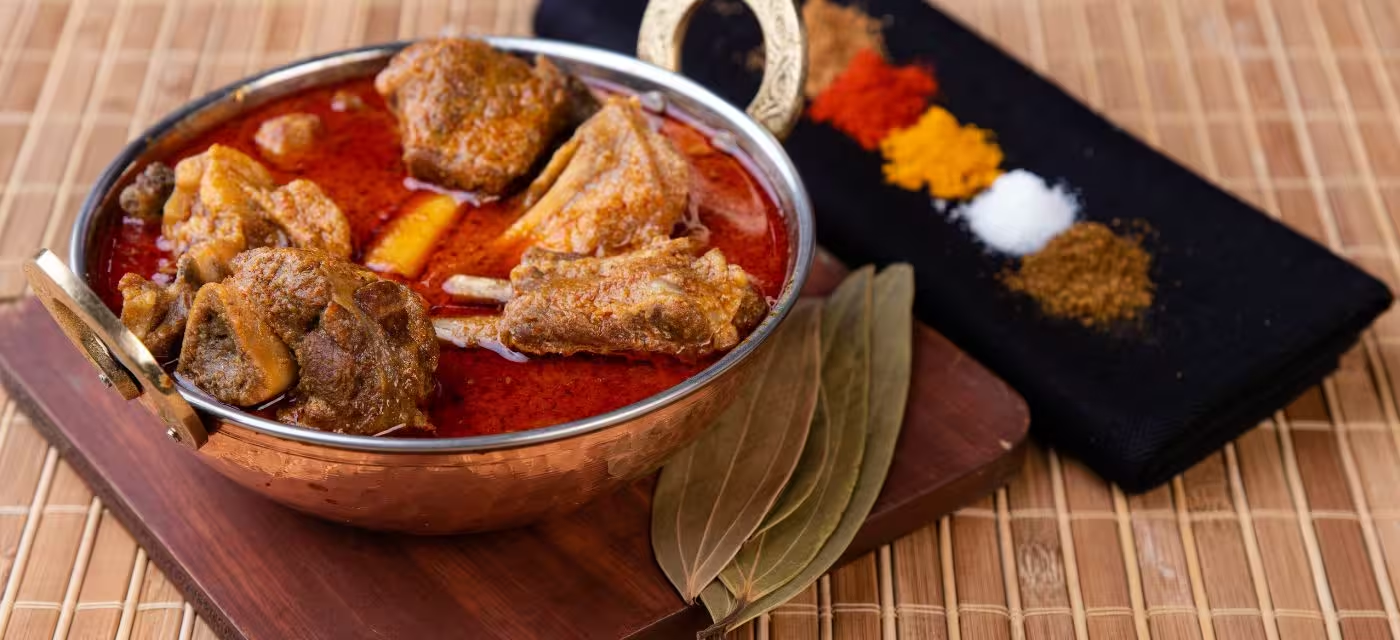
Complementing the coconut are generous proportions of ingredients such as triphala, tamarind, kokum (a fruit of the mangosteen family), red Konkan chillies, cumin, peppercorn, ginger, mace, cardamom, and coriander seeds – lending fire and warmth to the famous Malvani blend of masalas that are fundamental to the cooking style.
However, it is the technique of grinding these masalas with fresh coconut or coconut milk that gives this cuisine that edge.
The masala is coarsely ground and stored in jars to be utilised when required.
The Malvani cuisine also exhibits subtle differences in cooking techniques.
For instance, some areas prefer using kokum to impart tanginess while others prefer tamarind for the same effect.
Even raw mango is used in some preparations – balancing rich, full flavours with the delightful tartness of the mango.
Although Malvani food is predominantly non-vegetarian, certain communities in the region make preparations that are entirely vegetarian and comparatively bland in nature, yet equally delicious.
MALVANI SEAFOOD
It is the seafood though, that of course dominates the Malvani cuisine.
The simmered curries are hot and fiery but, incredibly tempting – enough to make you want another mouthful…and yet another!
What sets apart the Malvani fish curries is not only the variety of gravies used but also the variety of recipes used for the same fish – achieved by a dazzling permutation and combination of spices and ingredients, and significantly, dry-to-wet cooking styles.
The Malvani cuisine has two basic masala pastes that form the base for most of the dishes.
Rasgoli is a blend of freshly grated coconut and a variety of spices.
Bhajan is a blend of stronger spices with roasted coconut and onion.
The former is used for fish curries and the latter for meat. Both the masala blends are used equally effectively for vegetarian recipes as well.
Proteins like fish and chicken are often marinated in a simple marinade of salt, lime juice, garlic paste, red chilli paste, and turmeric; later coated in a mixture of rice flour and semolina before being deep or shallow fried.
Seafood connoisseurs will love the mori (shark) masala, paplet saar (pomfret), tisrya (shell fish) in a green masala, gaboli or fish eggs in a spicy thick curry and soft shell crabs cooked in a coconut base!
Fresh seafood is the mainstay of Malvan.
Mackerel, squid, pomfret, crab, shellfish, and prawn are abundant and perennial favourites too.
Marinated in a delicious masala (red or green), coated with rice flour and semolina, and fried mostly in coconut oil, these fish recipes are classic Malvani.
Add a dash of lemon juice to your crunchy fish for that zing!
BOMBIL FRY
Special mention must be made of the outstanding Bombil Fry or Bombay Duck.
Unique to this region, the fish definitely deserves hallmark status when we talk of Malvani cuisine.
Though deep fried, the Bombil Fry is light on the stomach – its soft flesh complementing the crispy flour coating perfectly.
Bombil is served with a spicy and tangy chutney.
KOMBDI VADE
Kombdi Vade or Murgh Malvani consists of chicken pieces with bones, vade (a fluffy, fried bread of wheat and nachni flour), onion, lemon and solkadhi (described below).
MALVANI VEGETARIAN SPECIALITIES
Phanasachi Bhaji is a popular and exotic vegetarian dish, made from jackfruit, chillies and spices.
Kaju chi aamti is a spicy veggie curry made with ground cashewnut.
The Malvani drumstick curry is also superb.
Kalya Vatanya chi aamti is a delicious black pea curry made using coconut and Malvani masala.
MALVANI SWEETS
If you crave sweet somethings, then don’t miss this Malvani specialty – the Dhondhas.
Not everyone can come up with a delicious steamed sweet cake using cucumber and semolina!
Dhondhas gets its wonderfully grainy texture from the semolina and grated cucumber, and its sweetness from jaggery.
Another lovely version of this near-forgotten recipe is made with that other tropical delight, the jackfruit.
Khaproli is a fluffy pancake dipped in a yellow sweet syrup.
Ghavan, a fried pancake is especially popular; its net-like appearance is quite appealing.
Malvani Malpua and Ras-Poli are other deep-fried sweet delicacies.
SOLKADHI
Finish your Malvani feast with the splendid Solkadhi.
An integral part of Malvani fare, the beautifully pink Solkadhi is a soothing digestive drink often had after a particularly hot and spicy Malvani meal.
The rich creaminess of coconut milk is infused with the tang of kokum petals; green chillies make for the slightly spicy edge.
THE FLAVOURS OF THE KONKAN COAST
Despite its mixed lineage, Malvani fare has truly come into its own.
The food is unpretentious, sumptuous, wholesome, and embodies the essential flavours of the region.
However, there are few standalone restaurants, outside of small towns in Maharashtra and Goa, which offer Malvani food.
Perhaps because not many know of this wonderfully simple yet gastronomically complex cuisine that is a treasure trove of India’s vast, varied, and remarkable culinary heritage.
Here’s hoping that this glorious gem of the Konkan Coast shines as brightly as it deserves to.
Related Posts