 English
 Deutsch
 Italia
 August 19, 2026 By admin
Where India loves to Eat
Where India Loves to Eat
If a country’s culture could be understood through its food, India’s flavours would surely seem like a magnificent potpourri — a heady mix of spices, tastes and aromas.
Yet with the very first bite, something remarkable happens.
Every flavour seems to complement another.
And just when you think you have had enough, you find yourself tempted to try something else.
Nowhere is India’s food more delicious, satisfying and revealing than on its bustling streets.
This is where the real India lives — and eats.
A Journey Through India’s Street Food
In cities around the world, street food often began as an affordable way to feed workers and communities.
India is no different.
But over generations, Indian street food has become much more than simple sustenance. It has become a reflection of migration, history, community and cultural exchange.
Our journey takes us through four cities whose street foods have been profoundly shaped by India’s multicultural traditions:
Mumbai, Kolkata, Delhi and Lucknow.
Each city tells a different culinary story.
Mumbai: Where Food Never Sleeps
Mumbai’s food reflects its people — adaptive, inventive, enterprising and tremendously hardworking.
The city never seems to stop or sleep, and neither does its food culture.
Here, you can find something delicious at almost any hour.
One of Mumbai’s most fascinating food stories concerns the humble vada pav.
In the early 1970s, a customer reportedly asked for an aloo vada served inside a pao — the Portuguese-influenced bun.
And so emerged one of Mumbai’s most iconic street foods.
A potato patty mashed with garlic, chillies and spices is dipped in chickpea flour, fried until golden and tucked inside a soft, buttered bun.
Simple.
Affordable.
And unmistakably Mumbai.
A City That Reinvents Food
Mumbai’s multicultural population has brought flavours from across India to its streets.
Here, culinary traditions are constantly reinvented.
You might encounter South Indian dosai stuffed with noodles, or even sushi given a distinctly Indian twist with masala and spices.
And then there is the humble sandwich — endlessly reinvented for the hungry and hurried Mumbaikar.
Mumbai’s street food is ultimately a story of serendipity, migration and opportunity transformed into enterprise.
Mohammad Ali Road After Dark
During Ramzan, the streets around Mohammad Ali Road come alive after sunset.
As Muslims break their fast, the neighbourhood transforms into a spectacular celebration of food, aromas and community.
Among the treats worth trying are:
- Phirni — a creamy rice pudding garnished with saffron, almonds and pistachios
- Maalpua — a fried pancake-like sweet
- Aflatoon — a rich preparation made with evaporated milk, eggs, sugar, semolina, ghee and raisins
The atmosphere itself is part of the experience.
Mumbai’s Street Food Favourites
Some of Mumbai’s earthy delights simply cannot be missed.
Bhelpuri
Puffed rice, vegetables, spices and tangy chutneys come together in one of India’s favourite chaats.
Misal Pav
Spiced mixed bean sprouts topped with onions and tomatoes, served alongside warm pav.
Pav Bhaji
A rich vegetable medley cooked with spices and served with soft pav and plenty of butter.
Pani Puri
Crisp, hollow puris filled with potato, onion, tamarind chutney, chilli and tangy flavoured water.
Golas
Mumbai’s colourful ice candies, packed with fruity flavours and rock salt.
And then there is falooda, a dessert introduced to India through Mughal culinary influence and derived from the Persian faloodeh.
Made with vermicelli, rose syrup, sweet basil seeds and creamy milk, it is a fittingly indulgent ending to Mumbai’s street-food adventure.
Kolkata: The City of Joy
If Mumbai’s street food represents invention and enterprise, Kolkata’s food culture celebrates authenticity and continuity.
The City of Joy carries the history of a bygone era.
Its colonial legacy, migrant communities and generations of culinary traditions continue to shape its streets.
Food here is a wonderful equaliser.
People from almost every social and economic background eat on Kolkata’s streets.
Jhalmuri: Bengal in a Bowl
One of Bengal’s most beloved street foods is jhalmuri.
Puffed rice is combined with peanuts, roasted gram, crushed chickpeas, coconut, green chillies, ginger, onion and boiled potato.
Rock salt and spices are added, followed by a generous drizzle of raw mustard oil.
The result is simple, fragrant and unmistakably Bengali.
Puchka: Kolkata’s Answer to Pani Puri
The iconic puchka is to Kolkata what pani puri is to Mumbai and golgappa is to Delhi.
But the flavours are distinctly its own.
The water is simpler and slightly sweeter, with rock salt and tamarind.
The filling is usually mashed potato mixed with chaat masala and finely chopped green chillies.
For something different, try churmur — essentially a dry puchka prepared with broken papris, mashed potato, tamarind pulp and tangy spices.
Kolkata’s Other Street-Food Treasures
Kolkata’s food story continues with an impressive variety of snacks.
Radhaballobi is a deep-fried savoury preparation filled with spiced lentils, ginger, green chillies, fennel and other seasonings.
The city’s famous chop and cutlet culture has connections with the kitchens of British-era clubs.
There is also the much-loved kathi roll — roasted skewered meat wrapped in flaky Moghlai paratha with onions, sauces and green chutney.
Then comes Moghlai paratha, generously stuffed with minced meat, onions and eggs.
And telebhaja — vegetables such as pumpkin, onion, potato and eggplant dipped in gram-flour batter and deep-fried.
Tibetan and Chinese Flavours
Kolkata’s multicultural character extends well beyond Bengali cuisine.
Tibetan food has long been popular in the city, particularly momos — steamed dumplings filled with vegetables or meat and served with spicy red chilli sauce and mayonnaise.
The famous breakfast stalls of Tiretti Bazar, established by Kolkata’s Chinese community, offer another glimpse into the city’s fascinating culinary diversity.
Kolkata’s street food demonstrates how communities can preserve their identity while becoming part of a larger urban culture.
Delhi: Where Flavours Meet
Delhi tells a different story.
If Kolkata is about preservation, Delhi is about assimilation.
Situated along the ancient Grand Trunk Road, Delhi has absorbed culinary influences from across the subcontinent.
Dynasties came and went.
Each left behind buildings, traditions and food.
Each new Delhi was built over an earlier one.
And each generation added another layer to the city’s cuisine.
The result is a food culture as complex and robust as Delhi itself.
Old Delhi: A Culinary Time Machine
The most treasured flavours are found in the old city, once known as Shahjahanabad.
The narrow lanes of Chandni Chowk conceal recipes carefully preserved by generations of families.
The best way to experience this culinary heritage is to walk through the lanes or take a rickshaw ride, stopping whenever an irresistible aroma catches your attention.
Delhi’s Street Food Classics
Samosa
A crisp flour pastry filled with potatoes, lentils, peas or cauliflower — and sometimes meat — served with chutneys.
Aloo Tikki
A crisp fried potato patty, sometimes filled with lentils and peas and served with coriander-mint and tamarind chutneys.
Golgappa
Hollow, crisp fried balls filled with potato and chickpeas before being dipped into spicy, tangy water.
Chhole Bhature
Fluffy, deep-fried bhature served with richly spiced chickpeas.
Chhole Kulche
Soft white-flour kulche served with spiced chickpeas, onion, tomatoes and lemon.
The Many Faces of Chaat
Delhi’s chaat culture is legendary.
Among the favourites are:
- Dahi Bhalla
- Papri Chaat
- Aloo Tikki Chaat
- Samosa Chaat
Dahi Bhalla combines fried lentil balls with yoghurt, chutneys, spices, pomegranate seeds and sev.
Papri chaat uses crisp wheat crackers with similar toppings.
Each variation offers a different balance of sweetness, tanginess, spice and texture.
Parathas, Rajma and Ram Ladoos
Delhi’s food traditions also include rajma chawal, red kidney beans cooked with aromatic spices and served with steamed rice.
Then there is the legendary paratha, available with an astonishing range of fillings:
Potato.
Cauliflower.
Radish.
Egg.
Keema.
Banana.
Even leftover dal.
And finally, the elusive Ram ladoo, made from boiled golden gram pulses and served with chutney and radish.
The Legendary Daulat Ki Chaat
But if there is one street food that captures the mystery of Old Delhi, it has to be Daulat ki Chaat.
Despite its name, this is actually a delicate winter dessert.
Sweetened milk and cream are whisked for hours until they become a light, airy foam.
The foam is collected at dawn and finished with saffron, silver leaf, pistachios, khoya and unrefined sugar.
The result is incredibly delicate.
It melts almost instantly in the mouth.
A dessert that looks impossibly simple, yet requires patience, skill and tradition to create.
Lucknow: The Taste of Awadh
Not far from Delhi lies Lucknow, the elegant city of the Nawabs.
Known for its refinement, culture, poetry and gracious spirit, Lucknow’s street food carries the unmistakable influence of the royal kitchens of Awadh.
When the Mughal era ended, many khansamas — royal chefs — took their culinary skills to the streets.
Their food survived.
And eventually became part of Lucknow’s everyday culinary culture.
Sheermal
Sheermal is one of Lucknow’s specialities.
This distinctive tandoori bread combines sugar, warm milk, ghee and saffron in carefully balanced proportions.
The result is unlike ordinary Indian bread.
Lucknow’s Biryani and Kebabs
The city’s chicken biryani is fragrant and richly flavoured, combining marinated chicken, rice and garden-fresh spices.
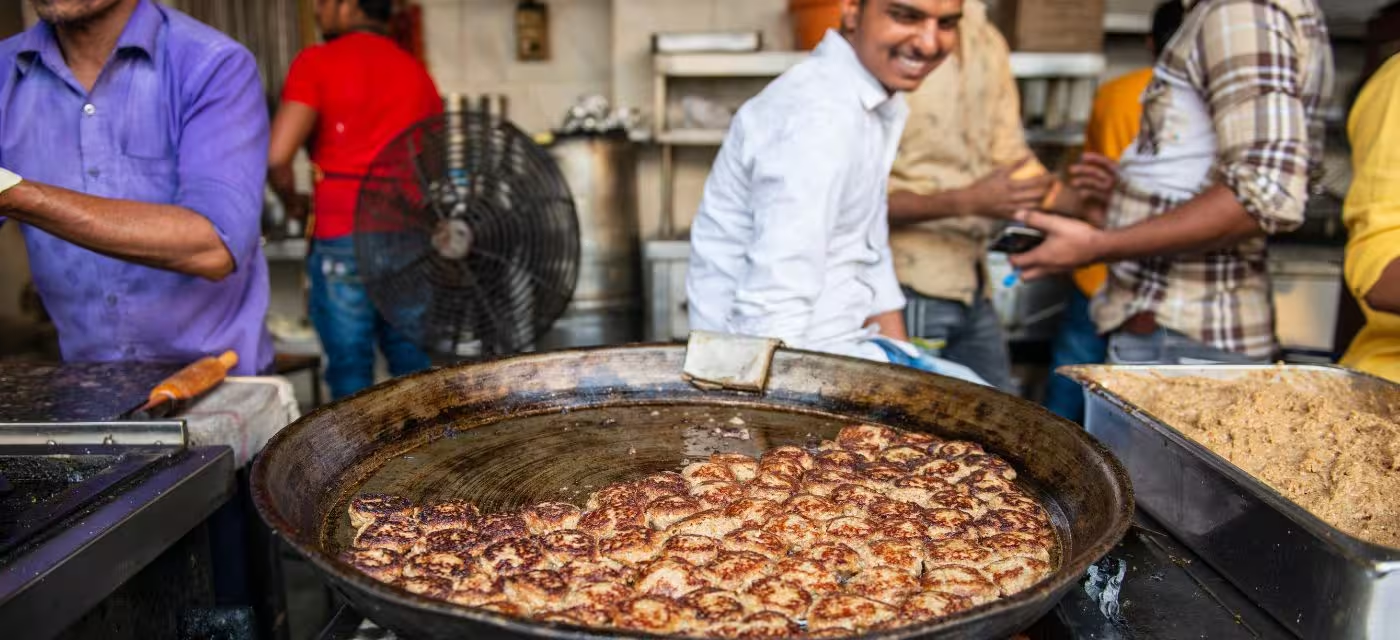
Then there are the legendary Lucknawi kebabs.
For these, the city’s famed Tunday Kebab shop remains an iconic destination.
Another classic is Paaya ki Nihari, a rich, spice-infused lamb-trotter broth traditionally served with kulcha.
What began as a breakfast for ordinary people eventually became one of Lucknow’s most beloved culinary traditions.
Sweet Memories of Awadh
Lucknow’s Nawabi heritage is equally evident in its desserts.
Kulfi, India’s much-loved frozen dessert, is especially popular during summer.
During winter, there is Nimish — a light, frothy cream dessert flavoured with saffron and rose water.
These dishes are more than food.
They are expressions of Shaam-e-Awadh, the evenings of Awadh, and Shaan-e-Awadh, the pride of Awadh.
India’s Street Food: A Story of Harmony
From Mumbai’s inventive vada pav to Kolkata’s authentic puchka.
From Delhi’s layered chaat culture to Lucknow’s refined Nawabi flavours.
India’s street food is rooted in history, but it is never frozen in time.
It changes.
It adapts.
It absorbs.
It reinvents.
Migrants carry recipes with them. Communities add their own ingredients. Old techniques meet new ideas. Royal dishes find their way onto ordinary streets.
And somehow, it all works.
India’s street food is ultimately a delicious expression of the country’s intrinsic harmony and democracy — where history, culture and community come together, one plate at a time.
Related Posts