 English
 Deutsch
 Italia
 August 19, 2026 By admin
Top 10 Experiences in Mumbai
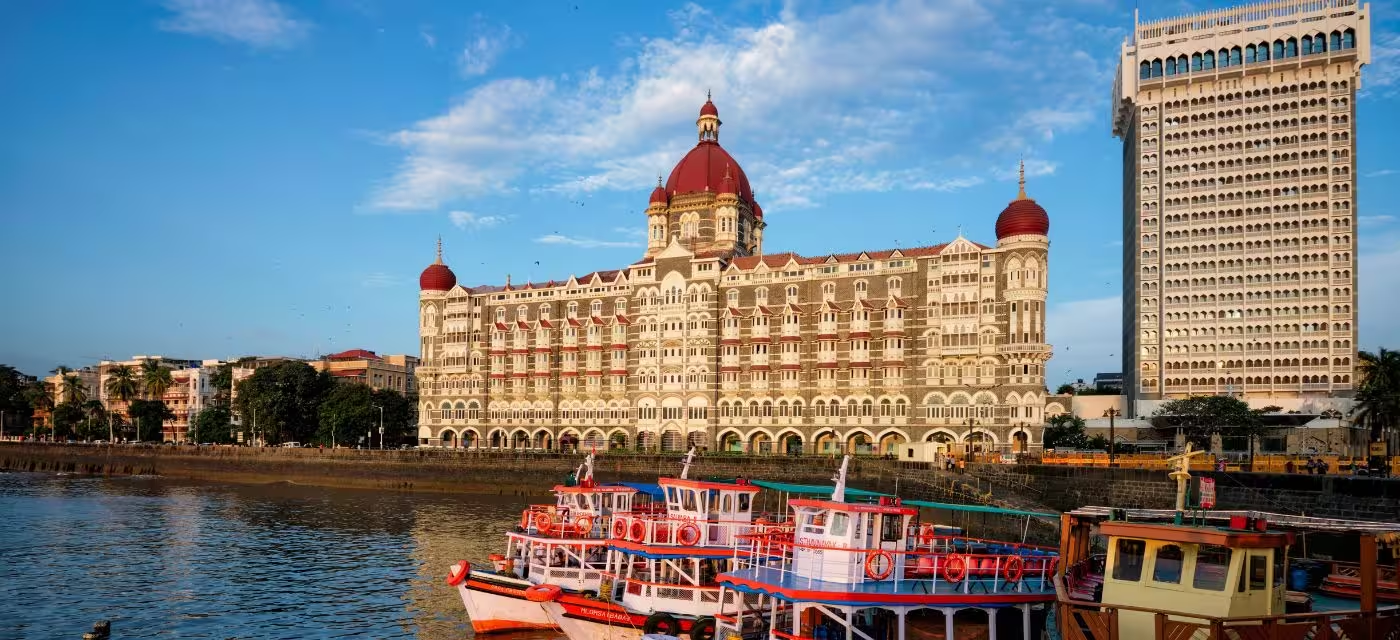
Top 10 Experiences in Mumbai
Mumbai is a city that never seems to stop moving. From the first activity at its docks before sunrise to the last street-food stall closing late at night, the city is driven by people, cultures, communities and dreams.
But beyond the glass towers, busy roads and glamorous façade lies another Mumbai — one shaped by fishermen, mill workers, migrants, artists, entrepreneurs, religious communities, traders and generations of families.
These top 10 experiences in Mumbai offer an opportunity to discover that deeper, more fascinating side of the city.
1. Mumbai by Dawn — A City Awakens
Mumbai begins its day long before most visitors are awake.
The Mumbai by Dawn experience takes you into the early-morning world of docks, markets and neighbourhoods that keep the city functioning throughout the day.
Begin at the bustling docks, where you can observe the traditional life of the Koli fisherfolk, the original inhabitants of Mumbai, and witness the arrival and grading of huge quantities of fish.
One of the highlights is a unique fish auction featuring the famous Bombay Duck.
The journey then moves through the city’s early-morning markets, where vendors sort newspapers in several languages and enormous quantities of meat, vegetables and fruit begin their journey towards Mumbai’s homes and restaurants.
Watch milkmen rushing through the streets, freshly baked bread being delivered and flower markets coming alive with colour and fragrance.
Another fascinating stop is the unusual all-herb mandi, where hundreds of vendors sell leafy vegetables from a bridge.
By the time you walk through these same streets later in the morning, the entire scene has disappeared.
This is Mumbai at its most authentic — hardworking, chaotic, colourful and endlessly energetic.
The catch? You’ll need to wake up at 5:15 AM.
2. Worli Village Walk — Fisherfolk Tales
Surrounded by modern architecture and towering skyscrapers, the Worli Fishing Village offers a remarkable glimpse into another era of Mumbai.
Around 800 years old, the village is one of the historic settlements associated with Mumbai’s original fisherfolk community.
Walking through its narrow lanes feels like stepping into a world of stories, legends, beliefs and traditions.
The traditional ways of making fishing nets, catching fish and conducting business continue to form part of village life.
One of the fascinating cultural landmarks is Golfa Devi, a revered goddess believed by devotees to communicate with them and offer guidance.
The walk also takes you to the historic Worli Fort, a British watchtower overlooking the Arabian Sea.
From the Fort, you can look towards the spectacular Bandra-Worli Sea Link while also seeing the traditional fishing village below.
It is a remarkable contrast — 800 years of history on one side and modern Mumbai on the other.
The experience continues at the Nipponzan Myohoji Temple, a Japanese Buddhist temple known for its Buddha statue and the story of resident monk Bhikshu Morita, who advocated peace and harmony during the communal violence of 1992.
3. Let’s Say Shalom — Jewish Heritage Tour
Mumbai’s history is also the story of communities that arrived from distant lands and made the city their home.
The city’s Jewish heritage stretches back centuries.
Mumbai’s Jewish community historically included two major groups — the Bene Israel and the Baghdadi Jews.
The Bene Israel trace their presence in India back many centuries, while Baghdadi Jews arrived largely during the 18th and 19th centuries from places including Iraq, Syria and Iran.
The Let’s Say Shalom heritage tour explores this fascinating chapter of Mumbai’s history.
The experience takes visitors through Jewish places of interest and introduces them to the community’s history, culture and contribution to the city.
It is a journey through a lesser-known side of Mumbai’s remarkably multicultural identity.
4. For the Love of Art
Mumbai is one of India’s most important centres for contemporary art.
For those fascinated by painting, sculpture and artistic expression, For the Love of Art provides an opportunity to explore the city’s evolving art scene with an art connoisseur.
The experience begins in Mumbai’s British Heritage District and introduces visitors to modern Indian art and its evolution.
The tour explores the cultural, social, spiritual and creative influences behind contemporary Indian artists.
Among the galleries and institutions featured are:
- NGMA
- Jehangir Art Gallery
- Volte
- Tasveer
- Chemould Prescott
- Chaterjee and Lal
Rather than simply looking at artworks, the experience aims to help visitors understand the stories, ideas and influences behind them.
It offers a window into the changing world of Mumbai’s contemporary art scene.
5. Minha Casa — A Walk Through Bandra
Minha Casa, meaning my home in Portuguese, explores the East Indian heritage of Bandra.
Bandra was once a collection of villages inhabited by the Koli fisherfolk. Portuguese influence later brought Catholicism to many of these communities, creating an important part of the cultural identity that survives in Bandra today.
The experience begins at the iconic Mount Mary Church, visited by people from different religious and cultural backgrounds.
The journey then continues towards the ruins of Castella de Aguada, the old Portuguese fort, offering both historical insights and spectacular views of the Bandra-Worli Sea Link.
Continue past St. Andrews Church, one of Bandra’s historic churches, before reaching areas such as Waroda Road and Pali Village.
Here, old Portuguese-style houses with large porches, wooden staircases and ornate grills provide a glimpse into Bandra’s past.
And then comes the modern Bandra — Bollywood.
The experience concludes with a look at celebrity homes and the Bollywood Walk of Fame along the seafront.
It is a journey from Portuguese villages to Bollywood glamour.
6. Entrepreneur’s Entourage — The Real Dharavi
Dharavi is often described through the lens of poverty.
But there is another story here — one of enterprise, ingenuity and ambition.
The Entrepreneur’s Entourage experience explores Dharavi as a thriving economic community where thousands of small businesses operate from remarkably compact spaces.
The neighbourhood grew as different migrant communities arrived, including potters from Saurashtra, tanners from Tamil Nadu and artisans from Uttar Pradesh.
Over generations, these communities established thriving cottage industries.
Visitors can explore industries including:
- Leather goods
- Embroidery
- Pottery
- Cardboard production
- Recycling
- Food production
The experience provides an insight into the remarkable entrepreneurial energy of Dharavi and its contribution to Mumbai’s economy.
More importantly, it introduces visitors to the people behind these businesses — individuals who have transformed small spaces into livelihoods and businesses.
Dharavi becomes a story not simply of hardship, but of hope, resilience and the pursuit of a better future.
7. Girangaon — The Mumbai Mill Fables
Mumbai’s textile mills played a fundamental role in shaping the city’s modern identity.
The Girangaon experience explores the Lalbaug area, once the heart of Mumbai’s textile mill industry.
From the mid-19th century onwards, the mills attracted thousands of workers from surrounding regions.
These communities helped create the multicultural Mumbai we know today.
The walk explores the area’s:
- Religious heritage
- Economic history
- Political movements
- Social culture
- Marathi-speaking communities
- Parsi heritage
- Muslim communities
- Historic chawls
The story of the famous Indian mill strike is another important part of the experience.
The tour also explores an old mill and an enormous antique store before heading to the lively Lalbaug Spice Market.
Here, visitors can see whole spices being roasted and ground according to individual customer requirements.
The experience concludes at the Bhau Daji Lad Museum, one of Mumbai’s important museums showcasing the culture and history of the city and its people.
8. Mumbai In-Design — Architecture and the City
Mumbai’s architecture tells the story of its multicultural past.
Over centuries, traders, sailors, merchants and communities arrived from different parts of the world.
Jews from Baghdad, the British, Portuguese merchants, Dutch traders and others all contributed to the development of the city.
They brought architectural ideas from their respective cultures but adapted them to local materials, traditions and environments.
The result is a fascinating architectural landscape where different styles exist alongside one another.
The Mumbai In-Design experience explores this architectural heritage and examines how Mumbai’s buildings reflect the city’s history.
It is a journey through the architectural identity of a city that has always been shaped by cultural exchange.
9. Food Walks — Tour Your Taste Buds
India’s culinary diversity is enormous.
Every region has its own ingredients, cooking techniques and distinctive flavours.
Mangalore is known for its use of tamarind, Kerala for coconut, Goa for vinegar, Bengal for mustard, Rajasthan for chilli and Maharashtra for ingredients such as kokum.
But you don’t necessarily need to travel across India to experience its culinary diversity.
Mumbai itself is a remarkable melting pot of Indian food traditions.
Communities arriving from different parts of the country brought their cuisines with them and gradually made them part of Mumbai’s food culture.
The Food Walks experience explores this culinary diversity through local homes, restaurants, backyards and food establishments.
The journey is about more than tasting dishes.
It introduces visitors to the history, culture and communities behind Mumbai’s food.
Each bite becomes part of a larger story about migration and cultural exchange.
10. Khau Gully — Street Food in Mumbai
And finally, for those who simply want to eat their way through Mumbai, there is Khau Gully.
Think cutting chai, vada pav, kathi rolls, desserts and countless other temptations.
Mumbai’s street food culture reflects the city’s extraordinary history of migration.
People arrived from across India carrying their recipes, tastes and traditions — and Mumbai absorbed them.
But the city also created dishes of its own.
One of the best examples is Pav Bhaji.
Originally associated with the city’s mill workers, the dish used leftover vegetables to create a filling vegetable mash. It was served with the Portuguese-inspired bread known as pao or pav.
What began as humble food for hungry workers eventually became one of India’s most beloved street foods.
And that is the magic of Mumbai’s food culture.
It takes whatever arrives at its doorstep, adds its own character and turns it into something uniquely Mumbai.
Experience the Real Mumbai
Mumbai is not just a city of skyscrapers, Bollywood and business.
It is a city of fisherfolk and mill workers, artists and entrepreneurs, migrants and merchants, temples and churches, cafés and markets, heritage buildings and modern bridges.
These experiences reveal the many layers of Mumbai — the city that wakes before sunrise, works relentlessly through the day and continues eating, celebrating and dreaming long after the sun goes down.
From Mumbai by Dawn to Khau Gully, every experience offers a different perspective.
Together, they reveal what makes Mumbai truly extraordinary:
A city where history and modernity, tradition and ambition, and hundreds of cultures come together to create one unforgettable experience.
Related Posts