 English
 Deutsch
 Italia
 August 28, 2026 By admin
Tamil Nadu Coastal Road Trip
Where India Meets the Sea
“In every outthrust headland, in every curving beach, in every grain of sand there is the story of the earth.”
— Rachel Carson
Travel might be complicated right now, but for those of us who want to explore, discover, and even rediscover the world outside our homes, a road trip is the perfect, most refreshing, and most spontaneous way to do that. The road is a great equaliser, allowing people from anywhere and everywhere to share in nature’s largesse.
A road trip in India represents what travelling in this spectacular country feels like – fascinating, thrilling, colourful, replete with local interactions, revealing hidden gems, brimming with experiences, and distinct at every bend. Yet imbued with a comforting sense of the familiar. And that’s the power of a road trip.
Long before the Silk Road gained fame and attracted attention, the vast expanse of the Indian Ocean was flush with trade. Explorers and merchants from overseas journeyed thousands of miles to India’s incredibly long coastline; their arrival not only heralded the exchange of goods but also the exchange and alliance of cultures.
We’ve put together a comprehensive guide to some of the best coastal road trips in the country, from the Coromandel Coast adorning the east to the shared Konkan and Malabar coasts of the west.
Tamil Nadu
Where the Waters of Three Seas Unite
The Coromandel Coast is a beautiful strip of shoreline that runs between the Eastern Ghats to the west and the Bay of Bengal to the east, taking in the states of Tamil Nadu and Andhra, and the Union Territory of Puducherry in the southeastern coast region of peninsular India. The coast is home to the East Deccan dry evergreen forests ecoregion, extensive mangrove forests, and several important wetlands that serve as habitats to thousands of migrating and resident birds.
Your journey will reveal little-known but fascinating vestiges of this remarkable region’s rich and long history involving an ancient Tamil dynasty, a clash of colonial powers, and a prosperous maritime trade.
Chennai – Tranquebar
Chennai
The story of Tamil Nadu’s iconic capital on the Coromandel Coast, off the Bay of Bengal, is really the story of two cities – Madras and Chennai. Madras grew out of the small British settlement of Fort St George in the 17th century, giving way to Chennai in 1996.
Today, Chennai is a sprawling, layered metropolis, the gateway to the state’s rich and beautiful heritage, which it continues to preserve and draw from; here, a gentler and older Tamil culture happily co-exists with its resonant colonial legacy.
Chennai’s unique character is also shaped by its rich cultural, religious, gastronomic, and sporting heritage – marked by the largest classical music festival in the world, an outstanding assortment of cuisines, love for cricket, tennis, and chess, and simply the finest filter coffee on the planet.
For the visitor wishing to explore southern India extensively, Chennai is the most convenient point of entry. Chennai has an international airport, a sea port, and a rail and road network that links it to all major towns and cities of the region.
See & Do
Mylapore and Santhome: The stunning Kapaleeswarar Koil (temple) sits in the heart of Mylapore, once the legendary 7th-century Pallava port of the region. Originally, a great shore temple dedicated to Siva stood here until the Portuguese arrived in the mid-16th century and destroyed it. The temple was re-built 300 years ago and is now called the Kapaleeswarar Temple. It is a fine example of pure Dravidian architectural style and is Mylapore’s most magnificent landmark.
The San Thome Basilica is a Neo-Gothic cathedral built by the Portuguese, who established the settlement of Santhome here in the 16th century. The name derives from the area’s association with St Thomas, who is believed to have come here to preach in 52 CE.
Luz Church, a kilometre away, has not been rebuilt since its construction in 1516; the Church of Our Lady of Expectations atop the Mount of St Thomas was also built by the Portuguese.
Triplicane: The lovely 9th-century Parthasarathy Koil; the house of the famous freedom fighter and rebel poet Subramanya Bharathi is now a museum (Bharathi Illam, No. 83) that traces his life; and the historic Wallajah Mosque or Big Mosque.
George Town and Around: Modern Chennai’s foundations were first laid at Fort St George, the earliest British settlement in India. The Fort Museum here showcases paintings and colonial-era antiquities.
Other colonial-era edifices include St Mary’s Church, St Andre’s Kirk Cathedral, Madras High Court, Victoria Memorial Hall, Southern Railway Headquarters, Madras Central Station, and Ripon Building.
Marina is one of the longest urban beaches in the world. It was made as an Italian-style promenade in the 1880s. Across the road from the beach is a row of elegant colonial-era buildings dotting the five-kilometre stretch.
Egmore: The Government Museum Complex houses the Museum Theatre, the Connemara Library, the National Art Gallery, and the Madras Museum.
Parks: The Arignar Anna Zoological Park is the largest zoological garden in India and also has a rescue and rehabilitation centre for animals. The Guindy National Park, one of the very few national parks situated inside a city, is a protected area enclosing beautiful forests, scrublands, lakes, and streams. It is also a conservation site and is home to several species of free-ranging fauna.
Adyar: Founded in 1875, the International Headquarters of the Theosophical Society lie in the Adyar area of Chennai. The society’s iconic symbol is the Adyar Banyan Tree, 400 years old, with roots spanning a vast cordoned-off area.
Founded by Rukmini Devi Arundale, famed danseuse and progressive thinker, in 1936, the Kalakshetra Foundation, spread over nearly 100 acres by the seashore, is a major centre for the study and performance of the fine arts. Stop by the Weaver’s Centre outside; they sell sarees woven in Rukmini Devi’s designs.
The famous Madras/Chennai Music Season, called Kutcheri Season, in December-January is when the city’s many cultural organisations host over 2,000 performances of music and dance.
Chennai is a wonderful place to enjoy a variety of South Indian cuisines, vegetarian and non-vegetarian, from neighbouring states; you’ll also find great continental fare at some of the finest restaurants and cafés. The city’s terrific street eateries are especially famous for their snacks and sweets.
Tranquebar
A six-hour drive from Chennai on the famous East Coast Road (ECR) will take you to Tranquebar, located 280 km south of the city.
Called Tharangambadi (the place of the singing waves) before it was rechristened by the Danes sometime in the early 17th century, this former Danish colony on the Coromandel Coast was also a flourishing port of trade.
The Danes, keen to strengthen not only their share in the pepper trade but also their new presence in India as a colonial power, stayed on in Tranquebar for the next two centuries, after which they sold it to the British East India Company.
Today, Tranquebar still retains its unique Danish-Tamil character, visible in parts of the townscape and its Indo-European architecture. The warm coastal town may be the laidback traveller’s delight with its tranquillity and understated air, but it reveals gems to those willing to explore.
See and Do
Take a heritage walk. Must-see highlights include King Street, colonial-era buildings such as Rehling’s House (former residence of the Danish Governor) and Van Theylingen House (home to a small maritime museum), the Zion Church, the New Jerusalem Church, the seaside Fort Dansborg and the museum inside, the ancient 14th-century Masilamani Nathar Temple, the Danish Cemetery, and the many ruins.
For those interested in visiting places of worship, there are quite a few nearby – the Nataraja Temple at Chidambaram (45 km/90 minutes), the 11th-century Siva temple at Thirukkadaiyur (30 km/1 hour), the renowned shrine Basilica of Our Lady of Good Health at Velankanni (38 km/1 hour), and the dargah of Saint Hazrat Meeran in the seaside town of Nagore (25 km/40 minutes).
Enjoy a boat trip on the Uppanar River (10 min from Fort Beach), stroll down the rock-strewn beach at sunset, watch fishermen come in with the day’s catch in their colourful fishing boats, spend quiet moments sitting on the ramparts of the Dansborg and take in the views out to sea, or even sight a migratory bird or two.
The best way to explore Tranquebar town itself is either on foot or by hiring a bicycle.
Chennai – Mamallapuram | Mamallapuram – Puducherry
Make the most of two distinctly different seaside destinations on a single road trip.
Start early morning for Mamallapuram on the beautiful East Coast Road (ECR or State Highway 49) out of Chennai so you can catch the glorious sunrise, enjoy the still-cool sea breeze, and halt for some delicious local breakfast.
En route: Chennai–Mamallapuram
- Kovalam/Covelong Beach
- Madras Crocodile Bank
- DakshinaChitra Heritage Village
- Cholamandalam Arts Village
- Muthukadu Boat House
Mamallapuram
Once the ancient port capital of the mighty Pallava dynasty kings some 1,400 years ago, Mamallapuram, earlier known as Mahabalipuram, was named after ‘Mamalla’, a title of Pallava King Narasimha Varman I. He established his capital here and transformed it into a glorious centre of art and sculpture in the 7th century CE.
Mamallapuram’s stunning temple complex, colossal monolithic structures, cave sanctuaries, the giant open-air rock relief, and exquisite sculpture, set against the gorgeous backdrop of the Coromandel Coast, are every bit worthy of their UNESCO World Heritage Site status.
Made doubly atmospheric by its mighty stone architecture and seaside location, Mamallapuram is a lovely place for a laidback beach holiday, with sun, sand, seafood, souvenirs, and great places to stay all year round.
See & Do
Temple-complex highlights include:
- The fabulous Shore Temple on the very edge of the sea, especially lovely at sunset.
- The Five Rathas, a set of temples or vimanas, each built from a single rock and covered with exquisite carvings.
- Arjuna’s Penance, an elaborately carved scene from the Mahabharata on the side of a cliff, considered the largest open-air bas-relief in the world.
- Krishna’s Butterball, a gigantic boulder perched precariously on a rock slope.
- Mahishasuramardhini Cave.
Planning a road trip during December-January will give you the chance to attend the Mamallapuram Dance Festival, an annual four-week-long dance festival organised by Tamil Nadu Tourism. Mamallapuram’s ancient natural seaside open-air stage serves as the magnificent backdrop for the vibrant festival.
Puducherry
En route: Mamallapuram–Puducherry
The spectacular 9th-century Gingee Fort and the tiny holy town of Thiruvannamalai, renowned for its magnificent Saivite shrine, the Annamalaiyar (or Arunachaleswarar) Temple, and the serenely beautiful Sri Ramanasramam, home to the revered sage and Advaita Vedanta philosopher Ramana Maharshi from 1922 until his death in 1950.
Riviera by the Bay of Bengal
Welcome to the Riviera by the Bay of Bengal.
This surprising town is a throwback to an era when it was a French enclave and carries its rich Franco-Tamil heritage with pride.
The French made Puducherry, earlier known as Pondicherry, their outpost in 1674 and the town was divided by a canal into the Tamil side, once known as Ville Noir (Black Town), where the natives lived; and the Ville Blanche (White Town), where the foreign expatriates and French diplomats stayed.
Puducherry remained under French rule till 1954, after which it was handed over to India. Those who decided to stay chose French citizenship. French is still an official language here.
See & Do
The best way to explore Puducherry is on foot because it’s a pedestrian-friendly town.
In the French quarter you’ll see windswept old tree-lined boulevards, painted colonial-era villas, buildings and monuments, a pretty sea-facing promenade, and calm, virgin beaches and backwaters.
Highlights include Gaubert Avenue, the War Memorial, an old lighthouse, the French Consulate General, Rue Dumas, Hotel de Pondicherry, Ecole Francaise d’Extreme Orient, the Statue of Joan of Arc, the Notre Dame des Anges Church, the Church of the Immaculate Conception, Rue Romain Rolland, the Pondicherry Museum, and the Sri Aurobindo Ashram (estd. 1926) on Rue De La Marine.
The Tamil quarter comprises the old Tamil neighbourhood with its ‘native’-style old family homes and lively, bustling market. Some of these traditional houses reveal the Gallic imprint on Indian wood and masonry.
A unique example of Franco-Tamil architecture here is the 18th-century mansion of Ananda Rangapillai, scribe to the French Governor Dupleix.
Visit Auroville (10 km), a universal township comprising people from some 59 nations, from all social classes, backgrounds, and cultures; they live and work together in communes. (Note: Public access is only possible with prior permission from the Auroville Visitors’ Centre.)
Don’t miss out on shopping here. Puducherry is especially famous for its exquisite textiles and silks, stylish apparel, beautifully tooled leather, glazed pottery, aromatics, handmade paper, homemade preserves, and antique furniture.
For those seeking wellness and rejuvenation, Puducherry offers numerous alternative healing therapy opportunities. Food lovers too will discover a variety of cuisines, including French, Vietnamese, and Tamil, served at café-style restaurants, as well as some lovely local fare.
Chennai – Rameswaram | Rameswaram – Dhanushkodi
Start early morning, at the crack of dawn if possible since there is a considerable distance to cover, for Rameswaram on the beautiful East Coast Road (ECR or State Highway 49) out of Chennai. There are other routes to Rameswaram from the city, but travelling via the ECR is a beautiful experience.
Rameswaram
Nestled in the conch-shell-shaped Pamban Island at the southeastern tip of the Indian peninsula, Rameswaram is a temple town with an interesting and unique geographic location.
It lies in the Gulf of Mannar, between India and Sri Lanka, and is connected to the Indian mainland by the Pamban Bridge. It is around 40 km from Mannar Island, Sri Lanka.
The Gulf of Mannar Biosphere Reserve, established in 1986, is a marine ecosystem with seaweed and seagrass communities, coral reefs, salt marshes, and mangrove forests.
An integral part of the Ramayana legend, Rameswaram is said to be the spot from where Lord Rama and his army crossed over into Lanka, making their way on a 29-km chain of shoals called Adam’s Bridge.
Rameswaram is considered one of the holiest Hindu pilgrimage sites in India and draws thousands of devotees who make the long journey to this quiet island town to worship Lord Siva at the Sri Ramanathaswamy Temple.
See & Do
The beautiful 12th-century Ramanathaswamy Temple, spread over 15 acres, is the very heart of Rameswaram, physically and spiritually. The Sivalinga in the temple is believed to have been consecrated and worshipped by Lord Rama.
The stunning architecture shows off intricate carvings, majestic towers, and grand corridors lined with imposing sculptured pillars. The temple’s famed third prakaram is India’s longest temple corridor, with 1,212 pillars. Circumambulating this superbly proportioned corridor is a sublime experience.
The temple has 22 theerthams or sacred baths where devotees take a dip to cleanse themselves of their sins. The temple remains open on all days of the week from 5 am to 1 pm and then from 3 pm to 9 pm.
Agnitheertham is one of the 64 sacred baths in Rameswaram; it is a stretch of shallow sea just 200 metres from the Ramanathaswamy Temple.
Gandhamathan Parvatham (3 km) is a hillock on which the Ramarpatham Temple is located. There is an image of ‘Rama’s footprints’ here, found as an imprint on a chakra.
You will never forget a train journey on the Pamban Bridge. This marvel of engineering was built by the British in 1914 and is the country’s first sea bridge. It is also the second-longest sea bridge in India, with 143 piers spanning a distance of over two kilometres.
The bridge is designed to have a double-leaf bascule section midway, which can be raised to let ships and barges pass through. Watching the two leaves of the bridge open has itself become a huge tourist attraction!
Although there is now a Pamban Road Bridge as well, we recommend that you experience the Pamban Rail Bridge in at least one direction, as the railway line lies spectacularly close to the sea.
Pamban Beach brings you the joys of discovering a secret beach destination in India. This stunning beach is a place of tranquil turquoise waters, beautiful coral reefs, fishing boats, soft white sands, azure skies, and best of all…barely any tourists.
Dhanushkodi
Flanked by the tranquil Bay of Bengal on one side and the choppy Indian Ocean on the other, Dhanushkodi is an explorer’s dream.
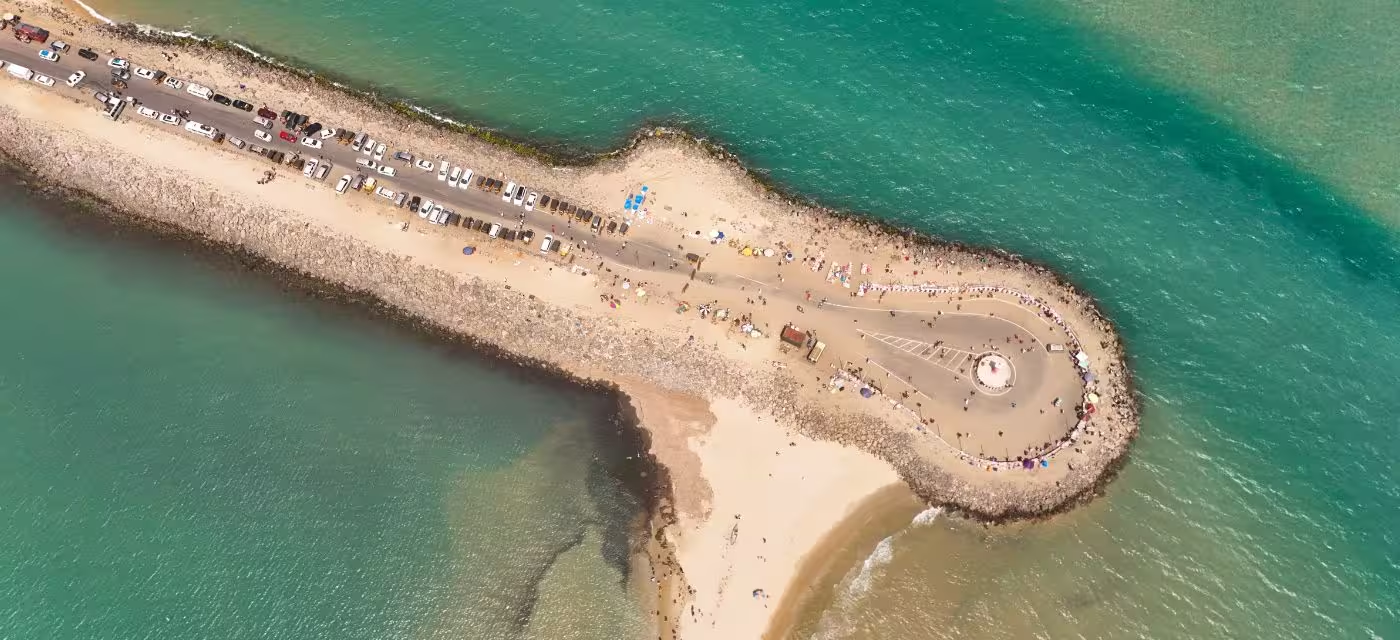
Dhanushkodi lies on the tip of Pamban Island, on its elongated southeastern sand spit, and is separated from the mainland by the Palk Strait. It’s around 20 km from Rameshwaram and around 30 km from Talaimannar in Sri Lanka.
Once a flourishing trade hub, Dhanushkodi was hit by a ferocious cyclone in 1964 that washed away most of the town and its people. The magnitude of the damage prompted the government to declare it a ghost town, unfit for habitation.
The new road that runs all the way through Dhanushkodi to the land’s end at Arichal Munai (Erosion Point) near Adam’s Bridge has made the town much more accessible. Now, you can drive there directly in your own vehicle.
The road is an extension of National Highway 87, which runs from the mainland to Pamban Island and Rameshwaram. The final stretch is strictly controlled by India’s Border Security Force. Entry is only permitted from 6 a.m. to 5 p.m.
Visit Dhanushkodi for both its extraordinary location and other-worldly ambience. You’ll not only have reached the end of India but will also feel that you’ve reached earth’s end – totally cut off from civilisation and eerie.
While the remnants of old Dhanushkodi are the main attraction, enhance your experience by simply soaking up the peaceful yet surreal atmosphere.
After you’ve finished exploring Dhanushkodi, take the road further to Arichal Munai (Erosion Point). This is land’s end. It’s a spellbinding scene, the straight needle-like strip of sand bounded by the sea on both sides.
A lone Ashoka pillar, India’s national emblem, stands on the sands here. You can look out across Adam’s Bridge in the hope of catching a glimpse of Sri Lanka!
For the best experience, leave for Dhanushkodi from Rameswaram at the crack of dawn so you can beat the crowds, spend at least a couple of hours, and catch the magical sunrise.
Facilities are limited, but you’ll find fresh seafood and souvenirs/products made from shells.
The Kothandaramaswamy Temple, located off the highway about 10 minutes before Dhanushkodi, is dedicated to Lord Rama and is the only structure to have survived the cyclone that destroyed the town.
If you’re here between January and March, chances are you’ll be able to spot flocks of migratory birds such as flamingos.
Related Posts