 English
 Deutsch
 Italia
 August 18, 2026 By admin
Muziris Ancient Spice Port
How Pepper Came to the Kitchens of the Roman Empire: The Chronicle of Muziris
“In Cheran’s prosperous Muciri town, the huge and beautiful Culli (Periyar) river flows, muddied with white foam. The Yavanas (Westerners) come with their fine ships, bearing gold, and leave with pepper.” — Sangam Tamil poet Tayankannanar’s description in the Akananuru (classical Tamil poetic work) 149, trans. Vaidehi Herbert
If you thought Kerala was about azure backwaters, ageless Ayurveda, graceful elephants, gorgeous temples, grand festivals, fabulous food, and magnificent natural beauty…then you’re right!
But the stunning state on the edge of the Indian Ocean on the south-western coast of India, has an ancient secret. Perhaps one you never knew about.
Circa 2300 years ago, a small town in Kerala suddenly rose to prominence as one of the ancient world’s greatest ports in the maritime trade networks in the Indian Ocean region.
This was the fabled Muziris. The flourishing port that found mention in ancient maps of the world, navigators’ accounts, and classical Tamil (called Muciri Pattinam), Greek, and Latin texts.
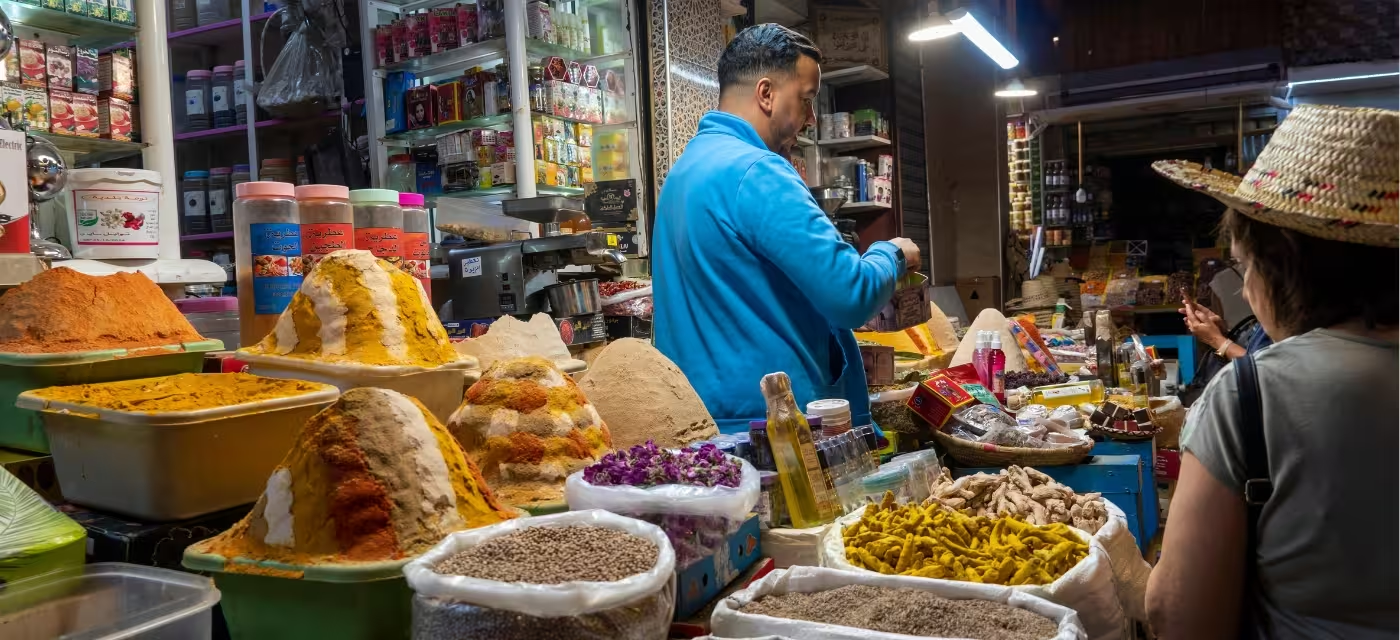
Sangam Age literature (Tamil, c. 300 BCE–300 CE) describes Roman ships coming to Muziris laden with gold to be exchanged for ‘black gold’ – PEPPER!
The port town was in fact at the very heart of the legendary Spice Route, one of history’s most significant and enigmatic trade routes.
The Spice Route ran from the monsoon laden Malabar Coast of Kerala, through the Red Sea, right up to the Mediterranean – to the mighty empire of Rome.
Ships laden with gold sailed the seas looking for the one thing their lands didn’t yield – SPICES – that only this part of the world could offer.
Many places emerged as bustling centres of trade during this time (ports like Kochi and Kozhikode in Kerala too). These spots stood witness to the emergence of civilisations, the rise and fall of mighty empires, wars being fought, vast riches being exchanged, and history being rewritten.
Perhaps the beginning of what the world calls ‘globalisation’ began with Muziris – circa 15 centuries before even the voyages of Christopher Columbus and Vasco da Gama in the late 15th century CE!
Historical records reveal that 31 countries in Europe, Asia, and the Far East had a thriving spice trade with ancient Kerala. For centuries, Kerala mesmerised the Arabs, Chinese, Romans, and Greeks… welcoming them to come and trade, and even settle here!
It is said that the port of Muziris traded in everything from spices to precious stones, with the Romans, Greeks, Arabs, Babylonians, Assyrians, Egyptians, Chinese, Portuguese, Dutch, British, AND the rest of the world.
Ships arrived here with gold, coral, fine glassware, amphorae of wine, grain, olive oil, and garum (fermented fish sauce) – all in exchange for pepper and other spices, precious stones, silk, beads, ivory, and pottery.
Then, sometime after the 5th century CE, Muziris simply dropped off the map. Centuries on, historians and archaeologists searched for signs of the mysterious lost port, but came across nothing.
Till one day, when the monsoon rains in Pattanam (literally meaning market-town or trading post), an ordinary village in the Ernakulam District of Kerala, revealed an extraordinary sight – thousands of gems made of multi-coloured stones eroded their way up to the surface of the earth and lay scattered across the ground!
Much investigation and many years of excavations (starting 2004) later, all evidence most importantly the town’s strategic location – pointed to the possibility that Pattanam might indeed be the lost port of ‘Muciri Pattinam’ or Muziris.
Located 4 km east of the Arabian Sea coast, 25 km from the city of Kochi, and 11 km from the town of Kodungallur, Pattanam is a remarkable archaeological site storing the history of some 3000 years from circa 1000 BCE.
It throws light on the history of Kerala in the period before the 9th century CE, on which there was very little evidence till now.
Pattanam is significant today because it’s an outstanding example of how the local settlers, with their technology, craftsmanship, architecture and immense natural wealth, made superb use of both land and sea, and contributed to the transoceanic exchange of cultures.
Welcome to Muziris
This is your doorway to the fascinating world of ancient maritime trade, one in which India first established links with the outside world.
This is where a lost legacy has been revived to conserve and showcase the life and times of an era nearly 3000 years ago.
This is where you will see beautiful churches, elegant mosques, stunning temples, unusual festivals, traditional synagogues, interesting museums, imposing forts, snaking old waterways, handloom weaves, and antique marketplaces – all different yet standing together as part of a single glorious legacy.
The hallmark of Muziris was how it welcomed and encompassed people of all cultures and religions – to give India its first churches, mosques, and synagogues.
Apart from the archaeological museum that rests on the Pattanam mound, Muziris stands out for its remarkable array of historic monuments and sites, both in terms of religion and architecture.
Tourists in the Heritage area here will have the opportunity to explore the ruins and remnants of an ancient seaport that was once believed to have been amazingly wealthy and self-sustaining.
Brimming with deep history and culture, Pattanam is the most integral part of the Muziris Heritage Project, set up by the Government of Kerala.
The Project – also the first Green Project of the state, and one of India’s largest heritage tourism projects – aims to create awareness of Kerala’s marvellous history and the distinct cultural diversity of Muziris; and involve and integrate local communities in all its work.
The Muziris Heritage Project offers the best of heritage tourism to both Indian and global travellers, and is a wonderful initiative to boost tourist footfalls in little known destinations in Kerala.
It also has the potential to change the local economy via tourism.
The Kottapuram Fort, Cheraman Juma Masjid, Kodungallur Temple, and Paliam Kovilakom are some of the landmark sites listed in the project.
The Region’s Most Famous Spiritual Sites
The region’s most famous spiritual sites to see are:
- The Holy Cross Church
- Marthoma Church
- Azheekal Sree Varaha Temple
- Manjumatha Church
- The Kottakavu Church
- Kodungallur Bhagavathy Temple
- Kizhthali Siva Temple
- Thiruvanchikulam Mahadeva Temple
- Cheraman Juma Masjid
- Vypeekotta Seminary
- Paravur Synagogue
- The Chendamangalam Synagogue
Historic Sites
The area’s historic sites include:
- The Pattanam Village
- Kottappuram Market
- Kottappuram Fort
- Pallippuram Fort
- Gothuruthu Performance and Chavittu Nadakam Centre
- Cheraman Parambu
- Paravur Market
- The Harmony Park (Jewish Cemetery)
Major Museums
The major museums to see here are:
- The Kerala Jews History Museum
- Kerala Jews Lifestyle Museum
- Paliam Palace Museum
- Paliam Nalukettu Museum
- Sahodaran Ayyappan Museum
- Abdul Rahman Sahib Museum
- Kesari Balakrishna Museum
- Islamic History Museum
All these sites are being conserved and protected for future generations and efforts to promote heritage tourism here couldn’t possibly go waste.
The Legacy of Muziris
Unique story to tell. Pattanam and its wonderful finds tell the story of how circa 2300 years ago the world came to the shores of a tiny village on the south-west coast of India, and transformed it into a key maritime trading centre.
As you walk through the village and its surrounding areas and experience its mosaic of cultural influences, you realise the true beauty of the legacy of Muziris – that even the most ordinary object here reveals bits of a time that once was; as if human history were slowly unfolding before your eyes.
Whether you’re driven by wanderlust or whether you’re drawn to history or even whether you’re simply a pilgrim, Muziris is an astonishing, incredible, unforgettable experience.
Perhaps because Pattanam is the closest link to Muziris at this time, and should be seen and treasured.
Perhaps because, the unearthing of Pattanam is not simply about reviving history. It’s also about how a composite, exceptional culture of tolerance and integration gives not just Kerala, but all of India, its place in the world.
“Mouziris…is a flourishing place with ships from Ariake coming to it, and also Greeks. It stands on a river, and is 500 stades distant from Tundis by river and by sea, and 20 stades from the mouth of the river…” — Periplus Maris Erythraei (The Periplus of the Erythraean Sea), by an anonymous navigator, (dated between CE 40 -70), this trans. 1980, G.W.B. Huntingford, The Hakluyt Society, London.
Related Posts