
 English
 Deutsch
 Italia
 August 19, 2026 By admin
A Bite of India Sil Nora And Boti
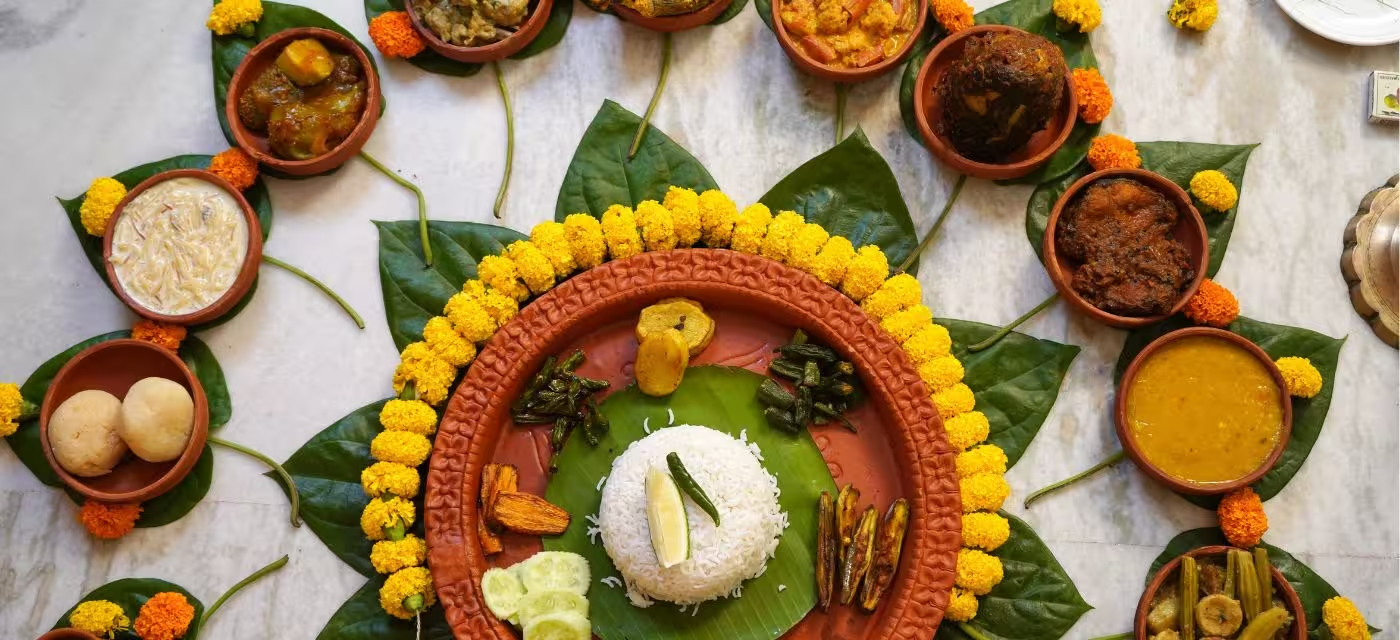
A Bite of India
Of the Sil Nora and the Boti
Once, during a visit to Calcutta, I was invited to lunch by a woman whose reputation as a Bengali cook made me accept with delighted anticipation. The meal she served surpassed my expectations.
What stood out above all the expensive fish and meat was her mochar ghanto, a fragrant dish consisting of banana blossom, or mocha, combined with tiny cubed potatoes, tinier coconut chips, chickpeas and spices. It is a classic of Bengali cuisine, known for its flavourful yet delicate use of spices and its wide range of ingredients.
The Land of Sonar Bangla
Geography has had the biggest role to play in shaping the traditional food of Bengal.
Bengal, or Sonar Bangla (“Golden Bengal”), was the name given to the combined regions that are now the Indian state of West Bengal and the country of Bangladesh, earlier called East Bengal.
Bengal is an enormous delta region, rich with alluvial soil, which comes to life every year with the silt deposited by innumerable flooding rivers. Small rivers meet the big ones—the Ganges, the Brahmaputra and the Padma—and together they eventually make their way into the Bay of Bengal.
The fertile delta land is manna to the farmers. The land and its great rivers offer them the precious and abundant gifts of rice, vegetables, fruits and the beloved fish, without which a Bengali meal is rarely complete.
The rivers, lakes and swampy coastal waters of the mangrove forests of the Sunderbans are flush with freshwater fish, which have come to form the most integral part of a Bengali repast.
But in Bengal, fish is not merely food.
The ubiquitous fish is seen as a symbol of fertility and prosperity, finding its way into practically every aspect of Bangla culture—from food and rituals to celebrations, art and even movies.
Fish is a way of life here.
A Cuisine Shaped by Many Influences
Traditional Bengali cuisine, like many other cuisines in India, has absorbed ingredients, flavours and cooking styles from many influences over the centuries, a result of India’s extensive trade links with the rest of the world.
Assimilating and modifying itself over time, Bengali cuisine has inherited a food legacy that is at once distinct, vibrant, rich and subtle in flavour.
In ancient times—and incredibly, even today—the cornerstones of this unique culinary tradition were always rice, vegetables, milk and fish, all local ingredients.
Mangoes, bananas, coconuts and sugarcane were also abundant. Yoghurt and spices such as ginger and black mustard were used for seasoning.
The Mughal Influence
When the Mughals came to India in the 16th century, they brought with them the Mughlai style of cooking, characterised by dum (slow cooking), rich gravies and sauces, and plenty of meat.
Muslim rule in Bengal was centred in Dhaka, in what was then East Bengal. Mughlai food traditions slowly made their way from there to the courts of the Nawabs of Bengal, who popularised the cuisine.
When Wajid Ali Shah, the last Nawab of Awadh, was exiled to Bengal in the 19th century, he brought with him the wonderful legacy of Awadhi cuisine, derived from Mughal cuisine. Among other dishes, it introduced kebabs, biryani and koftas to the state.
Tipu Sultan, the exiled ruler of Mysore, also brought his version of Mughlai cuisine when he shifted here.
European Influences
European traders brought food from the New World—potatoes, chillies and tomatoes. These were gradually integrated into native Bengali cuisine to create new dishes.
In colonial Bengal, the British famously introduced tea, along with chops, puffs, pastries and cutlets—all now inseparable parts of the Bengali snack tradition.
The Portuguese introduced cottage cheese, called chhana, which became the mainstay of most Bengali sweets.
Kolkata’s Multicultural Kitchen
Immigrant communities also contributed to Bengal’s culinary identity.
The Baghdadi Jews established Kolkata’s famous Jewish bakeries. The Anglo-Indians popularised baking and the celebration of Christmas, two significant traditions of the British legacy in India.
Bengal had its first taste of Chinese food when Chinese migrants arrived in the late 18th century.
The Marwaris from western India brought their confectionery skills, much to the delight of sweet-toothed Bengalis. Both Chinese and Marwari communities also popularised street food, which became deeply embedded in Bengali food culture.
All these multicultural culinary traditions were eventually woven into a distinct food heritage in Bengal.
The Bengali Meal: From Shukto to Payesh
Traditional Bengali cooking has always been largely confined to the home. Families have recipes passed down from generation to generation.
Today’s cosmopolitan Bengalis may enjoy experimenting with all kinds and styles of food, but what truly brings them home is traditional Bengali fare.
One of the most remarkable features of Bengali cuisine is that food is typically served through a sequence of traditional courses.
“From shukto to payesh,” was Rabindranath Tagore’s phrase for a complete Bengali meal.
It essentially means that one must begin with bitters and end with sweets.
The Traditional Course
The meal begins with shukto, a bitter palate cleanser made with neem or other bitter leaves, bitter gourd, eggplant, potatoes, radish and green bananas, along with spices such as turmeric, ginger, mustard and celery seed pastes.
It ends with payesh, a sweet milk and rice pudding.
A typical Bengali meal moves not only from bitter to sweet but also from delicate, subtle flavours to stronger ones, allowing the diner to experience an entire range of tastes.
Eating in Bengal is almost akin to the Japanese ritual of making, pouring and drinking tea—gradual, deliberate and focused on savouring each mouthful.
A traditional meal may progress as follows:
- Rice with ghee, salt, green lime and green chillies
- Vegetables, particularly bitter preparations
- Dal, or lentils
- Boiled vegetables, fries or fritters
- Dalna, ghanto or chachchari
- Lightly spiced fish jhol
- Other, spicier fish preparations
- Mangsho—mutton, lamb or chicken
- Sweet-sour chutney
- Paapad
- Mishti-doi, payesh or dry sweets
- Fruits such as mango
- Paan, traditionally enjoyed after the meal
Mustard Oil and Paanch Phoron
Pure golden mustard oil is the most important cooking medium in traditional Bengali cuisine. It lends a distinctive pungent flavour to many dishes.
Fish cooked in mustard oil is considered particularly exquisite.
But perhaps what secretly and quietly wins it for Bangla cooking is paanch phoron—a fragrant combination of five whole spices:
- Cumin
- Fennel
- Fenugreek
- Nigella
- Black mustard
The spices are fried and added at the beginning or end of cooking, creating a wonderful layer of flavour and lifting the character of each dish.
The Beloved Fish
Bengalis love their fish and prepare it in countless ways.
Fish may be steamed, braised, stewed with greens or other vegetables, or cooked in sauces based on mustard or thickened with a paste of poppy seeds (postho).
Fish is cooked almost daily and forms part of virtually every celebration, ritual and festivity.
Among the popular varieties are salmon, hilsa, bhetki, magur, carp, rui and prawns.
The Bengali Markets
So where does the quintessential Bengali meal begin?
At the markets, of course.
Every self-respecting Bengali home will stock up on vegetables and fish. This is why early mornings are especially reserved for trips to the anaj bazaar (vegetable and fruit market) and the maachher bazaar (fish market).
Both are usually open-air markets, simply bursting at the seams.
Inside the Ranna Bari
The kitchen, or ranna bari, of a traditional Bengali home is a place of activity, labour, attention to detail and, of course, culinary talent and ingenuity.
Here are some of the distinctive cooking styles you may encounter in a Bengali home.
Ambal
A tangy dish made either with vegetables or fish. Tamarind pulp contributes to its tartness.
Bhaja
A fry, either prepared on its own or coated in batter.
Bhapa
Fish or vegetables steamed with oil and spices. A traditional technique involves wrapping the fish in a banana leaf, lending it a delightful smoky flavour.
Bhate
A vegetable such as potatoes, beans or pumpkins, or even dal, is boiled whole, mashed and seasoned with mustard oil or ghee and spices.
Bhuna
Derived from Urdu, the term means frying for a long time with ground and whole spices over high heat. The technique is usually used for meat.
Chachchari
Mostly a mixed vegetable dish containing one or more varieties of vegetables cut into long strips, sometimes with stalks of leafy greens.
The dish may be lightly seasoned with mustard or poppy seeds and flavoured with a phoron. In another version, the skin and bones of large fish such as bhetki or chitol are used to make kanta-chachchari, meaning fish-bone chachchari.
Chhanchra
A combination dish made with different vegetables, portions of fish head and fish oil.
Chhenchki
Tiny pieces of one or more vegetables, sometimes even the peels of potatoes, bottle gourd and pumpkin. These are usually flavoured with panch-phoron, whole mustard seeds or black cumin seeds.
Chopped onion and garlic may also be used, but ground spices are rarely added.
Dalna
Mixed vegetables or eggs cooked in a medium-thick gravy seasoned with ground spices and a dash of ghee.
Dam
This is definitely a legacy of the Mughals. Vegetables, especially potatoes, or meat are cooked slowly in a covered pot over low heat and allowed to simmer.
Ghanto
Different yet complementary vegetables—such as cabbage, green peas, potatoes, banana blossom, coconut and chickpeas—are chopped or finely grated and cooked with both phoron and ground spices.
Dried pellets of dal, known as boris, are often added. Ghee is commonly added at the end.
A non-vegetarian ghanto is made with fish or fish heads added to vegetables. The famous murighanto is made with fish heads cooked with a fine variety of rice.
Some ghantos are very dry, while others are thick and juicy.
Jhaal
A hot and spicy dish, usually made with fish, shrimp or crab. The seafood is first lightly fried and then cooked in a light sauce of ground red chilli or mustard, with panch-phoron or black cumin seeds.
It is often eaten with a little lentil poured over rice.
Jhol
A light yet flavourful fish or vegetable stew seasoned with ginger, cumin, coriander, chilli and turmeric.
Pieces of fish and long slices of vegetables are added, followed by whole green chillies and coriander leaves as a final seasoning.
Kalia
A rich preparation of fish, meat or vegetables using generous amounts of oil and ghee. The sauce is usually made from ground ginger and onion paste, along with garam masala.
Koftas or Boras
Ground meat or vegetables formed into croquettes, bound together with spices and/or eggs, and served either alone or in a savoury gravy.
Korma
Another term of Urdu origin, meaning meat or chicken cooked in a mild yoghurt-based sauce with ghee instead of oil.
A Mughal favourite.
Kasundi
A sharp paste of mustard and raw mango pulp, commonly used as a dipping sauce.
Pora
Literally meaning “burnt”.
Vegetables are wrapped in leaves and roasted over a wood or charcoal fire. Some, such as eggplant, are roasted directly over the flames.
The smoked vegetable is then mixed with oil and spices and served.
Tarkari
A ubiquitous Bengali term used practically every day. It simply means cooked vegetables, or fish and vegetables cooked together.
Saag
Leafy greens such as spinach, fenugreek and mustard greens.
Shak is usually cooked until just wilted, with a dash of oil and nigella seeds used for tempering.
The Perfect Bengali Balance
Bengali food is all about the perfect blend of sweet and spicy flavours, each distinctive and vibrant.
The simplest of meals are elevated to extraordinary culinary levels through the subtle harmony and integration of remarkably understated ingredients and unusual seasonings.
The result is an exquisite food experience.
The Sil Nora and the Boti
And if you’re puzzling over the title, it’s probably time to explain.
The sil nora is the two-piece grinding stone used for grinding spices.
The boti is the remarkable bladed cutting tool used for vegetables and fish.
Both have been in use for hundreds of years. Both remain indispensable and inseparable from the traditional Bengali kitchen.
Both are the heroes of the Bengali kitchen—the absolute pride and joy of the chef.
Fancy kitchen tools may come and go.
But some things Bengali will never go out of fashion.
Related Posts