 English
 Deutsch
 Italia
 August 27, 2026 By admin
Gujarat Nature & Wildlife
Nature & Wildlife
Thanks to its unique geographical location and diverse climatic conditions, Gujarat has a diverse ecosystem that spans dry deciduous forests, majestic grasslands, unique saline deserts, wetlands, and marine ecosystems. These are home to some extremely rare wildlife and birds.
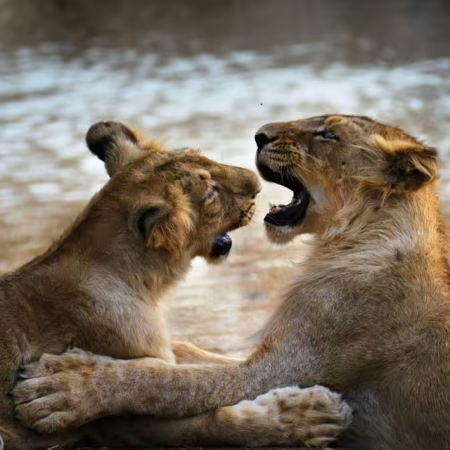
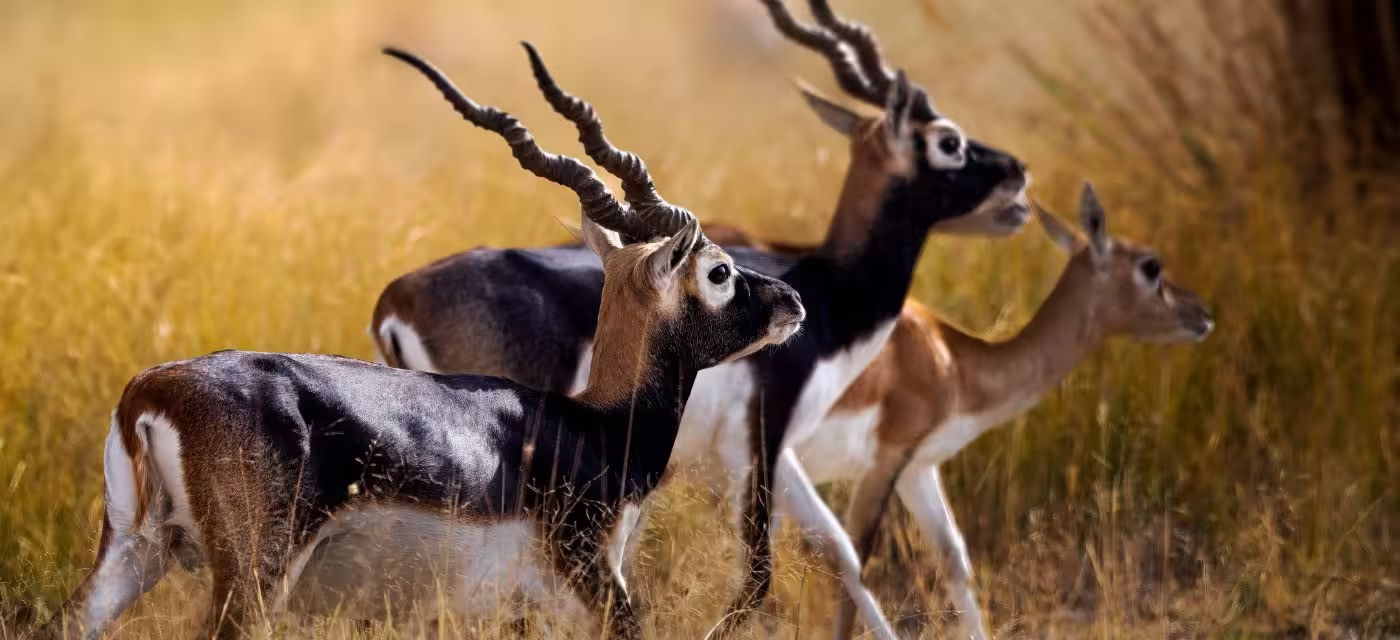
The Asiatic Lion, found only in Gir, the Wild Ass in the Little Rann of Kutch, and the Black Buck, which is the only four-horned antelope in the world, are some of the valued species protected in Gujarat.
Here are some of the state’s finest national parks and sanctuaries.
Sasangir
The Gir National Park holds the rare and proud distinction of being a wildlife sanctuary that is the only remaining habitat for the Asiatic Lion. Most of Gir falls under the Junagadh District of Gujarat. This is one of the regions where the mighty Asiatic lion once reigned – from Southern Europe to Africa to Central India, until around a century ago.
In the early 20th century, the lion population fell due to a massive famine. The Nawab of Junagadh then undertook a huge project to save the few remaining Asiatic lions.
Due to the Nawab’s tremendous efforts to bring the lions back from the brink of extinction, Gir was declared a lion sanctuary in 1965; and a National Park and Nature Reserve in 1974.
The Gir experience is of course fantastic for its close encounters with the majestic Asiatic lions but what also makes it special is that it has a very large leopard population, among several other species of animals.
The forest is also a birder’s paradise, home to over 250 varieties of birds.
Velavadar Blackbuck National Park
Once a part of the princely state of Bhavnagar, the sprawling grasslands of Velavadar, with their high populations of the Indian Blackbuck, were used as private hunting grounds, and grazing lands for the maharaja’s cattle.
A sanctuary was soon created to protect the Blackbuck, and Velavadar was declared a National Park in 1976.
Situated near the Gulf of Khambat in Bhavnagar, the Park abounds with animal and bird life, and is the home of the beautiful and thrilling spiral-horned antelope or the Blackbuck, also the fastest Indian antelope, with its maximum recorded speed standing at 80 km per hour!
Also here are the endangered Indian wolves, which hunt in packs in the forest.
For birders, this is heaven – close to the coast are wetlands full of rare and beautiful endangered and migratory birds.
Nalsarovar Bird Sanctuary
Around 65 km from Ahmedabad, the Nalsarovar Bird Sanctuary lies on the low-lying plains between Central Gujarat and Eastern Saurashtra.
The lake – Nalsarovar – and the wetlands around it were declared a bird sanctuary in 1969. The over 120 sq. km wetlands and the extensive reed beds and marshes are the perfect habitat for aquatic plants and animals.
The wetland is made up of open waters, emergent vegetation, islets, and mudflats.
Every year, between November and February, flocks and flocks of more than 200 types of migratory birds fly all the way from their nesting grounds in Central Europe to Nalsarovar, making an arduously long journey to escape the harsh winter of their nesting areas.
They come here to find food, shelter, and warmth. During these four months water is abundant, as are fish, insects, and aquatic plants – making it a bird watcher’s delight.
Little Rann of Kutch
Spread over 4,953 sq. km in the five districts of Kutch, Patan, Surendranagar, Banaskantha, and Rajkot in Gujarat, the Little Rann is the largest sanctuary in India and a Ramsar Wetlands Site.
It is also the only sanctuary for the Asiatic Wild Ass in India.
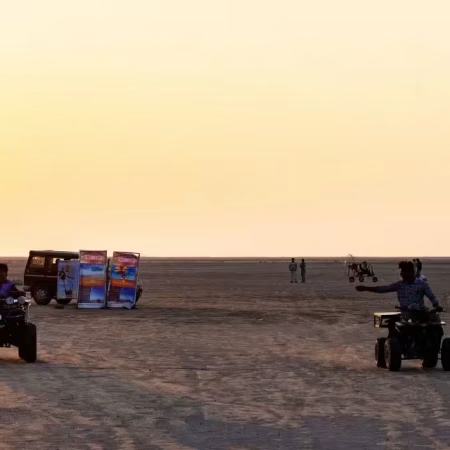
The Rann (meaning ‘salt marsh’) is an unusual, unique landscape that was once an arm of the Arabian Sea. As the land eventually separated from the sea, it became a vast plain of greys, blacks, and whites formed by salty mudflats and shimmering stretches of water.
The Rann is a seasonal marshland which is inundated with seawater that then dries up, leaving behind large patches of salt.
The region is rich in natural gas. To protect and conserve the unique ecosystem, several wildlife sanctuaries and reserves have been established here.
Apart from the Wild Ass, the Little Rann is also home to several other species of small animals and reptiles; and a birder’s paradise, with several migratory birds flocking here in the winter months.
The Marine National Park
Declared as the first marine national park in India in 1982, the Park lies off the southern coast of the Gulf of Kutch in Jamnagar. It was established for the protection of threatened marine flora and fauna in the area.
Colourful coral reefs, mangrove swamp forests, mudflats, sea grass, sea weeds, and rocky shoals form the landscape of the shallow waters of the Marine National Park.
This keeps land predators away from the water and also allows birds to nest and roost here.
During the monsoon, 30 different species of migratory birds make their home among the mangrove forests.
One of the most threatened birds, the great Indian bustard, and the Chowsingha, the world’s only four-horned antelope, is also found in certain protected areas here.
Khijadiya Bird Sanctuary
A short distance from Jamnagar, the Sanctuary has an incredibly diverse ecosystem in a small area.
Established during the early 20th century, the Sanctuary is formed by two man-made dykes that separate fresh water from sea water, making it possible to observe species that belong to both ecosystems, and some that share both.
The landscape also has marshes, mangroves, mudflats, salt pans, creeks, forest scrub, sandy beaches, and even farmlands.
The diverse terrain is home to more than 220 species of resident and migratory birds, including globally threatened species.
Saputara
Saputara, Gujarat’s only hill station, is located in the Dangs, the least developed of Gujarat’s districts.
Charming and unpretentious, Saputara looks out to a lush green valley and is a lovely place to unwind, go trekking, or take gentle walks in the hills.
The main attractions here are the Saputara Lake, Echo Point and Townview Point, the tribal villages of the Bhils, Warlis, and Gamits, Hatgadh Fort, Pandava Caves, and the Saputara Museum.
Gopnath Beach
This low-key, relatively little-known beach (some 90 km from Bhavnagar) on the coast of the Gulf of Khambat, is encircled by limestone cliffs, fishing villages, and temples, and is home to plovers and oyster-catchers.
Gopnath is also a great base for excursions to Palitana and Alang.
Ready to manage high-budget campaigns? We are looking for a Senior Performance Marketer (2+ yrs exp) specializing in FB, TikTok, or Google Ads to drive our scaling strategy.
100% Remote | Competitive Base + Performance Bonus.
Related Posts