
 English
 Deutsch
 Italia
 August 27, 2026 By admin
Gandhi Trail Gujarat
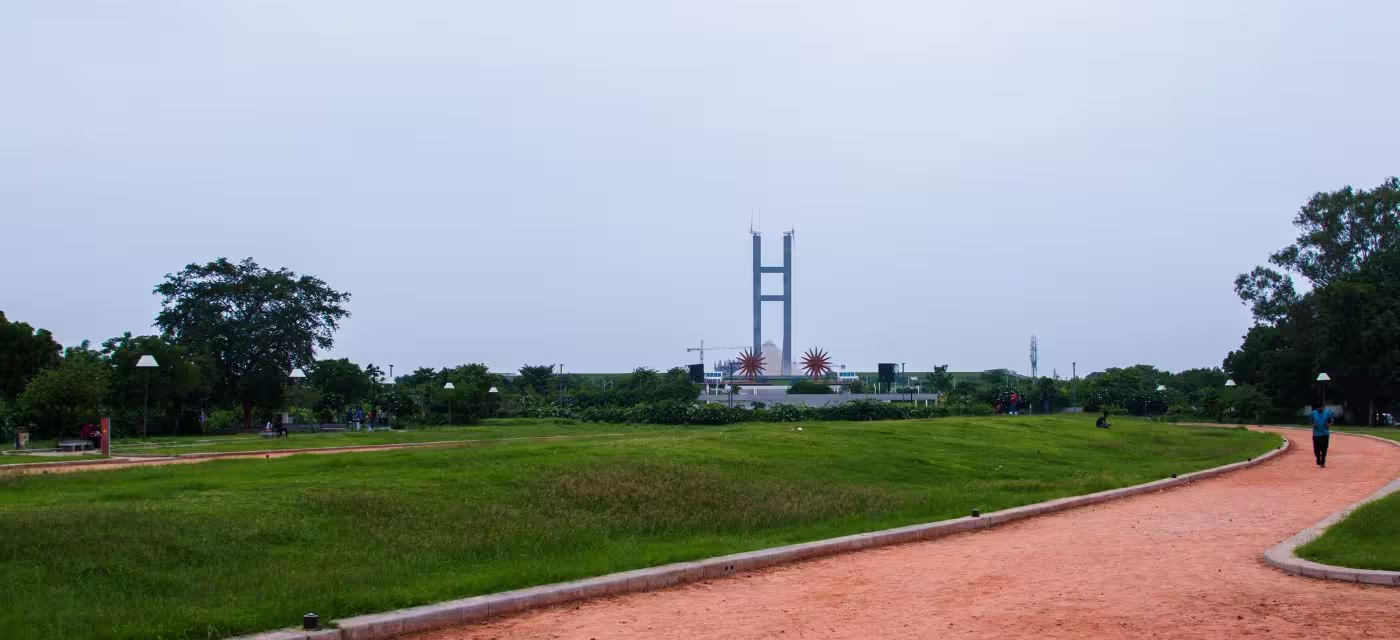
The Gandhi Trail
The Gandhi circuit in Gujarat, followed through museums and memorials, is one of the best ways to learn about the life and times of Mahatma Gandhi, the Father of the Indian Nation. Gujarat is not only the birthplace of Mohandas Karamchand Gandhi but was once also the site of several significant socio-political events, associations, meetings, and activities in the history of India’s struggle for independence.
The ‘haveli’ where Mohandas Karamchand Gandhi was born on October 2, 1869, in Porbandar is one of the biggest highlights on this circuit. The room where he was born has been preserved just the way it was. A part of the house has now been converted into a museum and called the Kirti Mandir.
It was in Rajkot that Gandhi spent his childhood, and the family residence, now called ‘Kaba Gandhi No Delo’, houses a small museum that exhibits a history of various events in Gandhi’s life through pictures. Gandhi returned to Rajkot in 1939 to establish the Rashtriyashala to instil the idea of Swaraj (self-rule) during the country’s fight for Independence. Today, the school imparts educational and vocational training; interestingly, it also popularised the art of single ‘ikat’ weaving, a craft Rajkot is famous for.
Located near Surat, the seaside town of Dandi is the iconic site from where Gandhi began his famous Salt Satyagraha (Dandi March) in protest against the British Salt Law imposed on India. Dandi shot to worldwide prominence in 1930 when Gandhi marched from Sabarmati (Ahmedabad) to Dandi with a group of followers and volunteers to protest against the imposition of a tax on salt. Thousands of people participated, travelling on foot for 24 days from Ahmedabad to Dandi.
At Dandi, he picked up a handful of saline mud and seawater, symbolising the production of salt in defiance of the British law. A memorial statue marks the historic event.
The Gandhi Ashram and the Gandhi Memorial Museum lie across the banks of the River Sabarmati in Ahmedabad. Established in 1918, the spartan and tranquil Ashram is where Gandhi lived, and from where he launched the famous Dandi March in 1930.
Here, he learnt the art of spinning and weaving khadi (a kind of cotton fabric) – the experiment not only revolutionised a whole new way of producing homespun cloth, but also a way of life and thought.
The Museum in the Ashram houses the personal effects and memorabilia of Gandhi, depicting historic events in his life. There are books, manuscripts, and photocopies of his correspondence (including a letter he wrote to Hitler), photographs with wife Kasturba and other associates, life-size oil paintings, and his writing desk and spinning wheel.
Related Posts