
 English
 Deutsch
 Italia
 August 19, 2026 By admin
Into the Beautiful Forests Sundarbans
Into the Beautiful Forest – Home of the Shadowy Cat
“There is no prettiness here to invite the stranger in. Yet, to the world at large, this archipelago is known as the Sundarban, which means the beautiful forest.”
— Amitav Ghosh, The Hungry Tide
The Sundarbans National Park has a wildness unlike almost anywhere else in India.
The magnificent and much-feared Royal Bengal Tiger, enormous saltwater crocodiles, rare birds and abundant aquatic and terrestrial wildlife inhabit a landscape shaped by shifting tides, muddy waterways and dense mangrove forests.
It is a place where river meets sea, freshwater mingles with saltwater and the forest seems to disappear into the horizon.
The experience is mysterious, remote and unforgettable.
The World’s Great Mangrove Wilderness
The Sundarbans National Park forms part of the world’s largest mangrove ecosystem.
Spread across the Ganga-Brahmaputra Delta, this watery wilderness consists of a maze of islands, rivers, creeks and tidal mudflats.
The landscape is unlike the traditional image of an Indian wildlife reserve.
There are no Jeep safaris here.
There are no broad forest roads.
Instead, the Sundarbans must be explored by boat or steamer.
The waterways become your safari route, while the dense mangrove forest forms an impenetrable green wall on either side.
This is what makes a wildlife experience here so different.
A Land of Water, Forest and Mystery
The Sundarbans is an archipelago of numerous islands, some inhabited and others forming part of the protected wilderness.
The islands are surrounded by an intricate network of waterways where the river and sea meet.
Only a limited number of islands are inhabited, and access to the forest itself is carefully regulated because of the dangers posed by tigers, snakes, crocodiles and other wildlife.
Some inhabited islands offer accommodation and resort facilities, while adventurous travellers can choose houseboat experiences.
But regardless of where you stay, the waterways remain the heart of the journey.
Exploring the Sundarbans by Boat
The only way to truly experience the Sundarbans is from the water.
As the boat moves slowly through the waterways, the scenery changes constantly.
Deep forests appear behind tidal channels.
The distinctive roots of mangrove trees grip the muddy banks.
Narrow waterways twist and turn through the landscape, creating an atmosphere that is both peaceful and slightly unsettling.
The stillness can be deceptive.
Every movement along the shoreline seems to suggest that something may be watching from within the forest.
An experienced guide adds another dimension to the journey, sharing stories and knowledge of the forest while helping travellers understand its wildlife and unusual ecosystem.
Wildlife Along the Waterways
The Sundarbans is home to an extraordinary variety of wildlife.
During a cruise, you may encounter large saltwater crocodiles, Irrawaddy dolphins and colourful birds.
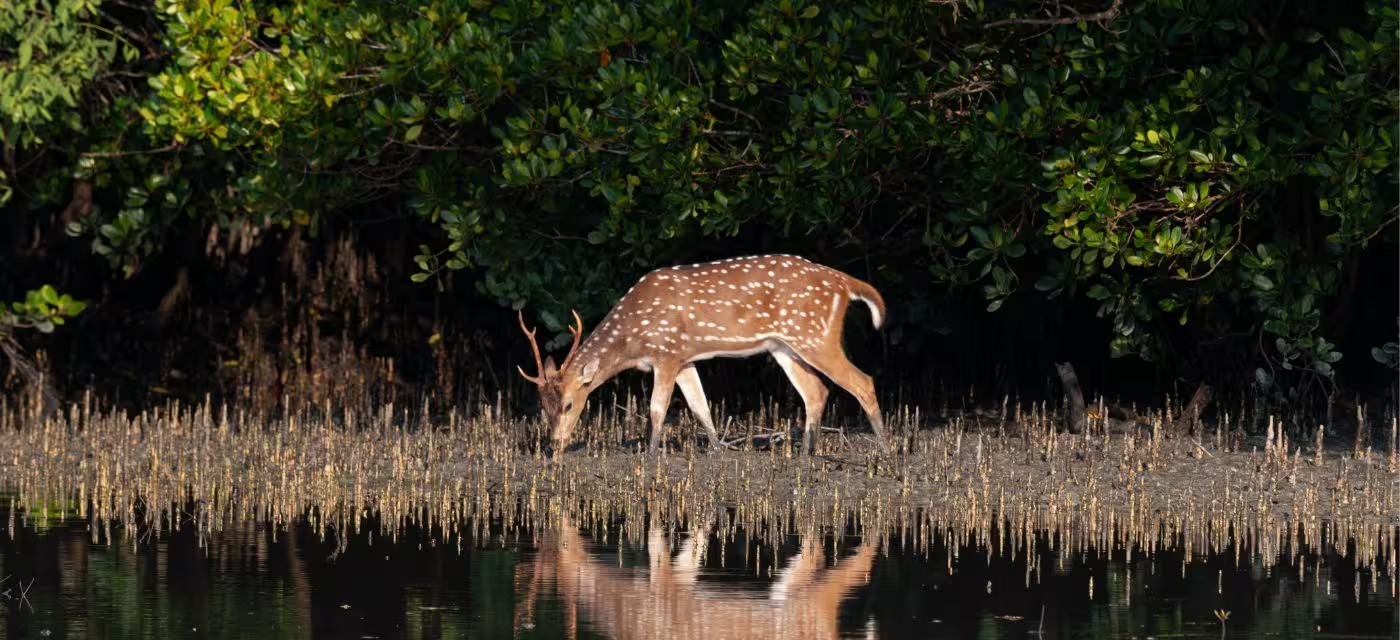
On the forest edges, fleeting glimpses of deer, wild boar, monkeys and other animals can add excitement to the journey.
Wildlife sightings are unpredictable, which is precisely what makes the experience so compelling.
You never quite know what might emerge from the mangroves.
And because boats are not permitted to approach the forest too closely, wildlife must be observed from a safe distance.
Sajnekhali and Dobanki
Most Sundarbans cruises include visits to Sajnekhali and Dobanki.
These locations offer specially protected watchtowers from which visitors can observe the surrounding forest and waterways.
At Dobanki, a raised canopy walkway provides another perspective over the mangrove landscape.
From above, the forest appears endless.
The combination of dense vegetation, winding waterways and distant wildlife creates some of the most memorable views in the Sundarbans.
Bengali Food on the River
A day spent cruising through the Sundarbans can work up quite an appetite.
Fortunately, meals are often prepared aboard the boats.
The cuisine typically draws from the flavours of Bengal, providing a satisfying local dimension to the wilderness experience.
There is something particularly memorable about enjoying a hearty Bengali meal while surrounded by mangrove forests and tidal waterways.
The landscape becomes part of the dining experience.
Discovering Island Life
When the day’s cruise comes to an end, the experience doesn’t necessarily stop.
A village walk offers an opportunity to meet local communities and understand how people have adapted to life in one of India’s most challenging environments.
The islanders live alongside tides, storms, wildlife and the ever-present risks of the forest.
Their resilience is one of the most moving aspects of a journey through the Sundarbans.
Village walks can also provide opportunities to discover local products, including the famous Sundarbans forest honey, along with other regional souvenirs.
Evenings may feature traditional dances, cultural performances and bonfires before dinner.
Places to Explore in the Sundarbans
Depending on the itinerary and tour package, visitors may be able to explore several notable attractions, including:
- Crocodile Pond
- Bonbibi Temple
- Tiger Rehabilitation Centre
- Sudhanyakhali Watchtower
- Jhingekhali Watchtower
- Bonnie Camp Watchtower
- Sajnekhali
- Dobanki
The exact experiences available depend on the particular tour package and interests of the traveller.
The Elusive Royal Bengal Tiger
The Royal Bengal Tiger is the ultimate symbol of the Sundarbans.
Yet seeing one is extraordinarily difficult.
Even experienced local residents may go through their entire lives without seeing a tiger.
For visitors, a sighting may consist of nothing more than a fleeting glimpse from a boat or watchtower — perhaps even a set of pugmarks pressed into the mud.
And that rarity makes the possibility of seeing one even more thrilling.
The Sundarbans is not a place where wildlife necessarily reveals itself on demand.
Here, patience is part of the experience.
The Tiger That Swims
Perhaps the most fascinating characteristic of the Sundarbans tiger is its relationship with water.
Unlike many large cats, these tigers are capable swimmers and can travel considerable distances between islands.
The mangrove environment has created a tiger unlike the one encountered in many other parts of India.
The source describes accounts of tigers crossing waterways and even entering fishing boats.
This extraordinary behaviour has contributed to the fear and mystery surrounding the Sundarbans tiger.
Dakkhin Rai – The Demon King of the South
The fear of the tiger is deeply woven into local culture.
In the Sundarbans, some islanders traditionally avoid saying the Bengali word for tiger, “baagh.”
Instead, they refer to the animal as Dakkhin Rai, or the “demon king of the south.”
The belief is that saying the tiger’s name aloud could attract it.
For visitors unfamiliar with the realities of life in the Sundarbans, such beliefs may seem like folklore.
But the dangers faced by people who depend on the forest are very real.
Fishermen and honey and firewood collectors who enter permitted forest areas can face significant risks.
The Guardian Goddess of the Forest
Before entering the forest, local people traditionally offer prayers to Bonbibi, regarded as the guardian of the forest.
Bonbibi occupies an important place in the cultural imagination of the Sundarbans, particularly among communities whose livelihoods depend upon the forest.
The tradition reflects a deeper relationship between people and nature — one based not simply on admiration, but on respect and caution.
In a landscape where survival can depend upon understanding the rhythms of the forest, these traditions have profound significance.
A Wilderness Where the Tiger Remains Wild
The Sundarbans offers an extraordinary contrast to conventional wildlife tourism.
Here, the forest is not easily accessible.
The roads disappear.
The waterways become the trails.
The mangroves hide what lies within.
And the tiger remains an elusive presence rather than an attraction that can be expected on schedule.
Perhaps that is the true magic of the Sundarbans.
It is a place where nature still dictates the terms.
You may cruise for hours without seeing the animal you came searching for. Yet every ripple, movement in the foliage, distant birdcall and footprint in the mud keeps the possibility alive.
The Sundarbans is beautiful not because it is gentle, but because it is wild, mysterious and uncompromising.
And somewhere beyond the mangrove shadows, the Royal Bengal Tiger continues to move silently through its kingdom.
Related Posts