 English
 Deutsch
 Italia
 August 19, 2026 By admin
A Wild Date in Kaziranga
A Wild Date in Kaziranga
“If a man aspires towards a righteous life, his first act of abstinence is from injury to animals.”
— Albert Einstein
My favourite animal is – yes, this is the best line with which to start sharing my experience with the only ape of India – the Hoolock Gibbon.
I had seen gibbons in different zoos, but I always wanted to see them in their natural habitat. Though I had spent more than seven years in the jungles of India studying different kinds of wildlife, including tigers, I had never had the chance to see this beautiful ape.
This year, however, I was given an assignment to visit the Gibbon Wildlife Sanctuary and the Kaziranga Tiger Reserve with our USA clients.
Both parks have resident populations of gibbons and other primates, although sightings are better in the Gibbon Wildlife Sanctuary.
Kaziranga – More Than Tigers and Rhinos
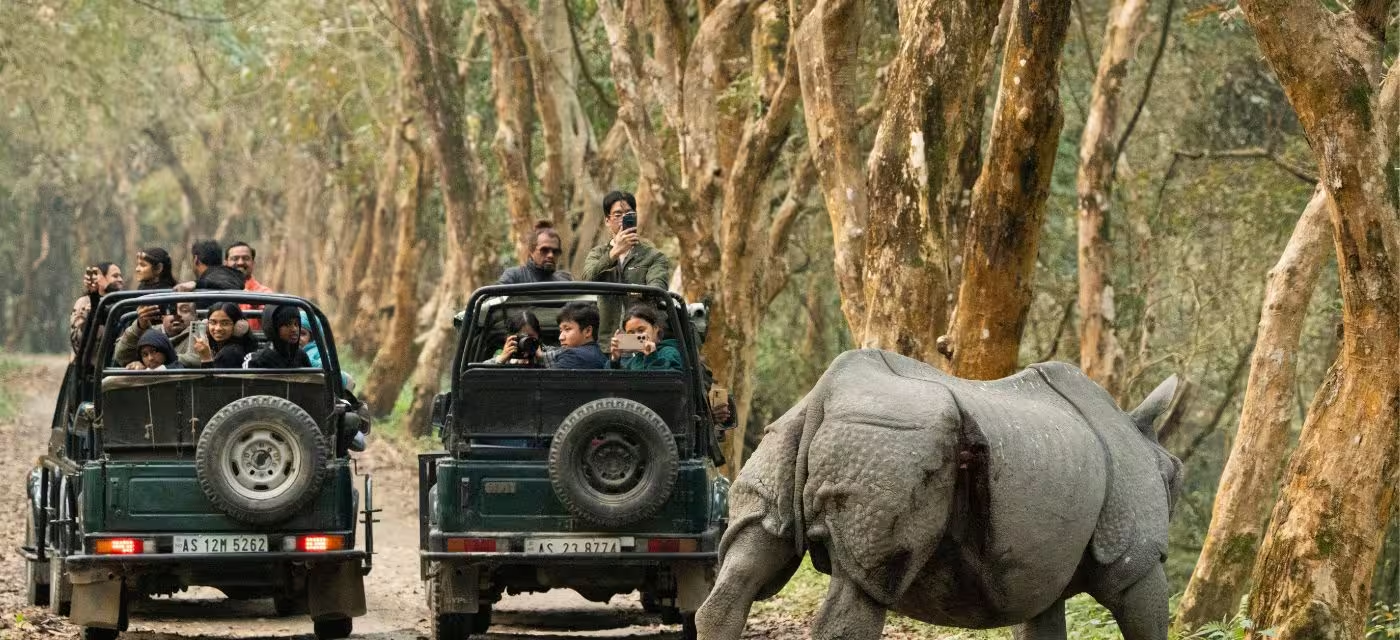
The Kaziranga Tiger Reserve is renowned for its high density of tigers and the iconic one-horned rhinoceros.
But Kaziranga has much more to offer.
The Reserve supports large populations of several endangered species, notably the Asiatic Wild Buffalo, which has its largest population here, along with the Asian Elephant, Eastern Swamp Deer, and many others.
The Reserve is equally rich in birdlife, with more than 490 species of birds recorded.
For a wildlife enthusiast, Kaziranga is therefore much more than a destination for tiger and rhino sightings.
Gibbon Wildlife Sanctuary
The Gibbon Wildlife Sanctuary lies in Assam’s Jorhat district in northeastern India.
Notified as a sanctuary in 1997, it covers approximately 20 square kilometres and has one of the highest densities of gibbon populations in Assam.
It is also unique for being the only sanctuary named after the ape.
The area was earlier known as the Hollongapar Reserve Forest, which was notified as a reserve forest in 1881.
Today, tea gardens surround much of the sanctuary, along with several villages.
But the forest itself remains an extraordinary refuge for primates.
A Forest Full of Primates
The Hoolock Gibbon is not the only primate found here.
The sanctuary is also home to:
- Capped Langur
- Pig-tailed Macaque
- Assamese Macaque
- Rhesus Macaque
- Stump-tailed Macaque
- Slow Loris
This remarkable diversity of primates is one reason the sanctuary is considered such an important wildlife destination.
Other animals found here include Asian Elephant, Tiger, Leopard, Leopard Cat, Barking Deer, Wild Boar, Chinese Porcupine, Chinese Pangolin, and Giant Squirrel.
India’s Only Ape
The Hoolock Gibbon is the only ape species found in India.
It belongs to a remarkable group of lesser apes found across South and Southeast Asia.
The species is restricted to the forests of northeastern India south of the Brahmaputra River, as well as parts of Bangladesh, southern Yunnan and Myanmar.
Hoolock Gibbons spend most of their lives high in the trees.
They are territorial, highly adapted to life in the canopy and famous for their extraordinary movement through the forest.
The Spectacular Art of Brachiation
One of the Hoolock Gibbon’s most fascinating characteristics is its unique method of movement.
Known as brachiation, this involves swinging from branch to branch using the arms.
Watching a gibbon move through the canopy is almost like watching an acrobat perform.
Their long arms allow them to travel rapidly between trees without needing to descend to the ground.
Adult males are black with distinctive continuous white eyebrows, while adult females are light brown with a whitish ring around their eyes and muzzle.
The young are born with pale coats that gradually change as they mature.
When the Forest Begins to Sing
Hoolock Gibbons are also famous for their extraordinary songs.
Their loud and elaborate duets are generally performed by adults, although young gibbons may join in.
The songs are believed to play an important role in defending their territory.
Interestingly, they sing more frequently when fruit is abundant, helping them protect the resources on which they depend.
For a visitor walking through the forest, hearing the distinctive calls before seeing the animals creates an unforgettable sense of anticipation.
Journey to Assam
My journey into the wonderful northeastern region of India began at Jorhat Airport.
Jorhat is a small town with a small airport, used largely by the Armed Forces.
When we walked out, I saw someone carrying a placard with the name of my group. I was travelling with the group as its leader.
It was hot in other parts of India at that time of year, but Assam was pleasantly cool. The region had apparently received good rainfall.
Soon, a car arrived to pick us up, and we began our journey towards the Kaziranga Tiger Reserve, where we were scheduled to spend three nights.
After approximately three hours, we reached our destination – the wonderful Diphlu River Lodge.
Our rooms were comfortable and designed in the style of traditional local huts.
At dinner, the resident naturalist briefed us about the activities planned for the following day.
A Day in Kaziranga
The next morning, we headed into the Reserve for a safari.
We saw numerous rhinos and, of course, pugmarks.
But despite Kaziranga’s impressive tiger density, actually spotting a tiger is extremely difficult.
That evening, we discussed the day’s sightings.
And although the rhinos had been wonderful, one bird had truly stolen the show – the Great Hornbill.
A large, colourful and majestic tropical bird, it is also one of my personal favourites.
At dinner, we discussed our plans for the next day.
Tomorrow was the day I had been waiting for.
We were going to my favourite place.
The Journey to the Gibbons
We decided to sleep early because we had to wake up early and travel approximately 132 kilometres, a journey of around three hours.
The following morning, I woke up excited and slightly nervous.
It felt almost like I was going to meet the love of my life after a long separation!
We departed on time with a packed breakfast and reached the Gibbon Wildlife Sanctuary at around 7:00 am.
We ate breakfast outside the Sanctuary because food is not permitted during walks inside.
I was thrilled to finally be there.
But something immediately concerned me.
A railway line crossed the Sanctuary, dividing the habitat into two unequal fragments.
For arboreal primates such as gibbons, which rarely come down to the ground, such fragmentation can create a serious barrier.
Fortunately, I later learned that a local gibbon conservation organisation had created a bridge-like crossing over the railway line, allowing gibbons and other primates to move between the forest fragments.
Into the Forest
Before entering the forest, we applied insect repellent to our bodies and shoes.
The purpose was not only to prevent insect bites but also to protect ourselves from leeches.
We began walking with a forest guard, a tracker and our naturalist from the lodge.
Suddenly, we heard our tracker, who was walking some distance ahead.
Excitedly, we rushed towards him.
There they were – a troupe of Capped Langurs moving through the middle canopy of the moist forest.
We photographed them and observed them for several minutes before continuing along the trail.
The forest was magnificent.
Huge trees rose above us, accompanied by giant ferns, orchids, lianas and countless other plants.
For a wildlife enthusiast, the biodiversity contained within just 20 square kilometres seemed almost unbelievable.
Along the way, we encountered giant wood spiders, interesting birds and butterflies, as well as a black giant squirrel.
I remember thinking that I could spend months here simply studying the flora and fauna.
HOO – HOO – HOO!
And then we heard it.
“HOO – HOO – HOO – HOO – HOO – HOO…”
We immediately rushed towards the sound.
The tracker was standing beneath a large Hollong tree, the state tree of Assam, its distinctive buttressed trunk clearly visible.
He was pointing towards the canopy some distance from the trail.
And there they were.
A pair of Hoolock Gibbons.
But wait.
There was another one.
A male?
No – a juvenile!
What an incredible sight.
The Moment I Had Been Waiting For
As soon as the gibbons noticed us, they began moving through the canopy.
They swung from one branch to another and from one tree to the next, using their remarkable arms to propel themselves through the forest.
It was spectacular.
My group and I stood amazed as we watched these extraordinary apes move effortlessly above us.
After some time, the adult male and juvenile became accustomed to our presence.
They relaxed, giving us enough time to observe and photograph them.
The light wasn’t ideal because the sky was cloudy, but I still managed to capture some beautiful photographs.
My group was absolutely delighted.
They had not expected such a rare and memorable sighting.
And yes, I was probably the happiest person among them.
When the Forest Answers Back
Soon afterwards, we tracked a few more pairs.
Unfortunately, they were far from the road and deep beneath the dense canopy.
We couldn’t see them clearly.
But we could hear their songs.
And sometimes, in a forest like this, hearing the wild is just as powerful as seeing it.
The journey to Kaziranga had begun as a wildlife assignment.
But somewhere beneath the canopy of the Gibbon Wildlife Sanctuary, it became something much more personal.
After years of seeing India’s wildlife, I had finally encountered the animal I had always wanted to see – the Hoolock Gibbon, swinging freely through its natural forest home.
It was, without doubt, a wild date worth waiting for.
Related Posts