
 English
 Deutsch
 Italia
 August 19, 2026 By admin
The Eye of the Tiger Sundarbans
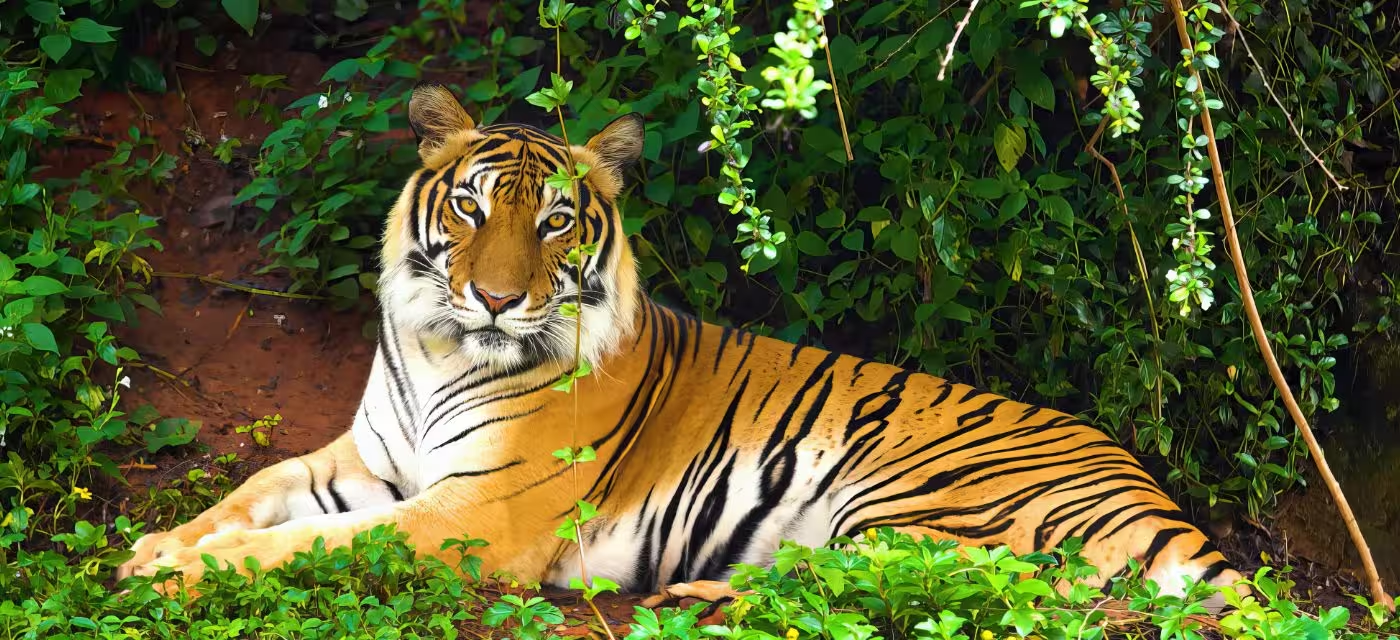
The Eye of the Tiger
“A thousand dangers lurk beneath the foliage among the mire and sallow waters. Large and ancient crocodiles patiently await their prey, hiding by ponds and riverbanks; tigers stalk passing boats, ready to pounce upon the first sailor that strays too close to shore. Rhinoceroses roam and attack at the slightest provocation; snakes abound in infinite varieties, from tiny poisonous serpents to enormous pythons large enough to grind an ox within their coils.”
— The Mystery of the Black Jungle (I Misteri Della Jungla Nera), 1895, by Emilio Salgari
Just 12 km south of Kolkata, away from the charming city’s chaos and busy streets, lies no ordinary city or town, nor even a thriving tourist spot. Here, deep in India’s vast and alluvial-rich Ganges Delta, lies an incredible portion of the earth—the Sunderbans.
Secret, secluded and difficult to reach except by water, the Sunderbans is a place of fierce and unrestrained beauty. Perhaps even somewhat intimidating at first sight. But this untamed treasure in the wild makes you catch your breath and wonder: could a place like this possibly be so close to civilisation and yet so remote?
But yes, it indeed is.
The World’s Largest Mangrove Forest
The Sunderbans is a delta in the Bay of Bengal that forms the world’s largest contiguous tidal mangrove forest. Named for the beautiful native sundari tree, this spectacular delta region is made up of densely forested, mangrove-fringed islands interwoven by an unbelievably labyrinthine network of creeks, backwaters and canals that crisscross each other in a vast saltwater swamp.
From the water, mangrove trees such as hetal, garjan and sundari appear like gnarled, tangled forms, fringing the land with long, twisted roots that rise snorkel-like through the thick mud of the swamp.
The spiky roots are magnificent. The mangrove’s sprawling root system at the water’s edge protects the land from erosion. The pneumatophores, as they are called, are specially modified roots that grow out of the water’s surface to allow the trees to breathe.
These remarkable mangroves have evolved over thousands of years to withstand the relentless pull of powerful shifting tides that swamp the low-lying forest, constantly creating new banks before receding and leaving behind only shimmering sand.
A Wilderness Across Two Countries
These remarkable mangrove forests encompass two countries—southern Bangladesh and part of West Bengal in India—covering an enormous area of approximately 6,000 sq km and another 4,000 sq km respectively.
On both sides of the border, densely populated villages flank protected areas specially earmarked for the region’s extraordinary biodiversity.
The Sunderbans was declared a UNESCO World Heritage Site in 1987 and a Biosphere Reserve in 1989. It is also a National Park and a Tiger Reserve. The Sunderbans Tiger Reserve is located in South 24 Parganas, West Bengal.
Here, in the deep, dark, swampy waters and secret forests, you may see a brilliantly hued kingfisher, a noisy macaque or a silent estuarine crocodile, ostensibly sleeping.
A Paradise for Wildlife
The Sunderbans is an absolute paradise for an astounding array of animal species.
If it is your lucky day, you could spot fantastic creatures such as the rare Irrawaddy and Ganges River dolphins, the highly endangered Royal Bengal tiger, and other endangered species including the saltwater crocodile, river terrapin, Olive Ridley turtle, hawksbill turtle and mangrove horseshoe crab.
At low tide, you might see wild boar, flying foxes, pangolins and spotted deer emerge from the forest. And often, on the mud banks, you’ll see the deep pugmarks of the elusive tiger.
The many species of mangrove are also home to more than 300 species of birds, along with an amazing variety of reptiles and marine animals.
The Royal Bengal Tiger
But the undisputed king of the mangroves is most definitely the stunning and menacing Royal Bengal Tiger.
Both feared and protected, the big cat of the world’s largest mangrove forests is a unique one, standing out among its fellow cats across the world.
Here, in the swampy forests, the endangered tigers are completely at home. They are also powerful and excellent swimmers, allowing them to navigate their way around this watery landscape.
For the tiger to adapt to the tough Sunderbans terrain is a testament to the remarkable resilience of the species. However, surviving in brackish water seems to have increased its appetite and changed its usual diet.
The Sunderbans is described as the only place on earth where tigers still actively hunt humans for food, making the Sunderbans tiger an exceptionally dangerous predator.
Having said that, you should still go.
Why?
Because the star of the mangroves is the Royal Bengal Tiger.
One of the last major tiger populations on earth lives here. More than a hundred tigers call the Sunderbans home.
Funnily enough, despite their dubious reputation, the tigers are extremely difficult to spot. Yet the incredible thrill of trying to track one down is indescribable.
And even if you are disappointed at seeing none, simply cruising through thick mangrove forests on your boat is an experience you will never forget.
Exploring the Sunderbans
Sajnekhali, at the confluence of the Peechkali and Gomdi rivers, is the main entry point to the Sunderbans.
Tourists can take routes designated by the Forest Department in the Sajnekhali Wildlife Sanctuary and Tiger Reserve. Every boat entering the sanctuary area needs a guide.
The core area is closed to tourists, but visitors can explore other buffer areas, all accessible only by boat.
Sajnekhali Tiger Reserve
The Sajnekhali Tiger Reserve is the heart of the Sunderbans.
It is the only place where tourists can safely step onto land and explore the reserve, with a guide, of course.
The reserve has:
- A watchtower
- A crocodile pond
- An Olive Ridley turtle enclosure
- A museum
- The Mangrove Interpretation Centre
- The Herbivore Acclimatisation Centre, which rehabilitates lost deer
Sajnekhali Bird Sanctuary
The Sajnekhali Bird Sanctuary lies at the confluence of the Matla and Gumdi rivers.
For birders, this is a wonderful destination. Among the birds that can be spotted are the rare Asian dowitcher, white ibis, paradise flycatcher, Caspian tern, white-bellied sea eagle and peregrine falcon.
The Magic of the Water
Perhaps what is truly worth doing here is simply spending a day on the boat.
Visit the mohona, the place where the waters of five mighty rivers merge. Or navigate the extraordinary network of creeks, canals and backwaters.
Monsoon cruises are especially stunning.
The experience of drifting through the waterways, surrounded by ancient mangroves and shifting tides, offers a perspective of the Sunderbans that cannot be experienced from land.
A Wilderness Like No Other
The largest mangrove forest in the world is a primeval place, shrouded in mist and crisscrossed by rivers.
It is a swamp of shifting tides, maze-like creeks and backwaters, silent man-eating tigers and unusual adventure.
It is flanked by two of the most densely populated countries on earth—India and Bangladesh—yet remains secluded, difficult, inhospitable and largely uninhabited by people.
But the breathtaking Sunderbans is truly wild terrain.
And when you ride the water into its mysterious, swampy heart of darkness, it is electrifying, enchanting, heart-stopping and tranquil—all at once.
Because in this place of shifting sands and tides, the indomitable mangroves are what hold the mighty land together.
Related Posts