

 English
 Deutsch
 Italia
 July 10, 2025 By admin
The Timeless Journey of the Mystic River
The timeless journey of the mystic river
A journey along the Ganga is a voyage to the very soul of India. Come and experience the myriad faces and moods of the mighty river reflected in her cool, ever moving waters. the mystic river S he begins as Bhagirathi at the foot of the Gangotri glacier in Gomukh, and then, at Devprayag, when Bhagirathi meets the river Alaknanda, she becomes the Ganga or the Ganges. Here is the goddess river who cascades down from the heavens above onto earth, only to be caught and tamed by Shiva, in the coils of his tangled locks! The beautiful river then meanders and makes her way down the Himalayas into the valleys below, flowing from there down across the plains, and eventually meets the great ocean, becoming one with it. “The Ganga is the river of India, beloved of her people, round which are intertwined her racial memories, her hopes and fears, her songs of triumph, her victories and her defeats. She has been a symbol of India’s age-long culture and civilization, ever-changing, ever-flowing, and yet ever the same Ganga.” (Jawaharlal Nehru, the first Prime Minister of India, expressing his wish for his mortal remains to be immersed in the Ganga) This is the journey of the Ganga. Worshipped as the most sacred river in India from ancient times and seen as the provider of life and livelihoods to millions of Indians, this river of Asia, which is the longest river of India, starts her sojourn in the state of Uttarakhand in the Western Himalayas and flows through the Gangetic Plain of North India into Bangladesh, where she finally empties into the Bay of Bengal. India and Bangladesh are the two countries through which the river flows. The greater part of the Indo-Gangetic Plain across which the Ganga flows, is the heartland of the region known as Hindustan, and has been the cradle of successive civilizations from the ancient Indian empires right up to the time when the Mughals came into India. A large number of cities have been built on this historic Gangetic Plain, the most notable ones among them being the cities of Rishikesh, Haridwar, Varanasi, Allahabad, Patna and Kolkata. Associated in myth and reality with India, its land and its people, the religious and spiritual significance of the Ganges probably exceeds that of any other river in the world. The Ganga is revered and regarded even today as the holiest of rivers, and most Hindus immerse the ashes of those departed, in the river, believing that this gives the souls a direct passage to heaven. A bath in the Ganges is said to purify and wash away all of one’s sins, both past and present, and cleanse the heart, mind, and soul.
Following the Restless River: THE GANGES TRAIL
Gomukh At a height of 12,760 ft (3890 m), in the state of Uttarakhand, Gomukh (or Gaumukh) is the terminus or snout of the Gangotri glacier. It is from here that the river Bhagirathi originates, its water gushing down with great force from the glacier, descending into the Gangotri valley and beyond. In ancient times, the sages called it ‘Gomukh’, (literally meaning ‘mouth of a cow’) because it probably appeared as having the shape of a cow’s mouth. Herds of bharal (Himalayan blue sheep) are a common sight from here as they clamber up the precarious mountain ridges, at heights of 10,000 ft and above. On the far side of the glacier, the Bhagirathi river, provides an equally impressive backdrop. Little wonder then, that this tranquility attracts spiritual seers, philosophers, and travellers to meditate here, undisturbed and uninterrupted, during the long summer months. Gomukh is about an 18 km trek from Gangotri and is one of the most popular Hindu pilgrimage sites in India. For trekkers, the route to the glacier has only one night halt, at Bhujbasa, which has a bungalow and a few ashrams, that offer food and lodging.
Gangotri
Gangotri is a pilgrim town in the state of Uttarakhand, and is situated on the banks of the Bhagirathi river. It is the point of origin of the Ganges river. According to Hindu mythology, Gangotri is the place where the Goddess Ganga descended on earth from heaven and took the form of a river. The Gangotri temple dedicated to the Goddess, marks the spot where she is said to have descended on earth.The shrine of Gangotri is situated at an elevation of 3200 m and is surrounded by deodar (cedar) and chir (pine) trees. The original temple was built by the Gorkha General Amar Singh Thapa. Every year people from all around the world visit this shrine. A number of ashrams and dharamshalas are located on the far side of the river. Submerged in the river is a natural Shivalingam (a smooth, cylindrical, upright rock symbolic of Shiva) where, according to mythology, Shiva sat when he received the Goddess Ganga in his matted locks, as she gushed down from heaven!
Uttarkashi
Uttarkashi is a town situated in the wide Bhagirathi valley, in the state of Uttarakhand. With a multitude of ashrams and temples, the town has been a centre for learning and religion since ancient times! This sacred town has been home to some of the most renowned and revered sages and saints of India. But Uttarkashi is also home to the Nehru Institute of Mountaineering! Which is why for the adventurous tourist or traveller, Uttarkashi, with its excellent trekking tracks, becomes the perfect place to stop and explore a range of adventure driven experiences like mountaineering, and climbing expeditions. It is also famous for adventure sports like white water river rafting. Depending on your mood or your interest, you could also trek to see some of the fresh water lakes around the town or visit the many temples that the town is known for; the most visited and the most famous of them being the Vishwanath temple, dedicated to Lord Shiva.
Devprayag
The sacred confluence or meeting of the Alaknanda and Bhagirathi rivers takes place at Devprayag, a town in Tehri Garhwal in the state of Uttarakhand, and is 74 km from Rishikesh. From this point on, the Bhagirathi is known as the Ganga or the Ganges. Among the many temples that dot this town, the most famous ones are of course the Raghunath and Sangam temples. But for those interested in more than just temple hopping, there’s an unlikely and exciting pleasure in store! And that, is the Nakshatra Vedh Shala. The Nakshatra Vedh Shala is an observatory that was established in 1946. It rests on a mountain called Dashrathanchal. The observatory is well equipped, with two telescopes and many books to support research in astronomy. It also contains about 3000 manuscripts from 1677 AD onwards, collected from various parts of country. But what is remarkable is that the observatory has preserved instruments and equipment used by astronomers in ancient India!
Rishikesh
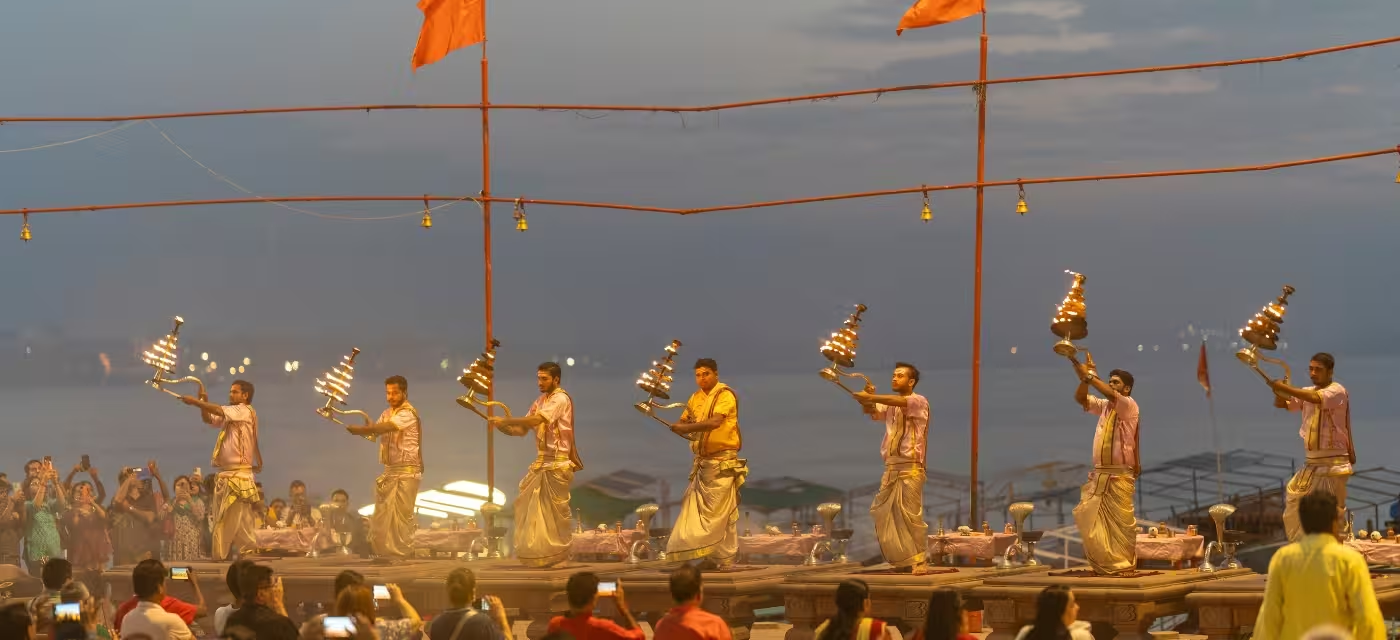
The town of Rishikesh lies in the foothills of the Himalayas, in the upper Garhwal region of the state of Uttarakhand. It is known as ‘The Gateway to the Garhwal Himalayas’. Rishikesh is a pilgrim town and has been regarded as one of the holiest places in India since ancient times. Sometimes called ‘the yoga capital of the world’ the little town has numerous yoga and meditation retreats and centres that attract tourists and travellers from all over the world. Perhaps Rishikesh’s biggest claim to international fame was in 1968, when the Beatles visited Maharishi Mahesh Yogi’s ashram there. For those wanting to experience the place on foot, evenings are a great time to visit the Triveni ghat on the banks of the Ganga to watch the spectacular and moving Ganga Aarti — an exhilarating experience of sights, sounds, and chanting. The other spots of interest are the iron suspension bridges (Ram Jhula and Lakshman Jhula) and the temples. And then for those of you who want to be adventurous and spend time outdoors, Rishikesh is famous for white water river rafting, trekking, rock climbing, rappelling, kayaking,mountain biking,and even bungee jumping.
Allahabad
Allahabad, which is in the state of Uttar Pradesh, is the second oldest city in India, said to be in origin from the Vedic period. It was originally called Prayag (meaning ‘place of offerings’ and still commonly used) because the Sangam or the confluence of the three holy rivers of India, the Ganga, Yamuna, and Saraswati, takes place here. Of great historical significance in ancient Indian history, Allahabad has been the centre of politics, culture and administration, in the IndoGangetic Plains, for centuries. During the British rule in the 1800s, it was even the capital of India for a day! For visitors to this ancient city, there are many tourist experiences to be seen and enjoyed. If you love history, then see Alfred Park, the Victoria and Thornhill Mayne Memorials, Minto Park, the Allahabad Fort, the Ashoka Pillar, and Khusro Bagh. For connoisseurs of culture, it might be a good idea to explore the Allahabad Museum, and also Anand Bhawan, the ancestral home of the Nehrus that now has memorabilia from the Gandhi-Nehru family. Allahabad is also renowned for its centres of art, dance, and music. And then, if you’d like to see the city’s religious spots, visit the All Saints Cathedral, the Triveni Sangam, and finally, the Kumbh Mela! There is nothing quite like it in the world! Every twelve years, Allahabad hosts the Maha Kumbh Mela, the largest religious gathering in the world, drawing thousands of people of faith, tourists and travelers, from all over the globe! And every six years, it hosts the Ardh (half) Kumbh Mela. The Kumbh Melas are one of the greatest tourist attractions on the Indian itinerary
Varanasi
Known as Benares or Kashi, Varanasi lies on the crescentshaped banks of the Ganges in the state of Uttar Pradesh. It has the most remarkable distinction of being one of the oldest continuously inhabited cities in the world! Also called the ‘spiritual capital of India’, Varanasi has been the cultural centre for religion, education, literature and music in North India for thousands of years. It also was an important industrial centre, noted for its silk, muslin, perfumes, ivory works and sculpture, to this day. The ancient city has been so closely associated with the Ganges that Hindus in India believe immersing the mortal remains in the river there will bring salvation to the soul! If you’re planning to make a trip to Varanasi, then be prepared to be simply swept away by the sheer colours, sights, sounds, smells, flavors, streets and people of this absolutely fascinating city! And there’s so much to see and do! Begin with the city’s beautiful ghats (steps of stone slabs along the river bank) where pilgrims bathe, offer prayers and perform ceremonies. The two main ghats here are the Dashashwamedh Ghat and the Manikarnika Ghat. This pilgrim city has an estimated 23,000 temples (yes!) of which the most important and popular ones are the Kashi Vishwanath temple of Shiva, the Sankat Mochan Hanuman temple, and the Durga Kund temple (also known as the ‘monkey temple’). It also has many mosques, of which the Alamgiri Mosque and the Gyanvapi Mosque are the most well known. You could then make your way to explore the Ramnagar Fort and its unusual museum, that contains, among other things, a rare collection of American vintage cars! The other place to see is the Jantar Mantar observatory, built in 1737, and located above the ghats. The other notable places to see are the Aghora Peeth,the Ashoka Pillar, and the Central University for Tibetan studies. Varanasi is renowned for its silk weaving industry and for its production of very fine silk and Benarasi sarees, brocades with gold and silver thread work, that are hand woven, luxurious, beautiful, and expensive (and possible heirlooms, if you decide to buy any!).
Kolkata
A city of love and warmth, sorrow and despair, dreams and hopes, poverty and squalor, grandeur and glory. Calcutta is compelling, effervescent, teeming with life and traditions – a medley of moods, styles, cultures, politics, industry and commerce. Calcutta has grown, remains a city of contrasts, a mix-up of light and shade, a strange medley of ancient and modern, skyscrapers and Victorian edifices, haven of the rich and the poor as seldom found anywhere in the world. There is so much to see in thiscalcu2.jpg (6143 bytes) incredible city. A million people from every corner of India stream across the massive Howrah Bridge, swarm around the Hooghly river, flock along the busy avenues, through its narrow lanes.
Related Posts



A fantastic place to connect
At vero eos et accusamus et iusto odio dignissimos ducimus qui blanditiis praesentium voluptatum deleniti atque corrupti quos dolores et quas molestias excepturi sint occaecati cupiditate non provident, similique sunt in culpa qui officia deserunt mollitia animi.