 English
 Deutsch
 Italia
 August 19, 2026 By admin
The Enchanting Giant of the Konkan
The Enchanting Giant of the Konkan
How do you describe a land whose sheer vastness, distinctiveness, and diversity at first takes you by surprise…and then has you coming back for more?
How do you describe a land whose sheer vastness, distinctiveness, and diversity at first takes you by surprise…and then has you coming back for more?
Simply as Maharashtra
Fringed by the beautiful Arabian Sea on its west, and sharing borders with Gujarat to the northwest, Madhya Pradesh to the north, Chhattisgarh to the east, Telangana to the southeast, Karnataka to the south, and Goa to the southwest, Maharashtra could be a world traveller’s delight—a marvellous melting pot of histories, a melange of cultures, an array of landscapes.
This incredible cosmopolitan quality—which it has continued to encourage and sustain over the centuries—is what makes the state stand out from the rest of India. Maharashtra is truly the Gateway to India.
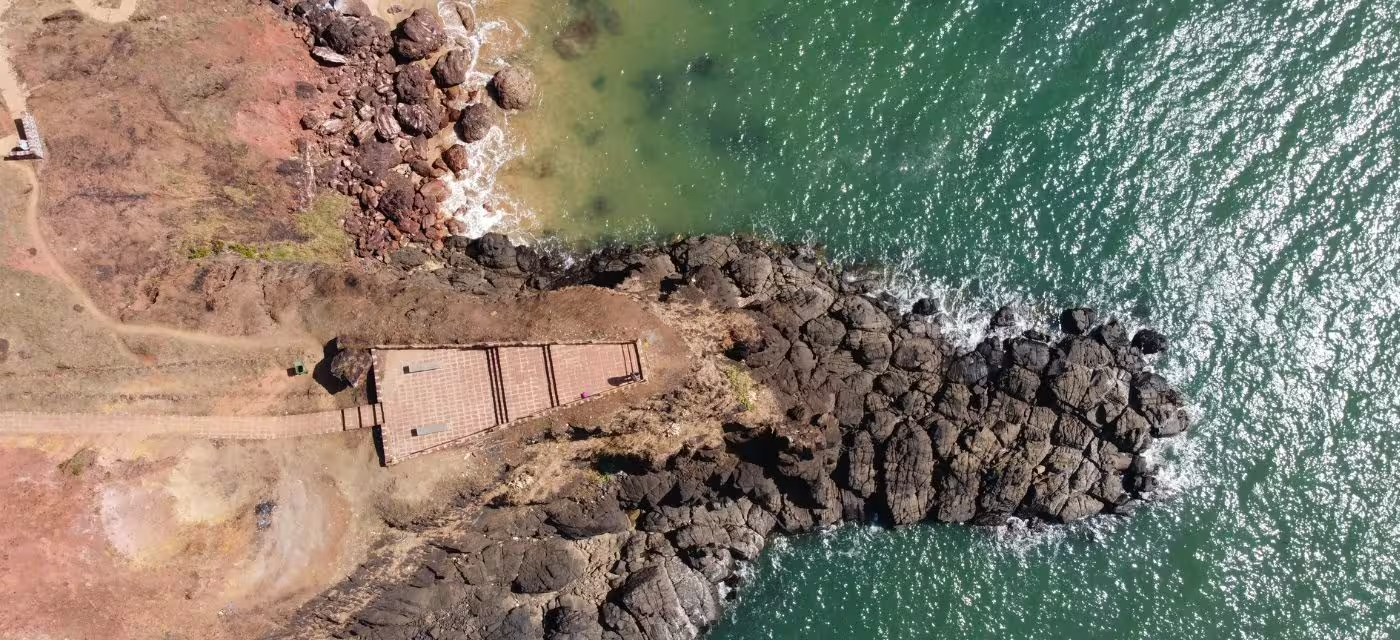
Lying on the grand Konkan Coast, Maharashtra’s pristine beaches run into miles of silvery sands—a 700 km coastline—that transform the state’s landscape and come alive with the energy of picturesque little fishing villages, fisher-folk, orchards, temples, and trading ports, inviting and enticing you to experience the azure waters of the ocean, fresh, clean air, and fabulous coastal cuisine.
Whether you enjoy vibrant promenades or the serenity of secluded alcoves, Maharashtra has them all. Naturally blessed because of its fantastic location, the Konkan Coast is cradled between the Arabian Sea and the Sahyadri range of the magnificent Western Ghats mountains.
The Sahyadri is every inch the trekker’s paradise, with its treasure trove of green hills, lakes, waterfalls, and forests. Unique and alluring, each hill destination also has the advantage of being within a few hours’ driving distance from each of the major cities in Maharashtra.
Scattered beautifully across this stunning landscape are the gems of Maharashtra’s rich historic and multi-cultural heritage—majestic, daunting forts; deep, ancient, exquisitely carved caves; scores of sculpted temples; remarkably unsullied wildlife sanctuaries; and four outstanding UNESCO World Heritage Sites:
- Ajanta Caves, Aurangabad
- Ellora Caves, Aurangabad
- Elephanta Caves, Elephanta Island, Mumbai Harbour
- Chhatrapati Shivaji Terminus, Mumbai
We bring you our pick of the finest from each region of the state.
Northern Konkan
Bordi-Dahanu
A 3-hour drive from Mumbai along the gorgeous Sahyadri mountain range, on Maharashtra’s long coastline, the Bordi-Dahanu stretch offers some of the most pristine beaches. It is also an experience of coastal village culture.
The area is famous for the delicious sapodilla, known in India as chickoo, and several fruit orchards nestled in the mountains. Dahanu is also home to the Parsis, who have lived here for generations, and the primitive Warli tribe, famed for its art. Both communities have contributed immensely to the unique cultural identity of the place.
Unspoiled by urbanisation, Bordi-Dahanu has been listed as a ‘green zone’ because it is ecologically fragile.
This is where you can soak up the sun, feel the cool sea breeze waft over you, and, if you like, take a walk on the 17 km-long white sands of Bordi Beach or stroll up to the lovely mangroves at the tip of the beach in the late evening.
At dawn or sunset, see the fishing boats returning with their catch or visit the local market to buy fresh seafood.
Asvali Dam is a lovely picnic spot, with its beautiful lake and surrounding Warli villages. Also nice to see are the Kalpataru Botanical Gardens in Umergaon, 10 km from Bordi.
Diveagar
This seaside treasure of the Konkan will entice you to stay for days and days!
Diveagar, with its nearly 5 km-long silvery sands, is one of the Konkan Coast’s finest beaches. Fragrant supari (betel nut) orchards line one side of the road, while the other side has coconut groves that part to make way for the stunning, secluded beach.
Visitors here can see the endless ‘shifting phenomena’—beach sands shifting due to the force of the waves. This strip of the coast is also abundant in marine life, flora, and fauna, making it wonderful for nature lovers.
The other prime attraction at Diveagar is the Roopnarayan Temple, which houses an exquisitely carved 900-year-old statue of Vishnu.
Murud-Janjira
A visit to the gorgeous Murud Beach will lead you to its other gem—the Janjira Fort, on an island in the sea.
Murud, a tiny village with a thick foliage of trees on its coastline, is a breezy, sheltered stretch of sand flanked by hills on three sides. It opens up spectacular views of the sunset.
The Janjira Fort is a famous 16th-century citadel that was built by the Siddis, trade-warriors from Abyssinia who settled in Murud-Janjira and ruled the region for about 400 years.
Durshet
Serene Durshet is hardly an hour’s drive from Mumbai.
You can explore nature trails here, as well as a river, lake, and forest so secluded that they could well be your very own. Durshet is part of a forest filled with mahua trees, with the River Amba flowing through.
You could walk the superb nature trails or bathe in the river, with not a soul around. The vast Lake Kalote invites you to take a dip in its cool, blue waters.
The monsoon is a wonderful time to visit because this is when the river is full and natural waterfalls roar in their full glory. Trek through the forest to see them.
Do stay at the Nature Trails Forest Lodge in Durshet. From this quiet base, you can explore the forest in the best possible ways—walk through plantations of fruit trees, casuarinas, and acacias; go insect-watching; see the temples here; go trekking in the Ghats; or enjoy rock climbing, rappelling, and river crossing.
The place is also rich in wildlife such as wild boar, barking deer, monkeys, and more, as well as birdlife such as drongos, warblers, doves, parakeets, and shrikes.
Southern Konkan
Ganapatipule
As you travel the road from Ratnagiri to Ganapatipule, with the Western Ghats forming a chain of green hills along the coastline, you immediately sense that you’re going to be rewarded with incredible beauty at the end of your journey.
Still, nothing will prepare you for the beach at Ganapatipule—a revelation of sorts.
The endless silvery sands here change colour with the time of day, best at sunset when the beach turns to gold against the backdrop of golden skies.
Remarkably, even though Ganapatipule draws hundreds of tourists, it never seems to be crowded, staying serene and unspoiled.
People come here from all over to seek blessings at the nearly 400-year-old Swayambhu Ganapati Temple, which faces the beach. The view from the hillock behind the Temple is especially breathtaking.
The sanctum sanctorum is lit by the golden rays of sunrise and sunset, illuminating the massive stone idol of Ganapati.
A wonderfully relaxing weekend getaway, Ganapatipule is where spirituality and nature seem to come together in sweet harmony.
It is also abundantly blessed with mango, cashew, betel nut, jackfruit, coconut, palm, and casuarina trees.
The tiny town stands out for its few roofed houses, neatly drawn roads, and red soil. Tourists can explore the backwaters here and enjoy water sports such as row boats, motorboats, aero boats, and pedal boats. There’s also paragliding to try.
A little outside, 35 km from Ganapatipule, is Jaigad Fort, lying at the entrance of the River Shastri. The 17th-century fort rewards you with majestic views of the sea.
If you’d like to try local delicacies, make sure to try ambapoli (thin pancakes of crushed and dried mango) and phanspoli (thin pancakes of dried and crushed jackfruit).
In the summer, you can savour the marvellous Devgad Hapus (Alphonso) mangoes.
Ratnagiri
Situated around 25 km from Ganapatipule, Ratnagiri is perhaps most famous for its delicious ‘hapus’ mangoes, which have firmly established it on the tourist map.
But look deeper, and you’ll see the other treasures the town has to offer—beautiful beaches made up of black and white sands, blue seas, green cliffs, a magnificent coastline, and enough historical and cultural attractions.
Ratnagiri’s nicest and quietest beach is Bhatye Beach, especially near the Regional Coconut Research Centre. The other two beaches worth visiting are Pandre Samudra and Mandavi.
Spread over 120 acres, the Ratnadurg Fort is not to be missed. You’ll catch fabulous views of the sea and the surrounding mountains from the citadel.
Thibaw Point also offers fantastic views. Thibaw Palace is the legacy of Ratnagiri’s Burmese connection. The mansion, now converted into a museum, is where the British kept King Thibaw of Burma, now Myanmar, under house arrest in 1910–11.
Ratnagiri is also the birthplace of renowned Indian freedom fighter Bal Gangadhar Tilak. Tilak’s ancestral home, now called Tilak Smarak, is one of the important landmarks of Ratnagiri and is open to visitors.
Also significant is the Patit Pawan Mandir, which was the first temple built for non-Brahmins by revolutionary leader Swatantryaveer Savarkar.
You can also visit Bhagwati Bunder, the sea port, if you’re interested.
Malvan
Once a tiny fishing hamlet on the Konkan Coast, Malvan sprang to new life when the Marathas came here, especially under their greatest leader, Chhatrapati Shivaji.
In 1664, Shivaji decided to build the massive Sindhudurg Fort on an island just off Malvan.
Remarkably, the imposing warrior king contributed his own physical labour to the construction of the Sindhudurg Fort. Which is why, when you visit the fort, you’ll see imprints of Shivaji’s hands and feet preserved in a slab of lime at the entrance.
The Sindhudurg Fort remains an incredible achievement, one for which the Marathas and their famed leader will forever be remembered. It stands as an enduring testament to their unquestionable power and fantastic naval prowess, which daunted even the British and the Portuguese.
Shivaji also fortified the nearby island of Padmagad and built a couple of towns north of Malvan on the mainland.
Malvan Beach and the jetty, vibrant and abuzz, are where you’ll get the rare opportunity to see a fish auction between 5 and 7 pm.
The other beaches to spend time and relax on are Chivia Beach, Asra Mahal Beach, Tandavali (around 19 km away), and Achara, which is perfect for dolphin-spotting between October and February.
The Sindhudurg Fort was built on a rock island called Kurte Bet. The outstanding fort has 3 km of zig-zagging ramparts, 12-foot-thick and 30-foot-high walls, 53 bastions, and three broad semi-circular formations crowning its head.
These towers have embrasures for cannons.
Among the temples inside the fort, the most unique one is the Shree Shivchhatrapati Temple, dedicated to Shivaji. The Maratha hero’s idol here is unusual—a non-bearded, silver-capped sculpture.
The temple is today a pilgrimage of sorts for Shivaji’s many followers.
Be sure to see the fort at sunset, which is when you will get breathtaking views from the top. Do also make time to see the splendid Vijaydurg Fort, lying some 74 km away from Sindhudurg.
Malvan today may be home to gentle fisherfolk, quiet villages, and a pristine coast, but it is the living legacy of Maharashtra’s rich history and must be experienced.
Desh Region
Radhanagari Wildlife Sanctuary
The Radhanagari (Dajipur) Bison Sanctuary in the beautiful Kolhapur District of Maharashtra is nestled in the endless green stretches of the Western Ghats.
Also known as the Dajipur Sanctuary, the area in and around the sanctuary was earlier used as the private shooting grounds of the Maharaja of Kolhapur.
The Indian bison, or gaur, is the flagship species of this sanctuary. Other inhabitants include the tiger, leopard, sloth bear, Giant Squirrel, Mouse Deer, Barking Deer, and several species of reptiles, birds, amphibians, and butterflies.
You can trek into the heart of the forest, with a local guide and permit, on wild roads or choose to travel by jeep.
Either way, you’ll see the amazing changes in landscape as you go through—unbelievably thick forest with dense undergrowth to large open meadows of wildflowers and dry grass on a bed of bauxite, where you can see the fascinating bison graze.
All this under azure, sunny skies!
These are the moments when you understand and appreciate not only the immense natural beauty of Radhanagari but also its great ecological significance in the region.
Bhimashankar Wildlife Sanctuary
If you want to explore the out of the ordinary, then Bhimashankar—with its stretches of sacred forests, emerald hills, gorgeous waterfalls, and the lovely waters of the River Bhima—is just right for you.
Nestled in dense forests stands the exquisite Nagara-style Jyotirlinga Temple, dedicated to Siva. The temple was erected over a sacred linga and attracts many devotees to the forest.
Behind the temple is a small trail that leads into the heart of the forest to Guptbheema, the origin of the River Bhima, and an absolutely stunning spot.
There are about 14 sacred groves (Devrais) in the forest. These are patches earmarked to protect endemic species of flora and fauna and often for water security. The rich groves are a great source of ecological and cultural heritage.
The Bhimashankar Wildlife Sanctuary is part of the Western Ghats, recognised as one of the 12 biodiversity hotspots of the world.
It is fantastic for trekkers and adventure lovers, especially during the monsoon.
If you’re trekking in the forest, then watch out for the shekru, an endangered giant flying squirrel which is also the state animal of Maharashtra.
Bhimashankar is surrounded by forts of varying heights and varying degrees of difficulty, such as Shivneri, Kothaligad, Padargad, and Siddhagad. Trek up to these forts and test your stamina and sense of adventure.
You can also visit the Chas Kaman Dam, built on the River Bhima. The dam and its backwaters make for an ideal monsoon retreat.
The Forest Interpretation Centre at Bhimashankar is equipped with a library and is a wonderful place for children and adults alike.
Karla-Bhaja-Bedse Caves
Maharashtra has some of the most interesting cave sites in the country, which you must definitely make time for, especially if you’re looking to visit unique places of historic interest.
About 15 km from Lonavla, towards Pune, are the striking rock-cut Karla Caves.
Begun by the Hinayana Buddhists in the 1st century BCE, the caves were later taken over by the Mahayana sect. The ancient Karla Caves are some of the most famous Buddhist rock-cut cave sites in India.
The magnificent structure includes a representation of the Buddha and an aisle with 37 pillars and carved elephant heads, which once had real ivory tusks.
Just outside is the Koli Temple, a shrine sacred to the Koli fishing community.
Opposite the Karla ridge lie the Bhaja Caves, dating back to the 2nd century BCE. The rock-cut architecture of the Bhaja Caves is even better preserved here than at Karla.
The chaityagriha, or prayer hall with a stupa inside, has timber beams and pillars.
The third set of caves to see in this group are the Bedse Caves, lying about 45 km northwest of Pune, reached via Kamshet.
Again dating back to the 1st century BCE, these comparatively little-known caves are also beautifully carved and are considered significant in the development of Buddhist cave architecture in India.
Kamshet
Surrounded by superb panoramic vistas of paddy and sunflower fields, fringed by pretty hills all around, Kamshet is simply wonderful for that ‘natural’ weekend.
It lies at an elevation of around 2,200 feet, around 17 km from Khandala-Lonavla.
Once the bastion of the great Maratha warriors, Kamshet is now famed for its paragliding pilots and adventure junkies.
Head here whenever you get the chance for a fantastic weekend of paragliding and high excitement. In case you’re new to paragliding, the paragliding schools here offer great courses.
Also go and see the lovely Vadivali Lake, home to abundant birdlife. And if you’d simply like a quiet place to picnic, the secluded Kandeshwar Temple is perfect.
Malshej Ghat
Certainly not your average hill station, Malshej Ghat is unbelievably picturesque.
Reached via a stunning drive, Malshej Ghat in the Junnar region of Pune District has high peaks and lush valleys, innumerable species of flora and fauna, and absolutely pure mountain air.
Malshej is for those who want nothing more than to take long, pleasurable walks down twisty mountain trails.
When the monsoon arrives in Maharashtra, Malshej is transformed into a place of spellbinding beauty—its breathtaking landscape set against the majestic Sahyadri mountains is a rain traveller’s abode.
Imagine showers of rain and waterfalls gushing down rock faces—all the more reason for you to experience the joy of the rains here!
What makes Malshej outstanding is that it offers a view that has no parallel. It is actually a mountain pass descending to the Konkan from the Desh region.
Here, the Sahyadri mountains literally tower over all else, dominating and influencing the environment and ecology of Maharashtra.
Malshej is a trekker’s paradise, with its extremely rugged and rocky hills that hold forts, temples, and ancient rock-cut caves.
July to September is the time to see the backwaters of the Pimpalgaon Joga Dam, where flocks and flocks of enchanting flamingos arrive.
You can also go on a lovely drive to the Lenyadri Girijatmaka Temple, 35 km away. The temple sits atop a majestic hill, reached by 307 winding steps.
If you’re trekking in the forest, then watch out for the shekru, an endangered giant flying squirrel, also the state animal of Maharashtra.
The 1646 m Mount Kalsubai is the highest peak in Maharashtra and the Western Ghats and attracts a large number of trekkers.
Nashik and Khandesh Region
Bhandardara
About 185 km from Mumbai, Bhandardara is a quiet hill station by the banks of the River Pravara, close to Mt Kalsubai, which, at 5,400 feet, is the highest peak in the Sahyadri mountains and is considered a trekker’s paradise.
The biggest draws here are the vast Bhandardara Lake, the thundering Randha Waterfalls, Umbrella Falls, and Agasti Rishi Ashram.
You can go angling on the lake or simply walk its shores.
Igatpuri
At a height of 2,000 feet, Igatpuri is flanked and protected by beautiful green hills shrouded in swirls of thick mist.
During the monsoon, the hills and deep river valleys turn emerald, drenched in bubbling streams and the rush of waterfalls.
On the way to Igatpuri from Mumbai lies the gorgeous Bhatsa River Valley—a stunning depth of rocks going down a slope off the road, only to resurface as majestic hills!
On the same highway is also the spectacular Camel Valley.
During the monsoon, Camel Valley is full of roaring waterfalls, some that are in full view and others that have to be discovered.
There are a few mini-plateaus here that you can walk up to and explore, each offering its own unique vista.
The ancient Tringalwadi Fort draws trekkers, especially during the monsoon. There is even a narrow path that leads to the serene Tringalwadi Lake.
The other lake nearby is Talegaon Lake, created by the Talegaon Dam.
Igatpuri is most famous for the headquarters of the Vipassana International Academy.
Vipassana (‘seeing things as they really are’), an ancient technique of meditation, was reintroduced to India by S. N. Goenka in 1969. By 1975, Dhammagiri in Igatpuri became the centre of Vipassana in India.
Though it is a Buddhist practice, courses are non-sectarian and offered to all.
A 10-day residential course, Vipassana requires absolute silence from the participant. There is also no contact with either the outside world or fellow participants throughout the 10-day period.
Mount Kalsubai
The 1646 m Mount Kalsubai is the highest peak in Maharashtra and the Western Ghats, and attracts a large number of trekkers and devotees determined to scale the mountain.
To reach the summit, there are well-designated trekking routes that can be covered by anyone who is reasonably fit.
Making the trek even more exhilarating are the iron ladders that lead you up precarious paths and a series of pinnacles that deceive you into imagining that you’ve reached the summit.
But when you finally reach your goal, you’re rewarded with incredibly beautiful vistas of shimmering waters and glorious forts.
Here, high up in the mountain, is a well from whose depths you can take a sip of delicious cool water and take in the pleasure of a climb well worth all the effort.
Atop Kalsubai sits a temple dedicated to Devi Kalsubai. The view from here is spectacular.
Far down below is the vast expanse of Arthur Hill Lake, or the backwaters of the Bhandardara Dam.
You can see Ghanchakkar, Katrabai Khind, Ratangad Fort, and Khutta Pinnacle in the south; to the west you can see Alang Fort, Madangad, and Kulang; and in the northeast you can see the lovely waters of Beal Lake, Aundha, Bitangad, and Patta.
Marathwada Region
Ghrishneshwar
The road to Ghrishneshwar is flanked by stunning giant banyan trees whose innumerable roots seem to be sculpted around the sides of the path.
Ghrishneshwar lies about 30 km from Aurangabad, and if you’ve made the trip all this way to see the outstanding UNESCO World Heritage Sites of the Ajanta and Ellora Caves, then do also take a day trip to see this remarkable town.
This is where an ancient temple stands on a bowl of flat land fringed by age-old basaltic hills in the distance.
This is the revered spot of the last among India’s 12 famed Jyotirlinga shrines mentioned in the ancient Indian religious text, the Siva Purana.
The temple is an important pilgrimage site in the Saivite tradition of Hinduism.
Ghrishneshwar means ‘lord of compassion’, and the beautiful temple stands testament to Siva’s abundant compassion for his devotees.
The Ghrishneshwar Jyotirlinga Temple stands in stone, in distinct bands of friezes—pink, rust, and pale yellow.
For those who want to witness the ritual of worship here, the main Trikaal Puja and the aarti take place early morning, noon, and in the evening daily.
A short walk from the temple leads to Shivalaya Tirth Kund, a lovely stepped tank built by Ahilyabai Holkar, the legendary warrior queen of Maharashtra.
The green waters of the tank reflect the eight shrines, each with a Sivalinga, resting on their edge.
Vidarbha Region
Melghat Tiger Reserve
Melghat’s remarkable terrain is defined not only by its vast tracts of inviolate natural forests that comprise unique ecosystems and rich biodiversity, but also by steep, jagged cliffs, rocky ravines, deep valleys, high hills, and rivers.
All these naturally protect this beautiful reserve from encroachers.
Melghat was among the first nine Tiger Reserves to be declared a reserve in 1973–74 as part of Project Tiger, a wildlife conservation project initiated in India in 1972 to protect the Royal Bengal tigers.
Located in the northern part of the Amravati District, where Maharashtra meets Madhya Pradesh in the southwestern Satpura mountain ranges, Melghat is spread over 3,600 sq km, encompassing the Gugamal National Park, the Melghat Wildlife Sanctuary, and the neighbouring deciduous reserve forests.
Maharashtra and various conservation organisations have been consistently making efforts to protect Melghat with several eco-development activities, resulting in an increase in the tiger population here.
Melghat is a wonderful jungle experience for tourists and presents some incredible photo opportunities.
The reserve is home to abundant wildlife—the flying squirrel, leopard, sloth bear, porcupine, pangolin, python, otter, black-naped hare, and more.
There are both early morning and evening jeep safaris into the forest, starting from Semadoh, one of the entry points to the reserve.
If you’d rather take a walk, there are many trekking routes along the River Sipna as it beautifully weaves its way through the dry deciduous forest, making for plenty of birdwatching too.
You may even get a glimpse of the rare Forest Owlet.
Most of the reserve is flat land, making it quite easy for trekkers. Always go with a guide, though, if you’re venturing into the forest.
The forest is also home to the Korkus and Gaolis, the tribal communities who live here. Perhaps you might even get the chance to spend a little time with them as they go about their work in the forest.
Chikhaldara
About an hour’s drive from Melghat lies Chikhaldara, a lovely little hill town sitting atop Vairat, the highest point in the region, just outside the reserve.
It abounds in wildlife—the tiger, panther, sloth bear, wild boar, and even the rarely seen dhol (wild dog).
The imposing Gavilgarh Fort is nearby. It has a large gateway called the Bara Darwaza, which is the principal entry point to the main fort.
Five kilometres from Chikhaldara is Bhim Kund, which offers great views of a waterfall that gushes down during the monsoon.
The Panchbol Point offers a grand view of a valley formed by five mountains.
Apart from this, Chikhaldara has plenty of other tourist points for visitors to enjoy.
Maharashtra: A Land Waiting to Be Discovered
Our attempt has been to give you a glimpse of the host of offerings that Maharashtra has in store for you—the countless treasures waiting to be discovered and destinations that will help you choose from as many themes as possible.
But to discover, experience, and enjoy the true spirit and energy of Maharashtra, you must come here.
And soon, because she is beckoning.
Related Posts