 English
 Deutsch
 Italia
 August 20, 2026 By admin
So Close to Heaven Nepal
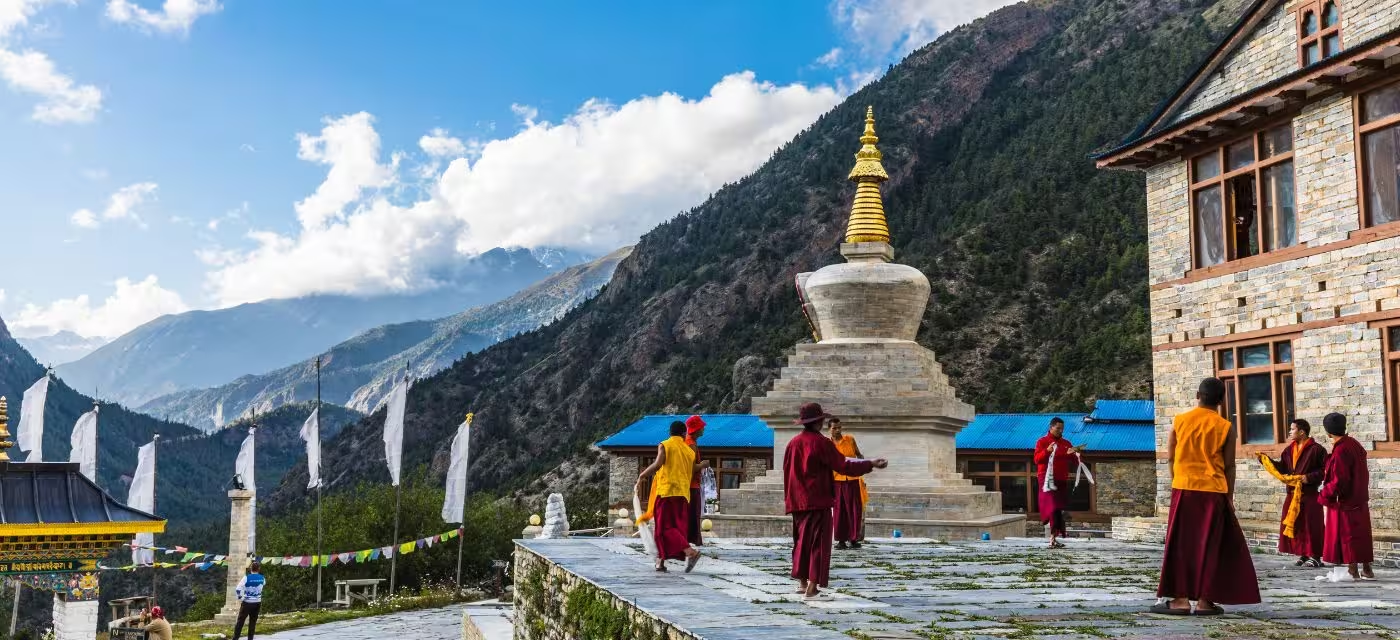
SO CLOSE TO HEAVEN – NEPAL
A landlocked country nestled between India in the south and China in the north, Nepal stands tallest with its Himalayan mountainous terrain. Other than the tallest mountain in the world, Mt Everest (known locally as Sagarmatha), Nepal is home to eight of the world’s highest mountains, making it one of the ‘must-go’ destinations for nature lovers.
Trekkers from around the world can enjoy over 150 trekking routes, the experience of which is only enhanced by the warm hospitality of the local people around these routes, the most ethnic and organic varieties of food, breathtaking natural beauty, vibrant lifestyle, and great cultural diversity. And the reasons why Nepal was listed in the Top 10 Destinations to Travel in 2016 by the National Geographic and listed as the World’s Best Value Destination in 2017 by Lonely Planet.
Nepal is home to a network of trails also called the Great Himalaya Trails, an extensive trail system that covers Nepal from Humla and Darchula in the west to Kanchenjunga in the east. The diversity of trekking in Nepal cannot be found in any other region of the world.
In fact, the lowest point in Nepal is 59 m above sea level in the Terai region while the highest point is Everest, 8,848 m above sea level, the two points are, in a straight line, only 200 kilometres apart.
We bring you some of the best trekking routes in Nepal.
ANNAPURNA CIRCUIT
The pride of Central Nepal is the Annapurna region. The region offers rich cultural experiences, beautiful mountain views, impressive landscapes, and villages that showcase remarkable ethnic diversity.
Most of the treks in this region start from the valley of Pokhara located 203 km west of Kathmandu, famous for magnificent mountain views and lakes. The route of these treks traverses through the foothills of the Western Himalayan Range offering beautiful views of the mighty peaks – three of them above 8,000 m – Annapurna 1 (8,091 m), Dhaulagiri (8,167 m), Manaslu (8,157 m), and Cho Oyu (8,201 m).
The range also includes the dramatic Machhapuchhre (6,993 m), Hiuchuli, Mardi Himal, and a host of other peaks.
One of the most popular trekking regions in Nepal, the Annapurna Circuit Trek draws thousands of domestic as well as foreign trekkers every year. Noted for its Tibetan and trans-Himalayan culture, the Annapurna Circuit trek opens up to jaw-dropping views of mountains and picturesque villages.
For foreign nationals, one will have to obtain the ACAP (Annapurna Conservation Area Permit) and TIMS (Trekkers Information Management System) card, which are easy to get from the Nepal Tourism Board in the capital city Kathmandu.
Reaching the Annapurna region is easy as your journey begins from Pokhara, the popular lake city of Nepal. While the Annapurna region is trekked round the year, it is however recommended that you trek during spring and autumn.
During monsoon, incessant rainfall poses high risk of snow in the high passes and around the Annapurna base camp. This may result in you being stranded for days.
It will take 21 days to accomplish the full 300 kilometres around the Annapurna massif. You will walk through Marshyangdi Valley to Manang to reach the Thorong La high pass, and then will gradually descend into the Kali Gandaki River Valley.
Thereafter, you could pitch further to Muktinath and Jomsom in Mustang district and to Tatopani, from where you could take a ride back to Pokhara.
If you still prefer to walk, you could continue your trek to Ghorepani and Poonhill for a panoramic view of the Himalayas and come down to Ulleri, from where you could drive to Pokhara.
From dry geography to bone chilling air to rice fields, deep gorges, lush forests, and welcoming locals from Manangi, Thakali and Gurung ethnic communities, you will bring back a lot of fascinating memories from your Annapurna Circuit trek.
EVEREST BASE CAMP TREK
The allure of Mount Everest, standing magnificently at 8,848 metres atop the world, is indescribable.
The Everest region (Solu-Khumbu), is home not only to this glorious Himalayan mountain but also to dramatic glaciers, deep settlements, and some of the world’s highest peaks such as Lhotse (8,501 m), Nuptse (7,879 m), Makalu (8,475 m), Cho Oyu (8,201 m), and Amadablam (6,956 m).
Trekking in the Everest region can be a deeply spiritual, physical, and cultural experience – all at once.
The trails that climb the foothills of Everest offer some of the most challenging trekking in Nepal. The districts of Solu and Khumbu have been well developed for trekking, with well-maintained trails and a lot of lodges, but still touching some of the highest trekking routes.
Solu-Khumbu is home to the ethnic Sherpa people, renowned for their guiding and mountaineering skills. Having said this, the strong influence of the Tibetan culture of the Sherpa people is also evident throughout the trails – in the stupas, chortens, gompas and mani-walls ornamenting the already spectacular landscape.
Trekkers usually fly to Lukla and then trek further on through the Sherpa homeland to the Everest Base Camp, but many choose to trek all the way from Jiri, the last village that has a road connection in the area.
Trekkers in the Everest Region need to obtain the Sagarmatha National Park permit and a TIMS (Trekkers Information Management System) card.
The Sagarmatha National Park – a UNESCO Natural World Heritage Site – holds not only some of the rarest bio-diversity on earth but also the highest and youngest mountain system in the world.
A 10–12 day trek through Solu to Khumbu and the Sagarmatha National Park is excellent both in terms of acclimatisation and experiences – see unique customs, traditions, and lifestyles as you pass through lower altitude settlements to those in the higher altitudes.
It is possible to trek in the Everest Region year round, but due to the frequent cancellation of flights to Lukla (because of poor visibility) in winter and during the monsoon, the best seasons to trek are in the autumn and spring.
Autumn is a very popular period for trekking because of the bearable temperatures at high altitudes and the clear weather, enabling magnificent views of the surrounding peaks.
Spring is a calmer time to visit, with slightly colder temperatures and the possibility of witnessing the Everest climbing season (with its peak in May).
You don’t have to climb Everest in order to experience the true essence of the Himalayas! Follow the initial steps of Tenzing Norgay and Sir Edmund Hillary to the Base Camp of the highest peak in the world.
The Everest Base Camp trek remains one of the most popular trekking trails in Nepal and worldwide. The trek begins either in Lukla (if you decide to fly from Kathmandu) or Jiri (if you decide to walk all the way from the last village with a road connection).
It usually takes 12–14 days to complete the trek, although walking from Jiri would add five to six days to the usual duration.
The highlights of the trek are the ancient Buddhist monastery of Thyangboche (the Monastery sits at 3,867 m in a clearing surrounded by dwarf firs and rhododendron forest), the astonishing views from Kalapatthar and, of course, the Everest Base Camp itself.
Please note that during the trek you will spend many days at high altitude, spectacular scenery notwithstanding, also poses the risk of altitude sickness if you ignore the general rules for keeping healthy on the trails.
RARA LAKE TREK
Think about the most organic trek, the rawest experience of trekking. If you are up for pushing your limits, changing your plans, adjusting to challenging circumstances, then the Rara Lake trek is one of the finest for you.
Then again, if you seek solitude in trekking and wish to explore the unexplored, Rara Lake is the trek you should plan for its sheer scenic beauty, biodiversity, and unique culture.
Journey to the Rara region through thick pine and juniper forests and camp next to the sparkling Rara Lake (at 3,000 m) walled by green hills on all sides.
The largest lake in Nepal, the Rara Lake is the main attraction of the Rara National Park in the western region of the country.
Boat in the clear waters, hike to nearby hills for nearer views of the mountains and lake, meet the charming local people, or just take a walk around the Lake watching out for a wild flower or a rare bird on the way.
Chuchemara Hill at 4,087 m is the best vantage point to get magnificent views of the beautifully clear Lake and the forested hillsides as well as the snowcapped peaks around it.
Nepal’s smallest National Park, the Rara National Park is surrounded by alpine coniferous vegetation and showcases beautiful examples of the region’s flora and fauna.
The Park is home to over 500 different kinds of flowers, 20 different species of mammals, and 214 species of birds. The Lake itself is home to the snow trout.
Wildlife here includes the endangered red panda, musk deer, Himalayan black bear, leopard, jackal, Himalayan tahr, yellow-throated marten, wild dog, wild boar, common langur, rhesus macaque, and common otter.
During winter, the park abounds in bird varieties like coots, great crested grebe, black-necked grebe, red-crested pochard, mallard, common teal, merganser and gulls. Migrant water fowl and gallinaceous birds can also be seen during certain seasons.
Getting to Rara, however, may pose a few logistic challenges. If you are completely new to Nepal, make sure you have guides and porters accompanying you.
You can drive from Kathmandu to Nepalgunj, from where flights operate daily to Jumla district. You could also travel in a local bus from Kathmandu to Jumla, but it will take you around two days to reach Jumla, a hilly village where apple orchards stretch out over the hills.
Up to Jumla you will find cosy lodges or hotels, but beyond that it is essential to plan ahead for camping and food supplies. Lately, with domestic tourism on the rise in Nepal, there are newer lodges but it is always safe to have a plan B in place.
The Trek leads through remote countryside toward the Tibetan border. A journey into the Jumla region and the beautiful Rara Lake, is probably one of the most rewarding and fascinating treks in all the Himalayan range given its un-spoilt splendour.
Set aside nine days or so for this trek.
LOWER DOLPO TREK
The Lower Dolpo Trek is one of the shortest treks to accomplish (around three days to reach the Phoksundo Lake) and still highly rewarding.
The mystical and turquoise-hued Phoksundo Lake cradled around high ridges and magical forested areas boasts abundant wildlife, of which the beautiful blue sheep and the rare snow leopard are perhaps the most talked about.
The trek is exhausting yet exhilarating, and there are lodges and food available on the way.
The easiest access to the Lake is through Dunai, which is three hours away from Juphal airport. There are regular flights to Juphal from Nepalgunj. You can also walk to Dunai from Jumla.
The spectacularly clean waters of Phoksundo and its stunning surroundings will leave you wanting more of this most memorable of treks in Nepal.
Besides the breathtaking mountains of the Himalayas, Nepal’s lowlands area in the south – called the Terai – is an expanse of forest and grasslands that preserve some of the densest and most diverse wildlife habitat in the subcontinent.
Giving you an experience of Nepal wholly different from the treks it is renowned for, the country’s national parks will surprise and stun you as you delve into tropical jungles and lose yourself in a land of treetop canopies, majestic tigers, magnificent elephants, rare rhinos, fluorescent butterflies, spectacular birdlife, and rivers with crocodiles and dolphins.
BARDIA NATIONAL PARK
A trip to Bardia, Nepal’s largest National Park and wilderness spread in the Terai, will reward you with superb wildlife-watching opportunities in an ambience surprisingly shielded from and undisturbed by tourism.
The Bardia National Park protects vast areas of sal forests, grasslands, and savannah as well as one of Asia’s largest stretches of tiger habitat, making it an ideal habitat for many species of wildlife.
Bardia is home to the endangered Royal Bengal tiger and the one-horned rhinoceros. You will also spot populations of wild elephants and an amazing variety of mammals (30 different species), reptiles, aquatic animals, and birds (over 250 species) here.
These jungles in the south-western parts of Nepal are just an hour’s flight away and let you experience the perfect mix of nature, culture, and adventure even as you enjoy the luxurious comfort of delightful jungle lodges.
Ride noiselessly through the jungle on elephant back or explore it on a thrilling Jeep safari to see animals up-close; go on exciting nature walks accompanied by expert naturalists; combine your jungle adventure with white-water rafting on Nepal’s longest river, the mighty Karnali that flows through here – if you are lucky, you might even spot the highly endangered Gangetic Dolphins or a gharial (crocodile species native to the Indian subcontinent).
And if you want to do a spot of fishing, the rivers Karnali and Babai present lovely opportunities to do just that.
The villages of the indigenous Tharu and Dangora people surround the Park, offering a great chance to interact with the charming locals and learn about their culture.
The best time to visit Bardia is during the autumn, winter, or early summer, when the weather is warm and dry.
Several safari lodges in Bardia offer excellent accommodation and facilities for guests to enjoy wildlife activities.
The nearest cities from here are Nepalgunj and Mahendranagar. The Park’s headquarters Thakurdwara, is approximately an hour’s drive away from the Nepalgunj-Surkhet road.
Bardia is accessible by land, by air (flight to Nepalgunj followed by a 2-hour drive) or one can even raft down the mighty Karnali River into the Park itself.
CHITWAN NATIONAL PARK
Chitwan or ‘heart of the jungle’ is one of the best wildlife-viewing national parks in Asia and is a UNESCO World Heritage Site.
One of the few remaining undisturbed vestiges of the natural eco-systems of Nepal’s Terai lowlands, the National Park preserves some of the last habitats for endangered species like the Great Indian One-Horned rhinoceros and the elusive Royal Bengal tiger, and has made great conservation efforts for both.
It is also home to the gharial and the Asiatic elephant.
Spread across an area of 932 sq. km, Chitwan’s spectacular landscape boasts lush forested hills and flowing rivers set against the backdrop of the Himalayas.
A thrilling jungle safari on open Jeeps deep into thick Sal forests is the perfect way to explore and enjoy Chitwan’s exceptional natural beauty.
The safari will also take you to the Gharial Breeding Centre as well as the Elephant Breeding Centre – of the two elephant-breeding centres in the world, one lies in the Chitwan National Park.
For a more laidback wilderness experience, a slow canoe ride or a boat safari on the gentle River Rapti is the best way to sight crocodiles and other aquatic creatures.
Another delightful experience, if you love pachyderms, would be feeding and bathing these gentle giants in the River Rapti, surrounded by paddy fields. These activities, of course, are supervised by the jungle guides.
Bird-watching is always best on foot. An exciting jungle walk amidst tall elephant grass, is a great idea. An accompanying naturalist will help you spot and identify both local and migratory birds.
With over 100 ethnic groups, Nepal is a virtual melting pot of communities, tribes, languages, cultures, and faiths.
Over 75 per cent of Nepal’s population relies on agriculture, farming, animal husbandry, and fishing – hence, ensuring that the majority of the country’s population lives in villages.
Visiting Nepal’s villages especially, is like visiting an open-air museum of history, art, and culture all rolled into one.
A village tour is a fascinating way to discover traditional life in rural Nepal through the local people themselves.
Both inspiring and informative, a village experience is a unique opportunity to understand the roots of the culture, customs, practices, indigenous skills, and lifestyle of the Nepali people.
You will see how villagers make the most use of natural resources in a nature-friendly way; but most of all, you will learn how to find joy in life’s simplest pleasures.
During your visit, you can also look forward to watching cultural programs, and indigenous songs and dances performed by local youth.
THARU
The Tharu people are an indigenous ethnic group who have lived in the Terai lowlands of Nepal for centuries and are considered the oldest inhabitants of the Terai.
Constituting the largest ethnic group of the Terai, the Tharu are spread across the length of Nepal’s plains and also extend westward into the Kumaon foothills in India.
Undisturbed for centuries, their relative isolation has allowed them to develop a distinct and self-sufficient society and a unique sense of language, religion, and culture all of their own.
The Tharu live in compact villages, usually in the middle of a forest clearing.
Not only are they naturally familiar with jungle life but also with farming and fishing, and have developed elaborate irrigation techniques for agriculture as well – following the same occupations since they settled here.
Though traditionally the Tharu religion is animist, the people enjoy the religious freedom to embrace their desired religion – Hinduism, Buddhism, Christianity or Islam.
Tharu huts have wattle walls and the thatch roof is usually covered with gourd creepers.
Inside the homes are containers made of gourd, earthen pots, and mats woven from paddy straw. The houses are kept clean and the walls decorated with floral and animal motifs.
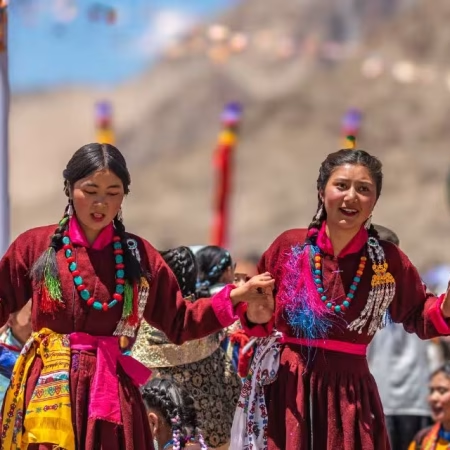
Tharu women dress in colourful attire and adorn themselves with intricate silver ornaments that include bangles and necklaces of beads and coins.
The women are also said to be highly skilled artisans – whose knowledge of their craft has been passed down from mother to daughter over generations.
Household furniture, clay pottery etc. are made using raw materials found in their surroundings itself.
Known not only for their vibrant, colourful culture but also for their hospitality, honesty, and generosity, the Tharu people draw thousands of tourists annually to the Terai region and play a vital role in Nepal’s tourism activities.
Related Posts