 English
 Deutsch
 Italia
 August 27, 2026 By admin
Kutch Gujarat
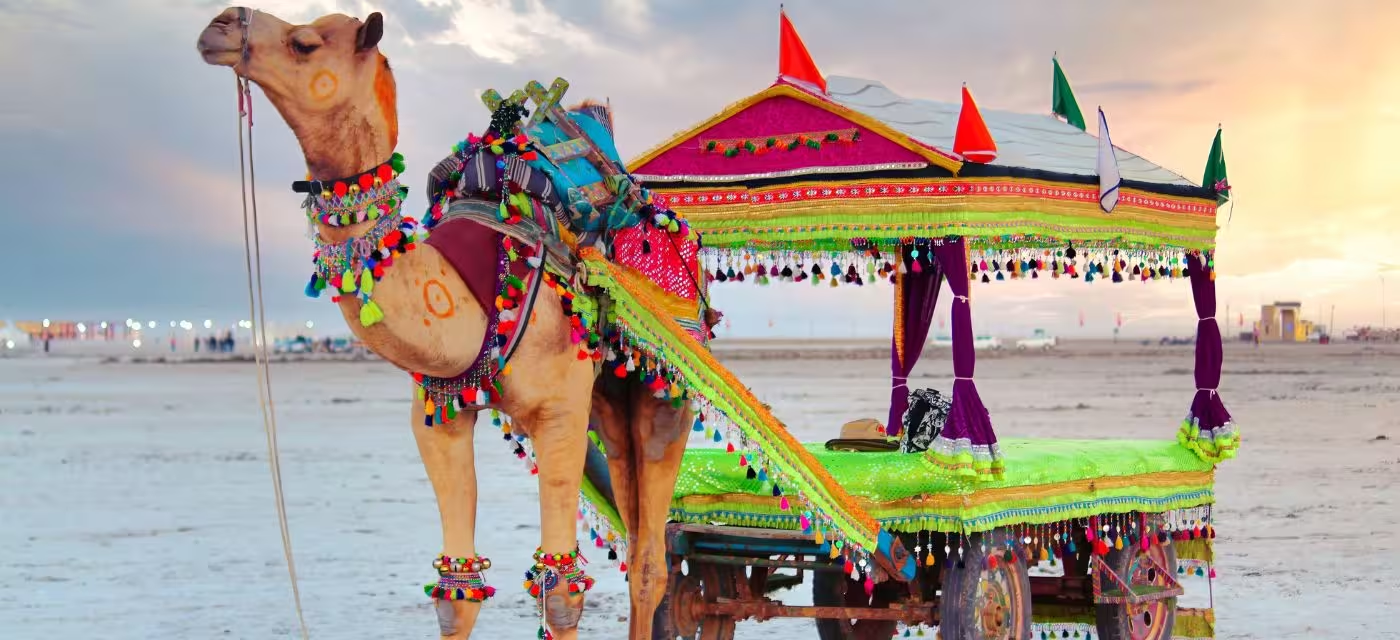
Kutch
Lunar Landscapes in India’s Wild West
“The desert, when the sun comes up. I couldn’t tell where heaven stopped and the Earth began.”
— Tom Hanks
Located between the vast deserts to the north that skirt Pakistan and the shimmering Arabian Sea to the south, Gujarat’s Kutch region in India’s far-flung western border is the final frontier for a confluence of cultures and crafts.
This infinite stretch of largely barren and harsh desert landscape covers a little over 45,000 sq. km and is geographically one of India’s largest and most distinctive districts. The name Kutch (or Kachchh) refers to how the land alternates between wet (submerged during the monsoon season) and dry.
Much of Kutch consists of seasonal wetlands known as the Rann (the word means ‘salt marsh’) – the Great Rann of Kutch and the smaller Little Rann of Kutch. The intriguing Ranns are seasonal marshes that transform into salt deserts during the summer months. The Great Rann is also a breeding ground for flamingoes, while the Little Rann is the only remaining natural abode of the endangered Indian Wild Ass.
The Great Rann, located in the far north, borders Pakistan and occupies a part of the Thar Desert, which also extends into Rajasthan. This geographical stretch explains the region’s many migrant communities from bordering areas as close as Pakistan (Sindh) and the Marwar region of Rajasthan to those much further away, including Persia (Iran).
Its historical significance apart, Kutch stands out for its unique natural wonders, fascinating mud architecture, and vivid, vibrant colours – most visible in the splendid attire of its people. The Kutch region, believed to have been inhabited for 4,000 years or so, was an ancient centre of trade and migration with faraway lands such as Zanzibar, the Middle East, and Greece. The intermingling resulted in a unique ethnic blend of peoples and traditions that together produce some of India’s finest handicrafts, especially textiles resplendent with bewitching embroidery and mirrorwork.
Bhuj
Bhuj, the capital of the former state of Kutch for nearly 400 years and now the headquarters of Kutch District, was ruled by the Jadeja Rajputs from 1540–1948. Bhuj’s architectural treasures, its forts, palaces, cenotaphs, and old gates stand testament to the city’s position as the seat of power of this mighty dynasty.
Today, it is a mix of the ancient and the modern and is the best base for exploring the spectacular Kutch region. Even with its dry, harsh, scantily populated terrain and hot climate, Bhuj is supremely fascinating and a land of strange beauty.
Located in north-western Gujarat, Bhuj could be called an island of sorts, with the Arabian Sea to its west, the Greater and Little Rann to the north and east, and the Gulf of Kutch to its south.
The road to Bhuj is flanked by hills – the Bhujiya Hills, from where Bhuj gets its name – crowned with a fort’s ramparts. The devastating earthquake that hit Bhuj in January 2001 saw over 20,000 people die and scores more injured. Nearly two decades on, the scars remain. The disaster permanently changed something among locals, who divide their lives into before and after the earthquake.
Things to see in Bhuj include the Darbargadh Palace Complex, Hamirsar Lake, Kutch Museum, Bhartiya Sanskriti Darshan, and Sharad Baug Palace. From Bhuj, you can also make a day trip to nearby villages famed for their crafts.
Mandvi
Mandvi, a little seaside town with a gorgeous beach just outside the town, lies 55 km southwest of Bhuj, on the southern shore of Kutch.
For several centuries, Mandvi was a major seaport in Kutch, with trade links to South Africa, Zanzibar, Malaysia, China, and Japan. The town is famous for its cottage shipbuilding industry, going on since the 16th century, and batik work.
Shipbuilding takes place on the River Rukmati, which runs through the town. Here, wooden ships are still built by hand. The ships are small and exhibit a Dutch influence.
Visit also the Mandvi Town Beach and the Vijay Vilas Palace (also called Mandvi Palace). Explore Mandvi town on foot to see its old architecture and fascinating bazaars.
Moti Virani & Banni
The village of Moti Virani, some 55 km northwest of Bhuj, is a good base from which to explore Kutch.
Banni is around 20 km north of Moti Virani. With its grasslands ecosystem, it is a virtual haven for naturalists and birders. Explore the wetlands of Chari Dhand and Baghera That, the marine fossil bed at the foot of Kiro Hill, the Fakirani Camps, and 360-degree views of saline silt and suaeda.
In the wet season, Banni is a flood plain. In winter, it hosts over 200 species of European and West Asian birds that migrate here.
You can also explore the Jathaveera thorn forest and the dried riverbeds at Layari and Sarannath, around 15 km from Moti Virani.
The Great Rann of Kutch
The Rann of Kutch, also called the Great Rann of Kutch, mostly consists of the world’s largest salt desert, running for 10,000 square kilometres. But what makes it truly astounding is that the salt desert is underwater during the main monsoon season in India. For the remaining eight months of the year, it is a massive expanse of packed white salt.
The Great Rann lies to the north of the Tropic of Cancer, at the top of the Kutch District. The Rann’s northern edge marks the border between India and Pakistan.
The Rann is best approached via Bhuj. Dhordo, located on the edge of the salt desert, is approximately an hour and a half north of Bhuj and is being developed by the Gujarat government as the Gateway to the Rann.
The Rann begins to dry up in October every year, gradually changing to the bleak, isolated, and surreal salt desert. The tourist season runs until March.
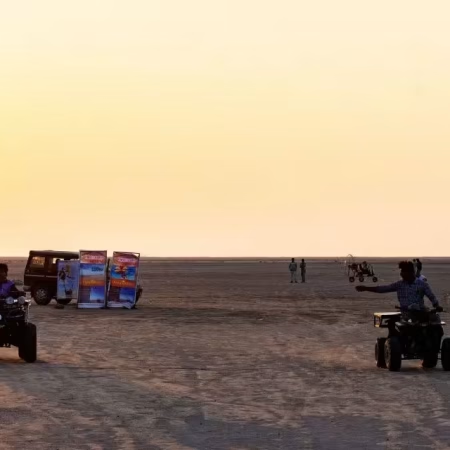
The best time to experience the desert is definitely the early morning or evening; otherwise, the salt can be blinding. Take a full moon-lit night camel safari into the desert to soak up the magic of these salt flats that look like snow at first sight – where the land and sky are indistinguishable.
The Great Rann of Kutch is a sensitive area due to its proximity to the Pakistan border. Therefore, a permit is required to visit the salt desert. This can be obtained on the way at the Bhirandiyara village army checkpoint, about 55 kilometres from Bhuj.
While most people enter the Great Rann by way of Bhuj, it is also possible to approach from Khadir Bet to the east. Rising out of the desert, this island is home to the 5,000-year-old Indus Valley civilisation site – Dholavira (see COVER STORY).
Hodka
Hodka, located in the Rann of Kutch, is one of the 36 villages that are part of the UNDP and the Indian Government-sponsored Endogenous Tourism Project.
The project encourages villagers to open up their homes to visitors so that they can benefit directly from tourism. A local NGO trains the villagers while creating employment and providing development to the villages.
At Hodka, the villagers own and run a stunning rural resort – Shaam-e-Sarhad – fitted with lovely bhungas (circular mud huts with conical thatch roofs) as well as tents.
Kala Dungar
At the very edge of Kutch, some 120 km from Bhuj, lie the Black Hills of Kutch, also known as Kala Dungar. It is the highest point in Kutch.
Kala Dungar’s elevation of around 1,500 feet gives you unsurpassed views of the endlessly vast expanse of the Great Rann of Kutch all the way across to the Pakistani border.
A vision in white extends to the horizon and beyond, constantly shifting shades with the changing light.
At the very top of Kala Dungar is an old and revered temple of Guru Dattatreya. Here, the wild jackals of the hills are fed rice sweetened with jaggery twice every day!
The old Lakhpat Fort, 140 kilometres from Bhuj, also provides a fabulous view of the Rann of Kutch.
The Little Rann of Kutch
The unusual, vast terrain of the Little Rann of Kutch is a salt marsh that features barren mudflats dotted with small islands, locally known as ‘bets’.
The Little Rann is most well-known for its Wild Ass Sanctuary – the last refuge of the Indian/Asiatic wild ass and the largest wildlife sanctuary in India. It stretches over almost 5,000 square kilometres.
The bleak landscape astounds with its rich biodiversity and is an ecologically important area for wildlife and many local and migratory water birds such as cranes, ducks, pelicans, flamingos, and land birds such as sandgrouse, francolins, and the Indian bustards.
The sanctuary was established in 1973 to protect the endangered wild ass. Wild asses can run an average of 50 kilometres an hour over long distances!
The sanctuary is also home to other wildlife such as wolves, desert foxes, jackals, wild boars, jungle cats, desert cats, blackbuck, chinkara, nilgai, and snakes.
Notably, the area is the largest breeding site in the world for the magnificent Lesser Flamingo.
Despite being barely habitable, the Rann sees a lot of human activity. The region is rich in natural gas, the Indo-Pak border is heavily militarised, and there is traditional cattle-grazing, firewood collection, and salt panning, with salt harvested by local salt farmers known as Agariyas.
The weather in the Little Rann is coolest from December to March, which is the peak winter season. Summer starts building from April onward and can get unbearably hot, so visiting isn’t advisable then.
During the monsoon season, from June to September, the Little Rann fills with water.
The sanctuary is open daily from dawn until dusk, except during the monsoon season. For the best wildlife experience and spotting, go on an early morning camel safari. Afternoon safaris are also possible.
To really soak up the spellbinding atmosphere, camp out for a night on the Little Rann.
The Bajana Creek, where migratory birds appear during winter, is fantastic for birdwatching. Cranes, greater and lesser flamingoes, ducks, pelicans, and storks can all be found here.
Numerous tribes live in villages around the Little Rann, so take a guided tour through the villages.
Zainabad is located on the edge of the Little Rann and is the perfect gateway to this glorious marshland. Ornithologists and naturalists can make this their base.
Dhrangadhra’s 18th-century palace and darbargarh are worth visiting. There are also some elegant colonial buildings in the town.
Jhinjwada Fort has some beautiful, intricately carved gateways. An old British salt-trading post was once in Kalaghoda. Other colonial highlights are a cricket pavilion and bandstand.
Rann Utsav
Gujarat Tourism holds the Rann Utsav festival, which begins in October/November and goes on until the end of February.
Set against the backdrop of the Great Rann of Kutch, the Rann Utsav offers an opportunity to take in the natural and cultural heritage of the region.
The music, concerts, jewellery, crafts, and communities make for interesting folk-tradition experiences.
The Craft Traditions of Kutch
In Kutch, you will discover crafts that are centuries old but are as relevant now as they ever were. The rich and diverse creative traditions of Kutch thrive at the intersection of cultures and communities.
As a border region, Kutch has been constantly absorbing cultures from the north, west, and east, and from across the seas over the centuries.
The arid climate and harsh terrain have compelled communities here to evolve an ingenious balance by converting resources into products for daily living. These gradually also became sources of employment, revenue, and recognition.
Kutch is dotted with villages of pastoral and nomadic communities who devised a rich tradition of handicrafts to add identity, colour, and ornamentation to their otherwise barren landscape.
For a craft lover, Kutch is a treasure trove like no other, where each village has a different compartment of delights.
Kutch’s traditional crafts include:
- Ajrakh Block Print
- Bandhani (Tie & Dye)
- Batik Print
- Bela Printing
- Camel Wool Weaving
- Embroidery
- Kala Cotton
- Kharad Weaving
- Knife Work
- Lacquered Wood
- Leather Art
- Mashru Weaving
- Metal Bells
- Namda
- Clay Pottery
- Rogan Painting
- Silversmithy
- Wood Carving
Related Posts