 English
 Deutsch
 Italia
August 28, 2026 By admin
Kerala Travel Guide
KERALA
Emerald in the Indian Ocean
Kerala, lying along the tropical Malabar Coast, on peninsular India’s west coast, fringes the Arabian Sea to the west and is flanked by the Western Ghats to the east. This sliver-like state is only 580 kilometres long. Its southern end lies 55 kilometres north of Cape Kanyakumari in Tamil Nadu, and the northern, 24 kilometres south of Mangaluru in Karnataka.
The sun-and-rain-drenched region of coastal Kerala is a marvellous kaleidoscope of centuries-old cultures and peoples from across the Indian Ocean, historic port cities and ancient maritime trade on the enigmatic Spice Route, colonial legacies, serene golden beaches and tranquil backwaters, forts and temples, India’s first synagogue, church, and mosque, adrenaline-pumping water sports and sublime seafood.
Bekal
Bekal lies on the Lakshadweep Sea coast in North Malabar’s Kasaragode District. It is a beautiful land of palm groves, beaches, red earth, paddy fields, and seaside forts, of which the Bekal Fort is the most famous.
The Bekal Fort was built by local Nayak kings in the mid-17th century. Later, Tipu Sultan made it a base but eventually conceded it to the British.
This colossal circular fort, facing and withstanding the foaming waves of the Arabian Sea, was built purely for defence purposes and is a testimony to the architectural and strategic brilliance of the times. The fort is made of laterite stone and is a superbly preserved structure.
The fort houses the Magazine, an Observation Tower that offers a panoramic view of neighbouring places, and peepholes. There are trenches around the fort, a water tank with a flight of steps, an ancient Anjaneya Temple, a mosque, a sea bastion, and several underground passages.
A 10-minute drive away, the casuarina-lined Kappil Beach is a secluded spot. Explore the lovely Valiyaparamba Backwaters on a kettuvallom (olden rice-barges turned houseboats) cruise on the River Tejaswini.
Kannur
Kannur reveals its multi-layered heritage through its colonial edifices, churches, mosques, and beautiful temples adorning rice fields and coconut groves.
The massive triangular-shaped Fort St Angelo stands majestically on a hill overlooking the sea. Built by the Portuguese in the 16th century, the fort is made of laterite and boasts a moat, strong and parallel bastions, ammunition dumps, underground jails, and secret tunnels that point to the meticulous construction of this strategic military and naval base.
From the fort walls you will get fantastic views of Moplah Bay, the natural fishing bay, and its colourful boats, and of Dharmadam Island in the Arabian Sea.
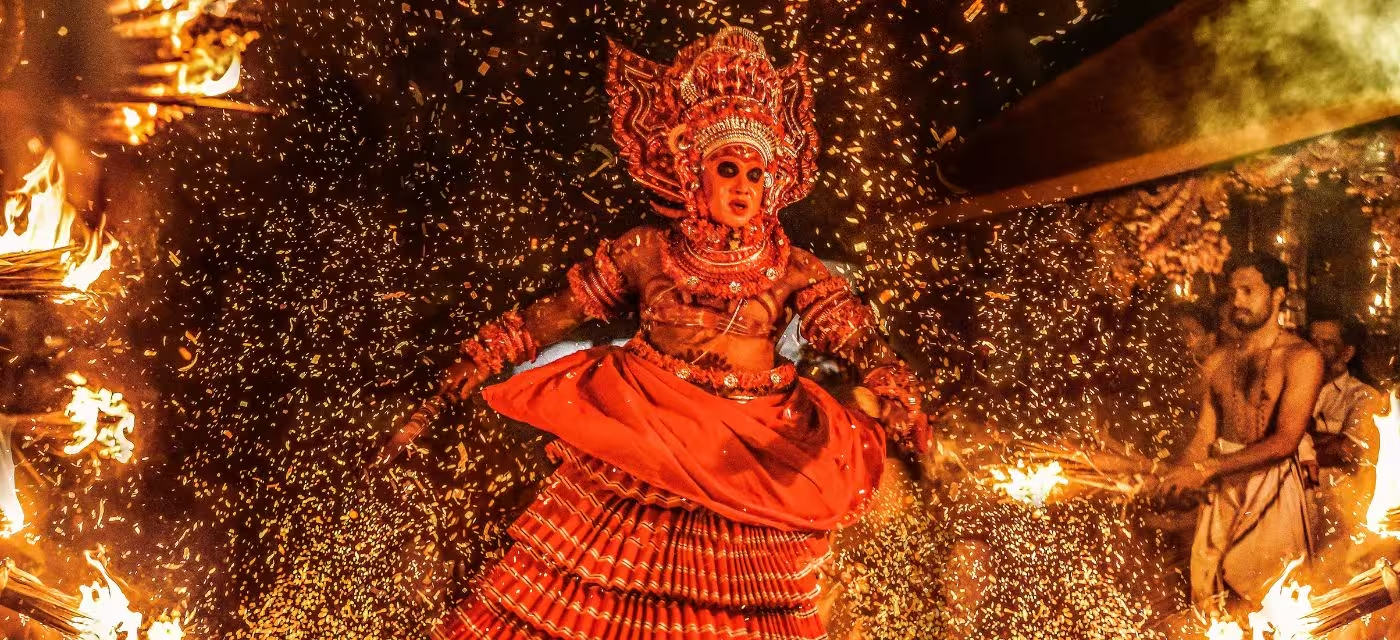
North Malabar’s famed Theyyam, an ancient art form, is a ritualistic performance which has elements of dance, mime, music, and worship. Theyyam season is December-May; plan your trip so as to experience a spectacular cultural tradition.
Shri Muthappan Temple (18 km) is dedicated to the toddy-loving deity Muthappan, and lies on the banks of the River Valapattanam, among the longest rivers in Malabar. Valapattanam itself is a timber-trading boat-making centre.
Payyambalam Beach is the largest beach in Kannur and is popular. Baby Beach is smaller and quieter.
Thalassery
This town by the sea surprises with its many remarkable facets. Once the hub of the spice trade that traded with the Arabs, Chinese, Jews, and Europeans, Thalassery (formerly Tellicherry) still carries remnants of an old bustling trading centre while several historical monuments including temples, mosques, churches, and bungalows stand as vestiges of its multi-layered heritage.
The British, Dutch, and the Portuguese, as well as Christian missionaries influenced the education, sports, culture, and development of this region and made notable contributions. Thalassery was the first British settlement on the Malabar Coast.
Did you know India’s first cricket club, which was later named the Town Cricket Club, was formed in 1850 at Tellichery by Lord Arthur Wellesley?
See & Do
The 17th-century Tellicherry Fort, with massive ramparts overlooking the sea, was built by the British. Situated on a headland guarding the port, it offers panoramic views.
Overbury’s Folly, built in the 19th century, is a seaside park with a watchtower.
The British introduced cakes and baking to Thalassery. Mambally Bakery or Mambally’s Royal Biscuit Factory, established by Mambally Babu in 1880, is a small but vintage bakery – the first bakery in Kerala. Try their delicious variety of biscuits.
Gundert Bungalow (4 km) is the former residence of Dr Hermann Gundert, a German missionary, scholar and lexicographer who settled here in 1839 and is remembered for his invaluable contributions to the Malayalam language. He compiled the first Malayalam-English dictionary.
Visit the CVN Kalari, one of the oldest establishments in Kerala dedicated to teaching Kalaripayattu.
Thalassery is famed for its Malabar cuisine-biriyani; and the Tellicherry pepper is famous in global kitchens.
Featured by BBC as one of the ‘6 Best Beaches for Driving in the World’, Muzhappilangad Beach (located parallel to NH 66 between Thalassery (7 km) and Kannur (15 km)) is Asia’s longest (a 4.5-km stretch) drive-in beach and Kerala’s only drive-in beach.
The packed sand is firm enough to not let your vehicle tires sink. This is a peaceful, uncrowded beach, best experienced during sunrise and sunset.
There are also activities such as paragliding, power boating, parasailing, and catamaran rides available here under the supervision of trained instructors.
The beach is a birder’s hotspot too; it sees over thirty species of migratory birds that fly down here in the winter.
It is also possible to walk to the Dharmadam Island nearby at low tide.
Kozhikode
Kozhikode (once called Calicut), the most important city in North Malabar, was once the trade, cultural, and culinary centre of ancient Kerala and was also the capital of an independent kingdom ruled by the legendary Zamorins in the Middle Ages.
This mighty and famed seaport drew traveller-explorers such as Ibn Batuta in the 14th century, and others from China, Persia, Italy, and Russia.
The flourishing trade in spices, coir, and timber brought the Arabs and Chinese here as well. In 1498, Vasco da Gama arrived on the shores of Kappad Beach, auguring the beginning of Portuguese colonisation in India.
Today, with its sandy coastal belt, laterite midlands, and rocky highlands, Kozhikode is one of Kerala’s major tourist destinations.
See & Do
Mananchira Square, the former courtyard of the Zamorin kings and currently the heart of the city, houses the Town Hall and the Public Library.
Kozhikode’s many temples, mosques, and churches reflect the cultural plurality of the region.
The 15th-century Kuttichara Mosque, or Mishkal Masjid, is an architecturally striking structure.
The Pazhassi Raja Museum on East Hill (5 km) exhibits ancient mural art, antique bronzes, old coins, models of temples, and parts of megalithic monuments such as dolmonoid cysts and umbrella stones, among the earliest found in Kerala.
The VK Krishna Menon Art Gallery next door displays the works of master painter Raja Ravi Varma.
Kozhikode’s tree-lined beach is hugely popular. Dolphin Point is where, early mornings, you may get to spot dolphins.
Food lovers will rejoice. Kozhikode is legendary for its delectable and authentic Malabar cuisine – simply out of this world and best experienced in its innumerable old local eateries.
The coastal town of Beypore (9 km) has been a ship-building centre for centuries, famed for its urus (country craft) that trace their origins to the town.
Several centuries ago, these handcrafted ‘Fat’ boats, known as pathemaris, carried spices and condiments across the Indian Ocean from India to the Arab countries.
Here, at the harbour at the mouth of the River Chaliyar, you can see colossal boats (some 65m long and 700 tonnes in weight!) being worked on by Khalasis (traditional shipbuilders).
Kochi
Cosmopolitan Kochi (often called Ernakulam too) is a time capsule of multi-cultural history you would love to enter – from its ancient harbour which hosted maritime traders to historic palaces to atmospheric heritage zones to surprising island architecture, it really is the ‘Queen of the Arabian Sea’.
Its importance over the centuries as a strategic maritime centre makes it the Gateway to Kerala. Today, Kochi has a world class port and international airport, linking it to many major cities worldwide.
Over the centuries, the Arabs, British, Chinese, Dutch, and Portuguese have left their impact on the trade, history, heritage, and culture of Kochi, making it today a melting pot of people of many different ethnicities and faiths who co-exist in synergy.
Kochi’s proximity to the equator, the sea, and the mountains, and its distinct geography – with islands, backwaters, peninsulas, and a harbour – make it a great travel destination.
See & Do
The Heritage Quarter of Fort Kochi and Mattancherry (around 6 km) offers the most sights for tourists:
The waterfront with Kochi’s iconic Chinese nets in action early morning
Princess Street with its row of European-style buildings and wonderful old houses converted into heritage hotels
The 16th-century St Francis Church
The Santa Cruz Basilica built by the Portuguese
The 16th-century Matancherry Palace or Dutch Palace
Jew Street with its old and colourful lanes, curio shops, and spice souks
The magnificent 16th-century Jewish Synagogue (Paradesi Synagogue)
The Kochi-Muziris Biennale is an international exhibition of contemporary art held in Kochi every year from December-March. It is the largest art exhibition in the country and the biggest contemporary art festival in Asia. Experience art by the Indian Ocean!
Kochi’s islands – Willingdon Island, Mulavukadu Island (for the Bolghatty Palace), and Vypeen Island (for Cherai Beach) – can be reached by ferry from Fort Kochi and Ernakulam, the central, mainland portion of Kochi.
Discover the backwaters with a cruise along the gorgeous Vembanad kayal, home to several communities of fisher folk.
Ernakulam’s shops and cafes are great to unwind in during the evenings.
Muziris Heritage Project
A day trip to see the Muziris Heritage Project will be unlike anything else you’ve experienced or known.
Reputed to be the ancient world’s greatest trading centre in the East, this legendary seaport traded in everything from spices to precious stones with the Greeks, Romans, and the rest of the world.
The Muziris Heritage Project intends to conserve and showcase the culture of 3000 years or more for posterity. Muziris was the doorway to India for varied cultures and races such as the Arabs, Chinese, Jews, Romans, Portuguese, Dutch, and British.
The Muziris Heritage Site is an outstanding example of buildings, archaeological sites, and landscape; and it illustrates a significant stage in the human history of Kerala.
This historic region stands testimony to an exceptional cultural tradition; of which monumental structures also occupy a significant place.
The built heritage of Muziris is extensive and there are a few notable buildings from the 18th and 19th centuries scattered around this heritage site; but mostly in Chennamangalam and Kodungalloor.
The surviving elements of Muziris comprise not only buildings but also the markets, streets and footways, bridges, and cemeteries.
The natural environment is integral to the Muziris Heritage Site. The networks of waterways have influenced and inspired the architecture and growth of the built heritage.
On the tour, you will see:
The first Bagavathy Temple in India
First Christian church in India
Excavation site
Paliam Naalukettu
Paravoor Synagogue
Siva Temple (2000 years old)
Alappuzha
Called the rice bowl of Kerala, the Kuttanad region grows paddy on water-filled fields reclaimed from the sea.
It is here that Alappuzha – with its endless stretches of paddy fields, streams and canals, bridges, a silver beach, serene lagoons, and emerald coconut palms – beckons.
Alappuzha’s location between the Arabian Sea and a vast network of rivers flowing into it accounts for its unique blend of fresh and saltwater eco-systems.
Alappuzha has at least six navigable canals that are its lifeline; they connect it to an intricate and stunning mesh of backwater trails, earning Alappuzha the sobriquet ‘the Venice of the East’.
This is where you’ll rediscover the joys of life lived at a languid pace.
A backwaters cruise aboard a kettuvallom is the finest way to see and experience Alappuzha’s beautiful fishing villages and savour deliciously fresh seafood straight off the nets.
Alappuzha’s Punnamada Kayal (Lake) is the starting point for the famed Nehru Trophy Boat Race held on the second Saturday of August every year. This is a spectacular experience in every way.
Mararikulam (around 17 km) is a pristine fishing village, untouched by modernity. Tall, green coconut trees hide fishermen’s huts on the sunny beach.
This is the perfect destination to relax in and experience traditional Kerala hospitality. For a wellness experience, you can get a holistic Ayurvedic massage carried out under the guidance of an expert vaidyan (physician) here.
Visit the fishing villages nearby and interact with the locals.
Alappuzha’s proximity to the sea ensures that the area is famous for seafood delicacies, especially the ones prepared from fresh catch.
Thiruvananthapuram
Thiruvananthapuram (earlier called Trivandrum), Kerala’s capital city, does not possess the hustle and hassle of other capital cities; instead it bustles at a gentle pace and is content doing so.
No skyscrapers, luxury cars, or frenetic nightlife; just elegant tree-lined avenues, leafy neighbourhoods, and rouge sunsets.
Thiruvananthapuram’s unique geographical location places it on the seafront and spread over seven low hills.
Full of small cliffs and sloping roads that turn into ribbons, parts of this clean and green postcard-sized city are quite unmatched in beauty.
The forests of the Western Ghats in the eastern and northeastern borders give the city some of the most beautiful picnic getaway spots.
A long shoreline with world-famous beaches, historic monuments, backwater stretches, and a rich cultural heritage make this city a great tourist destination.
See & Do
The ancient Padmanabhaswamy Temple of Lord Vishnu is the spiritual heart of Thiruvananthapuram and the city’s most defining feature.
The core shrine may well be 2,000 years old; it finds mention in 1st and 2nd century CE Sangam literature.
In the sanctum sanctorum, the principal deity Padmanabhaswamy is enshrined reclining in the ‘Anantha Shayana’ posture, the eternal yogic sleep on the serpent Adi Shesha.
The Deity is visible through three doors, each door revealing a part of the reclining deity’s image. The deity is made from 12,008 saligramams (fossilised shells).
The 19th-century Kuthiramalika Palace, built by Swathi Thirunal Rama Varma, forms part of a vast complex of royal buildings in the vicinity of the temple.
A striking example of traditional Kerala architecture, Kuthiramalika gets its name from the 122 horses that are carved into the wooden wall brackets that support the southern roof.
The Napier Museum houses an impressive collection of ancient bronze and stone sculptures.
The Kanakakunnu Palace, Kowdiar Palace, Pattom Palace, and Belle Haven, and the Meteorological Centre are the other highlights.
For a vibrant and interesting local experience, go shopping in Chala (or Chalai).
This old marketplace has numerous lanes and shops aligned like matchboxes. Each area of Chala is assigned according to specific items and sells just about anything – vegetables and fruits, spices, jewellery, steel utensils, brass items, textiles, and much more.
Just outside the city, three crescent sandscapes of Kovalam’s sunny beach trio beckon with water adventures, fabulous seaside resorts, and stunning views.
Varkala’s beaches backed by a ragged line of rich red laterite cliffs looking out to sea make it a place of dramatic and sublime beauty.
Agasthyamalai Biosphere Reserve
This is a little off the planned route but if you can manage the time, we highly recommend a trip to the Agasthyamalai Biosphere Reserve (listed by the UNESCO World Network of Biosphere Reserves (WNBR)).
The ABR is located in the Western Ghats straddling the borders of Kerala and Tamil Nadu; it has peaks reaching 1,868 m above sea level.
The site hosts one of the most diverse ecosystems in peninsular India.
It is home to tropical rainforests, over 2,000 species of plants, three wildlife sanctuaries, a tiger reserve, and a number of tribal settlements.
Bonacaud, about 60 km from Thiruvananthapuram, serves as the base to trek to the ABR.
Related Posts