 English
 Deutsch
 Italia
 August 20, 2026 By admin
Walking in the Wild West Satpura
Walking in the Wild West
“The thin line dividing a tourist and a traveller is the choice one makes in deciding the destination. The former will choose a new city to visit, whereas the latter will keep returning to nature.”
— Prabhat Verma
A short flight to Bhopal and a comfortable three-hour drive, via the UNESCO World Heritage Site of Bhimbetka, brings one to Madhai – popularly known as Satpura.
I was invited by a friend-cum-host to join him and a few others on a challenging trek through the core of a Wildlife Park. I must admit, I didn’t even know that such a trek was possible.
I had walked all my life in the mountains and plains, but the thought of walking through the wilderness seemed too good to be true.
So I grabbed the opportunity and looked forward to my first sojourn in a jungle on foot.
The Journey to Satpura
A group of eight, we had divided ourselves between three Innovas. Since we hadn’t had the chance for a formal introduction at the airport, we decided to break the ice over a hot cup of tea and a fresh breakfast of poha and jalebi at a roadside stall.
The group included two travel agents, a travel blogger, a staff member from National Geographic, a hotel representative, our naturalist, our host, and a local guide who had completed the same trek more than a dozen times.
Instead of driving to the lodge as is usually done, our host arranged a private boat transfer.
Given the searing heat, it turned out to be a wonderful decision.
Denwa Backwater Escape
Pugdundee Safaris organises the treks with great care, efficiency and attention to detail.
The first night is ideally spent at their lodge in Satpura – Denwa Backwater Escape.
This is where you are introduced to the jungle and its unpredictable terrain.
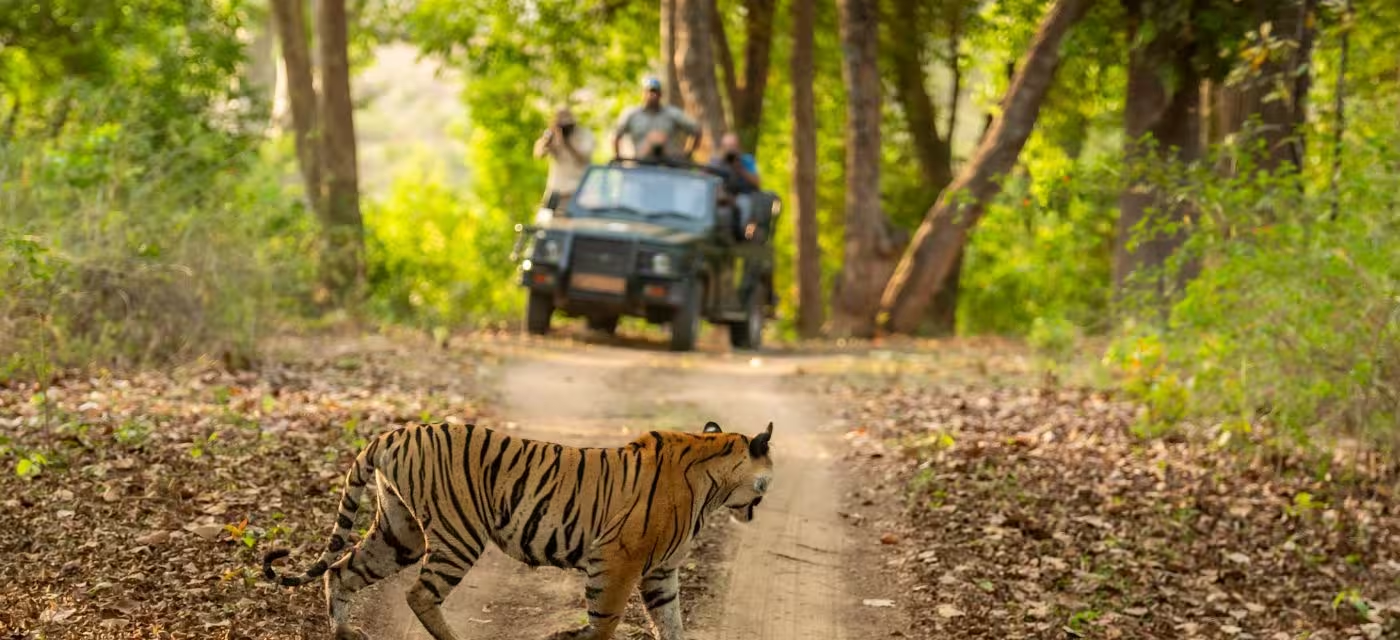
We decided to go on a night safari on the day of our arrival. It turned out to be quite an adventure.
A few jeeps ahead of us had spotted a leopard in the fields, although our searchlights stubbornly refused to find it.
We did, however, spot some other wildlife.
The luxury lodge at Denwa is also the only one facing the River Denwa. Its restaurant deck overlooks the captivating landscape, while the cottages and tree houses have peaceful sit-outs.
From the comfort of the beds, large glass doors and windows provide beautiful views of the river.
Satpura – A Different Kind of Safari
Satpura is the relatively little-known cousin of Bandhavgarh and Kanha in Madhya Pradesh.
What makes it unique is the variety of ways in which the wilderness can be explored:
- Jeep Safari
- Walking Safari
- Boat Safari
- Night Safari
- Jungle Trek
But the experience that truly challenged the adventurers in us was the jungle trek through the core zone.
Where else can you walk through a forest, camp in mobile tents, sense wild boars, sloth bears and leopards nearby, and disconnect from civilisation for several days?
The stunning landscape allows travellers to cross the forest towards Pachmarhi over three days of walking and camping in the wilderness.
The Forsyth Trail
The jungle trek is known as the Forsyth Trail.
It is an adrenaline-pumping experience and certainly not for the faint-hearted.
Although professionally conducted and extremely safe, the trail has an unmistakable air of suspense.
Every tree seems to conceal something.
Every alarm call makes you wonder what wild creature might be nearby.
Our naturalist was an authority on plants, trees, birds, reptiles and other fascinating aspects of the forest. Almost everything we stopped to admire came with an interesting story.
Interestingly, the trail isn’t primarily about spotting animals or birds.
The trek itself is the main attraction.
The route follows the original trail taken by Captain Forsyth in 1857, after he came to India as an Assistant Conservator of Forests.
For travellers looking for a shorter and more comfortable experience, day treks are also available, allowing guests to return to the lodge without camping.
Through the Pachmarhi Biosphere Reserve
The trek can be undertaken from Satpura to Pachmarhi or in the opposite direction.
Travellers can choose to camp for one, two or three nights at sites including Dhelia, Manakachar and Jamani Dev, all within the Pachmarhi Biosphere Reserve.
The Reserve was established in 1999 because of its natural resources, rich flora and fauna, unusual topography and substantial tribal population.
Covering approximately 5,000 square kilometres, the Reserve includes Satpura National Park as its core zone.
The Satpura Mountain Range contains a fascinating variety of geological rock and soil formations and forms a natural junction for the important timber species Teak and Sal.
Luxury in the Wilderness
The campsites are carefully selected for their picturesque surroundings, green meadows and access to the river.
The terrain is rugged and demanding, but the mobile camps add an unexpected element of luxury.
Hot showers.
Delicious food.
Sundowners.
Comfortable beds.
Nightcaps.
And warm blankets at the end of a demanding day.
It is an extraordinary contrast – comfort placed in the middle of an unforgiving wilderness.
Each campsite is supported by a crew of around 20 people who work tirelessly to ensure guests are comfortable.
Lunch is often served beneath tree canopies or beside a rivulet, providing a much-needed break from the scorching sun.
Day One – 20 Kilometres
The first day covers approximately 20 kilometres, combining ascents and descents that can become challenging at times.
As we gained height, the views became increasingly spectacular.
A Serpent Eagle accompanied us for a while, jumping from one tree to another before finally flying away.
We also encountered:
- Parakeets
- Drongos
- Green Bee-eaters
- Blue Rock Thrush
- Green Sandpipers
- Spotted Doves
- Yellow-footed Green Pigeons
- Lapwings
The jungle was remarkably quiet.
The sound of birds occasionally broke the silence, while the dry Sal leaves crackled beneath our feet.
For miles there was no sign of civilisation.
It was strangely liberating to be completely disconnected from the outside world.
After walking about 10 kilometres, we stopped for lunch. The four-hour walk had taken its toll, but the break gave us enough energy to continue.
Another ten kilometres remained.
Day Two – Along the Denwa
The second day’s walk covered approximately 25 kilometres and was very different from the first.
The morning section passed through dense forest and offered excellent birdwatching.
After lunch, the terrain became much more demanding.
We had to make calculated leaps across large boulders along the banks of the River Denwa.
The best strategy was to begin early and walk from dawn towards dusk.
The trail was rugged but incredibly scenic, with old Arjuna trees whose roots twisted around their trunks.
We also heard the sounds of Giant Malabar Squirrels, although these shy creatures were difficult to see.
For what seemed like miles, all we could see were boulders stretching towards the horizon.
We stopped frequently to rest and drink water, making sure not to become dehydrated.
Eventually, darkness began to fall.
With our legs exhausted and several kilometres still remaining, we increased our pace.
The final stretch was completed using torchlights.
And perhaps that is exactly what a jungle trek is about:
Expecting the unexpected.
Two Nights in the Wild
After a delicious breakfast that could easily have rivalled a luxury hotel buffet, we left the second campsite.
We trekked for another hour or so before reaching the transport waiting at the edge of the forest.
It was time to return to the lodge.
Two nights of camping had given us an excellent taste of the Forsyth Trail.
A Bird Walk by the Denwa
Back at the river-facing lodge, we decided to take a bird walk along the river.
The sunset was mesmerising – one of the most beautiful we had seen.
The walk introduced us to several avian species, including:
- Rose-ringed Parakeets
- Black-hooded Ioras
- Woody Shrikes
- Indian Rollers
After days in the wilderness, even a simple riverside walk felt extraordinary.
A Boat Ride to Remember
On our final day, we had a boat ride on the river planned.
It was another highlight of the Satpura experience and offered an opportunity to observe birds at close quarters.
We spotted Black-winged Stilts, Bar-headed Geese, Woolly-necked Storks, Sandpipers, River Lapwings, White-breasted Kingfishers, Larks, White-browed Wagtails, Pied Kingfishers, River Terns, Redshanks, Ringed Plovers, Barn Swallows, Cormorants and Darters.
We also witnessed an Osprey catching a fish.
But the real icing on the cake was seeing the Indian Skimmers.
Only six had made it to Satpura that season.
With their distinctive red bills, they were an absolute delight for photographers.
Leaving the Wild West
After the boat ride, we returned to the lodge for brunch before beginning the journey to Bhopal Airport.
We left Satpura with heavy hearts.
The jungle had captivated me far beyond what I had imagined.
I felt closer to nature here than I had in a long time. For a moment, I even felt that I could make this wilderness my home.
But the city and its commitments were waiting.
So I left, carrying something far more valuable than photographs – the memory of walking through an extraordinary wilderness, the beauty of the Satpura landscape, and the warmth of the people who made the experience unforgettable.
Sometimes, the best way to discover the wild is simply to walk into it.
Related Posts