 English
 Deutsch
 Italia
 August 20, 2026 By admin
Of Bulls and Battlefields Ochira Kali
Of Bulls and Battlefields – Celebrating Ochira Kali
“India is a curious place that still preserves the past, religions, and its history. No matter how modern India becomes, it is still very much an old country.”
— Anita Desai
Come the Malayalam month of Midhunam, around mid-June, Kerala is drenched in lush monsoon rain and ready to celebrate Ochira Kali at the Ochira Parabrahma Temple, around 32 km from Kollam.
Around the temple, waterlogged paddy fields are transformed into famed padanilams, or battlefields, where trained warriors from different karas (divisions) gather for a spectacular mock battle.
The combat is choreographed in the ancient Kerala martial art style of Kalaripayattu.
The Battle of Ochira
Clad in traditional Kerala warrior attire, complete with headgear and armour, the participants carry cane sticks in place of swords and shields.
Around 3,000 participants from 52 localities gather at the main padanilam.
Spread over two days, Ochira Kali is celebrated annually to commemorate battles said to have been fought between the neighbouring erstwhile kingdoms of Kayamkulam and Venad around 200 years ago.
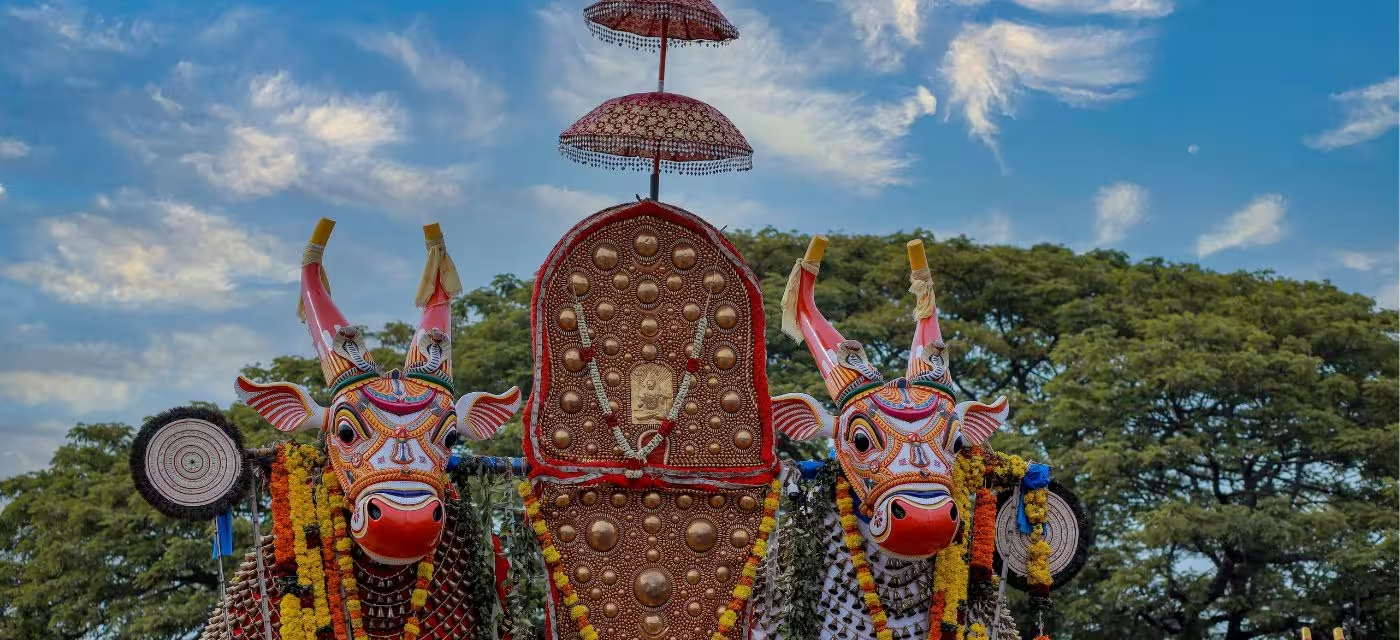
The festival begins with a colourful procession of decorated tuskers and dancers, led by veterans representing each kara, making its way around the temple.
But the celebrations begin only after an auspicious sighting of the Krishna parunthu, the Brahminy kite believed to be the vehicle of the god Krishna, flying over the padanilam.
The leaders of the rival teams then race onto the field, shake hands and mutually declare their intention to fight the following afternoon.
Warriors in the Wet Fields
The following day, the fighters assemble on the waterlogged battlefield and demonstrate their skills through thakida kali, a traditional fighting style.
The atmosphere is electrifying.
The powerful beats of the chenda, Kerala’s traditional percussion instrument, accompany the rhythmic battle.
One side advances first, allowing the other to move forward before retreating.
Even newcomers quickly learn the traditional rhythm of advance and retreat.
Divided into two groups, the warriors jump into the wet fields, brandishing their sticks and splashing muddy water as they attempt to outdo one another.
Yet beneath all the excitement is something deeper – camaraderie, fraternity and sportsmanship.
Watching this extraordinary spectacle alongside hundreds of spectators gathered around the padanilam is an experience that is difficult to put into words.
A Festival for Everyone
Ochira Kali is a remarkable celebration of Kerala’s cultural heritage.
Men of all ages, from five to eighty-five, and people of different faiths come together at this sacred place to participate in the festivities.
People from across Kerala, and sometimes from much farther away, arrive to witness the colourful performances.
The temple authorities also honour kalari asans, or martial arts masters, with special awards to encourage greater participation each year.
Prize money is presented to performers by the festival organisers.
And as the energetic celebrations come to an end, the festival concludes with a grand feast.
Ochira Parabrahma Temple
Situated on NH47 between Kollam and Alappuzha, Ochira Temple is unlike conventional temples.
It is dedicated to Parabrahma – the Supreme Consciousness – and has no idol or conventional deity.
Instead, two raised platforms stand around a couple of enormous ficus trees, where worshippers light lamps.
There is no defined temple structure or prescribed mode of worship.
What you encounter instead is a vast open tract of land with a few sacred trees.
The belief is that Supreme Consciousness cannot be confined within four walls.
It is this sense of infinite vastness that is worshipped at Ochira.
Interestingly, some historians have suggested that Ochira may once have been a Buddhist vihara, or monastery/temple, perhaps because nearby Karunagappally was once an important centre of Buddhism.
A Temple of Acceptance
Ochira follows a simple credo:
Serving mankind is akin to serving God.
The temple consequently serves as a place of shelter and acceptance for people seeking help and refuge.
But there is another unusual sight waiting here.
The Bulls of Ochira
Bulls roam freely around Ochira, including within the temple compound.
Known as Ochira Kala, these animals are deeply revered and hold a special place in the traditions of the temple.
Their presence adds yet another fascinating dimension to this already unusual sacred landscape.
Exploring Around Ochira
Once the festival is over, there are several interesting places to explore around Ochira.
The Mata Amruthananda Mayi Devi Ashram at Vallikkavu is just a few kilometres away and Ochira serves as a gateway to the sprawling ashram.
Nearby is also the historic Krishnapuram Palace, built in the 18th century by the erstwhile Travancore ruler Marthanda Varma Maharaja.
Ochira Kali is therefore much more than a mock battle.
It is a celebration where history, martial tradition, spirituality, music, community and Kerala’s monsoon landscape come together in one extraordinary spectacle.
Related Posts